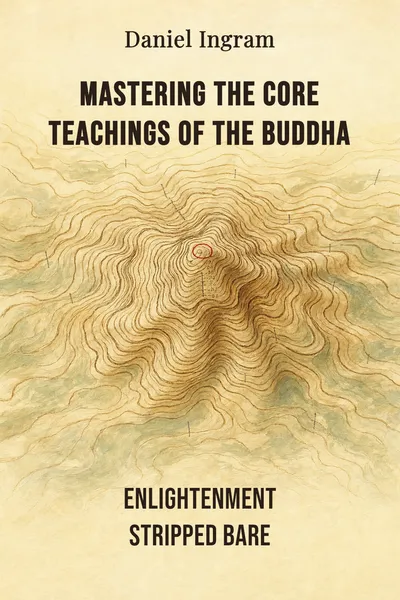
Mastering the Core Teachings of the Buddha
Enlightenment stripped bare
Description
In 2008, an emergency-room physician in Alabama named Daniel Ingram published a meditation manual and called it Mastering the Core Teachings of the Buddha. The title alone was a provocation. In most Buddhist circles, you do not say you have mastered anything, and you certainly do not announce that awakening is a goal you can check off. Ingram went further. On the strength of years of intensive practice, largely in the Burmese Theravada tradition, he described himself, in the book's later editions, as an arahat — a fully awakened being in the oldest map of the path. Then he wrote down, in plain clinical prose, exactly how he got there.
The reaction was predictable. To a lot of readers, claiming enlightenment is the surest sign you have not attained it — humility being, supposedly, the whole point. Ingram's answer was that this reflex is precisely the problem. Awakening had been wrapped in so much reverence, mystery, and vague spiritual mood-setting that ordinary people had stopped believing it was available to them at all. He wanted to strip the concept down to something concrete: a set of describable experiences, reachable by a describable method, with signs you could recognize along the way.
So the book is not a gentle invitation to be more present. It is closer to a technical field guide — blunt about what works, impatient with what he saw as feel-good vagueness, and unusually specific about the strange territory serious meditators actually pass through. It reads less like a sermon than like notes from someone who went in, mapped the terrain, and came back to argue that the maps had been hidden for no good reason.
The question we’re asking : Can something as elusive as enlightenment really be treated as an attainable, teachable skill — and what has to be stripped away for that claim to hold?What we’ll see : How one contrarian practitioner took the mysticism out of awakening and handed us the mechanics instead.
Table of contents
01 Chapter 1 — The heretic who wrote the manual
Ingram's credibility problem is also his selling point. He is not a monk, not a lineage-holder, not the head of a center with robes and a donation box. He held down a demanding medical career while practicing meditation with the intensity most people reserve for a religion. That double life shapes the whole book. He writes about the mind the way a clinician writes about a body: here is the mechanism, here is what you'll observe, here is what to do when it goes sideways. No incense, no reverence for its own sake.
The tradition he draws on most is Theravada, the older, more austere current of Buddhism preserved in Southeast Asia, and specifically the Burmese vipassana lineages that treat insight meditation as a step-by-step technology. That tradition already has detailed maps of the path. Ingram's complaint was that in the West these maps had been softened, mystified, or quietly dropped — teachers hinting at stages without naming them, students left to stumble through intense experiences with no idea what was happening.

02 Chapter 2 — Concentration, insight, and the difference nobody explains
The core of the method rests on a distinction Ingram thinks most beginners never have explained to them: the difference between concentration practice and insight practice. They feel similar from the outside — someone sitting still, eyes closed — but they aim at completely different things, and confusing them, he argues, wastes years.
Concentration practice, samatha, is about stability. You fix attention on a single object — the breath, a sensation, an image — and train it to stay there until the mind settles into deep, absorbed, blissful states the tradition calls the jhanas. These states are genuine, pleasurable, and, on their own, temporary. You come out, and ordinary life resumes unchanged. Ingram is careful here: concentration is powerful and worth cultivating, but mistaking its peace for awakening is one of the classic errors. A calm mind is a tool, not the destination.
03 Chapter 3 — The maps meditators fall off
The most striking and controversial section of the book is where Ingram lays out what happens once insight practice really takes hold. Here he leans on an old Theravada scheme called the progress of insight — a sequence of stages a meditator passes through on the way to a first awakening, sometimes called stream entry. He presents it not as folklore but as something like a reliable itinerary, with recognizable landmarks in a recognizable order.
The early stages sound benign enough: the mind starts perceiving experience as a rapid flow of arising and passing sensations. Then it turns dark. In the stretch Theravada texts bluntly name the Dark Night, or the dukkha nanas, practitioners can be hit with fear, disgust, misery, and a bleak sense that everything is falling apart, sometimes for weeks or months. Ingram's point in describing this so frankly is practical and even compassionate. People land in these states, assume something has gone terribly wrong with them, and quit — or worse, spiral — because no one told them this was a known feature of the path, not a personal failure.
04 Chapter 4 — A path with an end
Step back from the technical detail and the real argument of the book is about who gets to be awakened, and on what terms. For a long time, enlightenment functioned as a kind of asymptote — always approached, never claimed, reserved in practice for figures safely dead or safely distant. Ingram's insistence that it is attainable, describable, and reproducible is an attempt to pull it back down into the range of ordinary, committed human beings, doctors and office workers included.
That move is quietly radical because it reframes awakening as a skill rather than a grace. A skill has criteria. It can be taught, tested, practiced badly or well, and — crucially — confirmed. If you can say what stream entry consists of, you can also say whether someone has reached it, which strips away the mystique that let a certain kind of teacher stay unaccountable. Ingram's blunt talk about his own attainment is partly a refusal to hide behind that mystique. Say what you claim, describe how to check it, and let the method stand or fall on results.
05 Conclusion
The emergency physician who wrote a meditation manual never softened his tone. Across expanding editions, Ingram kept saying the same disruptive thing: enlightenment is not a poetic aspiration but a describable achievement, with a technique behind it, stages within it, and signs by which you can know where you are. He separated concentration from insight, named the dark passages nobody had warned him about, and argued that the reverence surrounding awakening had mostly served to keep people from attempting it.
Related books