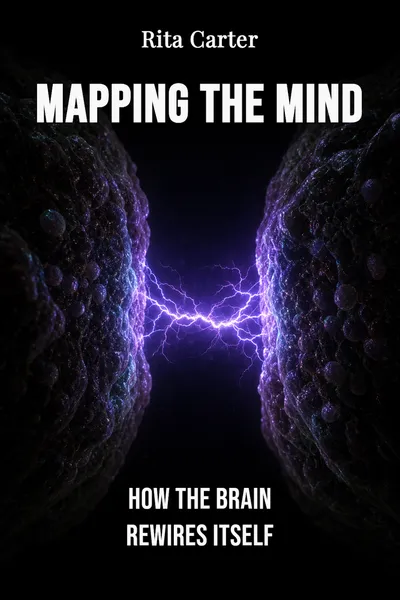
Mapping the Mind
How the brain rewires itself
Description
For most of history, the inside of the head was a locked room. We could describe behaviour, catalogue madness, guess at the seat of the soul, but the living brain kept its business private. Then, over the last few decades of the twentieth century, the machines arrived. PET and functional MRI let researchers watch a brain do arithmetic, recall a face, feel afraid — not by cutting it open, but by tracking where blood and glucose rushed while a person lay still and thought. Rita Carter's Mapping the Mind, first published in 1998, is the book that took all of this new territory and turned it into an atlas a curious reader could actually follow.
Carter is a science writer, not a lab neuroscientist, and that turns out to be the point. Her job in the book is to translate — to take the folded grey organ, roughly three pounds of tissue, and show which parts light up for language, for memory, for terror, for the particular warmth of recognising someone you love. She builds the tour out of real cases: the man who could no longer feel fear, the patients whose personalities shifted after damage to one small region, the phantom limbs that still itched. The abstract becomes a place you can visit.
But the deeper argument running under the atlas is that the map is never finished, because the territory keeps moving. The brain Carter describes is not hardware running fixed software. It rewires. Experience, injury, practice, even a piece of music leave physical traces that change what the organ can do next. That is where the book stops being a guidebook and becomes something stranger.
The question we’re asking : If we can finally see which parts of the brain do what, does that settle who we are — or unsettle it?What we’ll see : How the new brain-imaging turned the mind into a readable map, and why that map refuses to stay still.
Table of contents
01 Chapter 1 — The map replaces the ghost
Before the scanners, most of what we knew about brain function came from damage. A stroke, a tumour, a bar of iron through the skull — each robbed someone of a specific ability, and each loss pointed to what the ruined patch had been doing. The nineteenth-century case of Phineas Gage, whose personality changed after an explosion drove an iron rod through his frontal lobe, is the founding story Carter returns to: the man survived, but his judgement and restraint did not. Function, it turned out, had an address.
The imaging era let researchers stop waiting for accidents. With PET, and then functional MRI, they could give a healthy volunteer a task and watch the corresponding region grow busy in real time. Carter uses this to walk us through the territory. The visual cortex at the back of the head, which doesn't just receive images but assembles them from separately processed streams of colour, motion and shape. The auditory regions, the language areas clustered mostly on the left, the motor strip that maps onto the body in that famous distorted figure with the huge hands and lips.

02 Chapter 2 — Emotion runs the show before reason does
One of the book's most persistent themes is that we badly overrate the calm, reasoning part of ourselves. The image we carry is of a rational mind occasionally hijacked by feeling. Carter's map suggests something closer to the reverse: emotion arrives first, fast and beneath awareness, and reason spends much of its time explaining decisions the deeper structures have already made.
The central character here is the amygdala, a small almond-shaped structure deep in the brain that acts as an alarm system. Carter draws on Joseph LeDoux's work to describe two routes a frightening signal can take. A slow, high road goes up to the cortex, gets analysed, and produces a considered response. A fast, low road runs straight to the amygdala and triggers the body — heart, muscles, stress hormones — before the thinking part has even identified what the threat was. We jump back from the coiled shape on the path a fraction of a second before we register that it is only a hose.
03 Chapter 3 — The brain that keeps redrawing itself
The idea that gives the book its lasting charge is neuroplasticity — the discovery that the adult brain, long assumed to be fixed after childhood, keeps physically reshaping itself in response to what we do. Connections between neurons strengthen with use and wither with neglect. The map is drawn in pencil, and experience is always rubbing bits out and adding others.
Carter reaches for the vivid examples. The territory devoted to a violinist's left hand, the fingering hand, is measurably enlarged compared with the right. Blind readers of Braille develop expanded touch-processing regions. When a limb is lost, the brain area that once served it does not go quiet; neighbouring regions colonise the vacated space, which is part of why an amputee may feel a phantom hand being touched when their cheek is stroked. The organ abhors idle real estate and constantly redeploys it.
04 Chapter 4 — A self that isn't fixed anywhere
Step back from the tour of regions and case studies, and Carter's atlas points somewhere unsettling. We tend to assume there is a fixed self somewhere in the head — a central watcher, a little chief executive receiving reports and issuing orders. The map offers no such office. Search the scans and you find networks, alarms, negotiations, provinces trading signals, but no throne room where a single unified 'I' sits in charge.
What the book describes instead is a self that is distributed and provisional. Perception is assembled, not received. Memory is reconstructed each time we recall it, not played back. Emotion tilts decisions before reason gets a vote. And all of it runs on tissue that keeps rewiring according to what we do. The person doing the reading is, quite literally, a slightly different physical object by the end of the paragraph than at the start.
05 Conclusion
Mapping the Mind set out to do something modest and did something larger. It took the flood of images pouring out of the new scanners and organised them into a tour any curious reader could take — this region for fear, this network for language, this deep structure sounding the alarm before we know why our heart is racing. The atlas is genuinely useful, and Carter draws it with unusual clarity and patience.
Related books