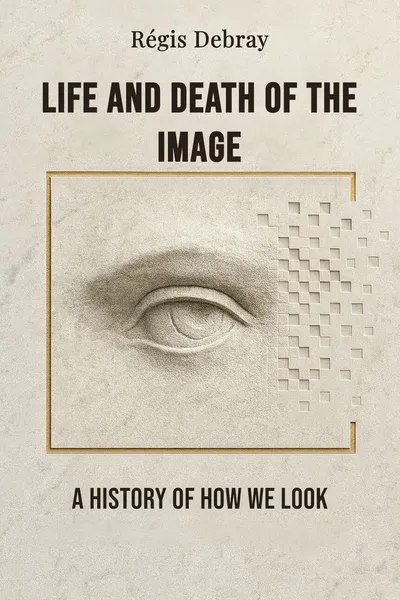
Life and Death of the Image
A history of how we look
Description
Somewhere in the caves of Lascaux, roughly seventeen thousand years ago, someone pressed a torch to a wall and traced an animal that was not there. We tend to file this under the origins of art, as if a bison on limestone were an early museum piece. Régis Debray, a French philosopher who spent decades thinking about how ideas travel through media, proposed something stranger in his 1992 book Vie et mort de l'image. The first images were not made to be admired. They were made to hold off death — to make the absent present, to keep the dead among the living. Before the image was ever beautiful, it was a way of not letting go.
That single move reframes a very long story. If the image began as a stand-in for the vanished, its history is not a slow climb toward realism, not a tale of styles succeeding styles. It is a history of what we ask an image to do — and of who, or what, we believe stands behind it. For most of that history, the thing behind the image was sacred, dangerous, alive. A statue could be prayed to, feared, carried into battle, blinded by an enemy. It was not a picture of a god. In some sense it was the god.
Debray's wager is that we can periodise this whole arc, and that doing so reveals something uncomfortable about the screens we now spend our days inside. Between the idol on the altar and the image on the phone lies a mutation in the very act of looking — and possibly a quiet extinction we have not noticed because it wears the costume of abundance.
The question we’re asking : What has changed, across the millennia, in what we ask an image to be — and what do we lose when there is nothing behind it anymore?What we’ll see : How the image travelled from tomb to church to museum to screen, and what happens to looking when everything is visible and nothing is absent.
Table of contents
01 Chapter 1 — The dead were the first to be seen
Debray starts where images start: at the grave. The earliest human images we can date are bound up with burial and the hunt, with what escapes us. His argument, borrowed and sharpened from anthropologists, is that the image is born as a substitute for the missing body. A death opens a hole in the group, and the image fills it. The figure on the cave wall, the painted skull, the funerary effigy — these are not representations of the dead so much as prostheses for their absence. To make an image, in this first regime, is to negotiate with disappearance.
This is why the oldest images carry a charge we struggle to feel today. They were not looked at in our sense. Many were made in darkness, deep in caves no one revisited, or sealed inside tombs meant never to be reopened. The image worked whether or not anyone stood in front of it, because its job was done by its mere existence — the way a keepsake does its work in a drawer we rarely open. Visibility was almost beside the point.

02 Chapter 2 — When the image left the tomb for the church
The second great mutation arrives with the monotheisms, and above all with the long argument Christianity had with itself over whether images were permitted. The Hebrew prohibition was flat: no graven images, because the divine cannot be enclosed in matter. Islam largely held that line. Christianity did not, and the reason is central to Debray's periodisation. In the eighth and ninth centuries the Byzantine world tore itself apart over icons — the iconoclast crisis — and the defenders of images won with a subtle theological move. Because God had become flesh in Christ, the invisible had made itself visible, and the image could be honoured, not as the thing itself but as a window onto it.
That distinction changed everything. The image was demoted from god to sign of god, and in that demotion it gained a new job: to teach, to move, to point beyond itself toward a truth located elsewhere. Debray calls this the age of art, though he means something closer to the age of the icon than to the modern museum. The Byzantine icon, the Romanesque tympanum, the stained glass of a cathedral — these are not admired for their invention. They are read. Gregory the Great's famous line, that pictures are the books of the illiterate, captures the regime exactly. The image serves a text, a doctrine, a Church.
03 Chapter 3 — The age of art, and the birth of the beholder
The third mutation is the one we tend to mistake for the whole story, because it produced the objects that hang in the Louvre. Somewhere across the Italian Renaissance the image slips free of the Church and becomes, for the first time, art in our sense. The decisive technical event is perspective — the geometric method, formalised by Alberti and the Florentines in the fifteenth century, for organising a painting around a single vanishing point. Perspective is not just a trick for making things look solid. It installs a viewer. The whole scene is now composed for one eye, at one place, at one moment. The image stops looking back at us and waits, instead, to be looked at.
This is the quiet revolution Debray wants us to feel. Power reverses direction. In the age of the idol, the figure judged the beholder. Now the beholder judges the figure — its likeness, its balance, its skill. We begin to ask whether a painting is good. We begin to know who painted it. The artist emerges from anonymity into signature and fame; Vasari writes his lives; collectors compete; the picture acquires a price. The image has migrated from tomb to church to palace to gallery to museum, where it is neither prayed to nor read but contemplated for its own sake.
04 Chapter 4 — Screens without shadows
The machine was the camera, and then everything that followed it. Debray's fourth age — he calls it the age of the visual — begins with photography and cinema and reaches full force with television and the digital image on our screens. What defines it is not a new style but a new mode of existence for the image. The visual is produced automatically, reproduced infinitely, circulated without end. A photograph is not made so much as taken, and once taken it can be copied endlessly at no cost — which is precisely what strips it of the singular presence the idol and even the painting once held.
Here is where the book earns its ominous title. If the first image was born to hold off death, the visual, Debray argues, no longer has any relation to death — and so the image dies inside its own triumph. Nothing is absent anymore; everything is available instantly in quantities no eye can absorb. The screen shows us the world in real time, continuously, and in doing so abolishes the very distance that made looking meaningful. There is no longer a beyond behind the image, no invisible it points toward. The visual points only at more visual.
05 Conclusion
We opened in a cave, before a painted animal made to keep the dead among the living. Debray's arc runs from that charged, almost living image — the idol that looked back — through the icon that pointed beyond itself, the painting that waited to be judged, and finally the screen that asks nothing and shows everything. Three mutations in what stands behind the image: first a presence, then a god, then the visible world, then nothing at all. What travelled all that way was not really the picture. It was us, and the act of looking.
Related books