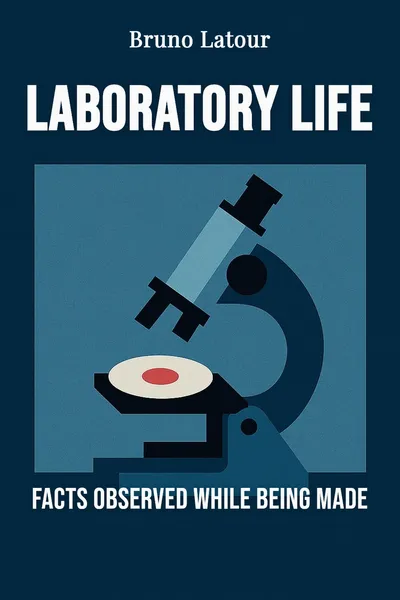
Laboratory Life
Facts observed while being made
Description
In 1975, a young French philosopher named Bruno Latour arrived at the Salk Institute in La Jolla, California, and did something almost nobody had done before: he treated a working science laboratory the way an anthropologist treats a remote village. He didn't come to admire the researchers or to check their results. He came to watch. For roughly two years he sat in Roger Guillemin's endocrinology lab — a group that would win a Nobel Prize in 1977 — and recorded who did what, who said what, which machines hummed in which corner, and where the paper piled up. He knew almost no biochemistry going in, and he treated that ignorance as a method rather than a handicap.
What came out, in 1979, was a book written with the sociologist Steve Woolgar: Laboratory Life. Its subtitle in the first edition promised "the social construction of scientific facts," a phrase so combustible that the second edition quietly dropped the word "social." The claim underneath was simpler and stranger than a slogan. Latour wasn't saying scientists invent whatever they please. He was saying that a fact — the kind of thing we imagine sitting out in nature, waiting to be found — is assembled, day by day, out of pipettes, printouts, arguments, and drafts. And once it's assembled, the assembly line vanishes from view.
That's the puzzle worth sitting with. We tend to think a lab is where humans go to get out of the way so nature can speak. Latour's field notes suggest something closer to a small factory, one whose main product is written statements and whose most important trick is hiding its own labor.
The question we’re asking : If we follow a scientific fact backward, from the textbook to the bench, what do we actually find being done to make it true?What we’ll see : Two years of field notes from inside a Nobel-winning lab, and the machinery that turns messy activity into clean, author-less facts.
Table of contents
01 Chapter 1 — An anthropologist walks into a lab
The conceit of Laboratory Life is deliberately naive. Latour decided to describe the Salk lab as if he'd never heard of science — as if the white coats and the humming equipment were the customs of a tribe he had to decode from scratch. He would not assume the researchers were rational, or that their results were true, or that the instruments revealed nature. He would just note what people did with their hands, their voices, and their time. This is what he and Woolgar half-jokingly called the stance of the stranger, and it lets them see things a trained biochemist would walk straight past.
The first thing the stranger notices is that the lab is split in two. There's a section full of animals, benches, glassware, and machines — the messy end where substances get injected, spun, heated, and measured. And there's an office section where people in the same white coats sit at desks, read, write, and argue over paper. What connects the two halves is a steady flow of documents. Something happens at the bench; a machine registers it; the registration becomes a figure, a curve, a number on a sheet; that sheet travels to the office, where it gets compared, discussed, and eventually folded into an article.

02 Chapter 2 — Papers, machines, and the traffic in inscriptions
To make sense of the traffic between bench and desk, Latour reaches for a term he borrows and sharpens: the inscription device. An inscription device is any piece of apparatus that takes some material substance and turns it into a mark on paper — a graph, a peak on a chart, a spectrometer readout, a column of figures. The bioassay that responds to a hormone, the recorder that traces a line, the counter that prints a value: each converts a lump of matter into a legible trace. The lab, in this light, is a dense population of such devices, and their shared job is to produce inscriptions.
Why does this matter so much? Because once you have the inscription, you can forget the substance. The rat, the reagent, the hours of preparation, the animal that had to be sacrificed — all of that drops away, and what remains is a clean curve you can pin to a wall and point at during an argument. The inscription is portable, comparable, and combinable in a way that a vial of fluid never is. When two researchers disagree, they don't wave test tubes at each other; they lay printouts side by side. The peak on the page becomes the thing they fight over, and the messy history that produced it recedes.
03 Chapter 3 — How a fact loses its author
The heart of the book is a claim about what a fact is and how it comes to be one. Latour and Woolgar propose that statements in science exist on a sliding scale. At one end sit raw conjectures, hedged and personal: "it seems possible that," "our group suspects." At the other end sit bare facts, stated flatly with no author and no doubt: substance X has structure Y. Between the two lie all the intermediate forms — claims attributed to someone, claims qualified, claims almost but not quite settled. The work of the lab is to push a statement along this scale, from tentative toward taken-for-granted.
The trick is in the stripping. As a claim gains acceptance, the qualifications fall away one by one. First it's "Guillemin's group reports that," then it's "it has been shown that," then, if all goes well, it simply becomes true — a line in a textbook with no name attached, something students learn without ever wondering who established it or how much argument it cost. The author disappears, the doubt disappears, the labor disappears. What's left reads as if it were always out there in nature, patiently waiting to be noticed.
04 Chapter 4 — The disappearing act at the heart of science
Step back from the Salk lab and the general claim comes into focus. Latour's book is, at bottom, an argument about erasure. A scientific fact is made — through instruments, arguments, drafts, and money — and the signature of that making is systematically wiped clean. The more successful the fact, the more thoroughly its history of construction vanishes. What we call objectivity is, on this reading, partly the achievement of a very good disappearing act: the moment when a statement stops looking like anyone's work and starts looking like the world itself.
The inscription device is where the erasure gets its purchase. It's the hinge that lets a substance become a mark, and a mark become a fact. And it works precisely by dropping context: it takes a specific animal, a specific afternoon, a specific technician's hands, and it outputs a curve that carries none of that with it. The curve looks universal, timeless, unauthored — which is exactly the look a fact needs. The device doesn't just record nature; it produces the very form in which nature can be spoken about as if no one had spoken.
05 Conclusion
Guillemin's lab won its Nobel in 1977, two years into Latour's stay, and by then the hormones he'd watched being argued into existence had already begun their quiet migration into textbooks, where they read as plain fact with no trace of the benches, the printouts, or the drafts that had produced them. That migration is the whole story. Latour hadn't gone to La Jolla to expose fraud or to question the chemistry. He'd gone to catch a fact in the act of becoming one, and to write down what usually gets thrown away with the packaging.
Related books