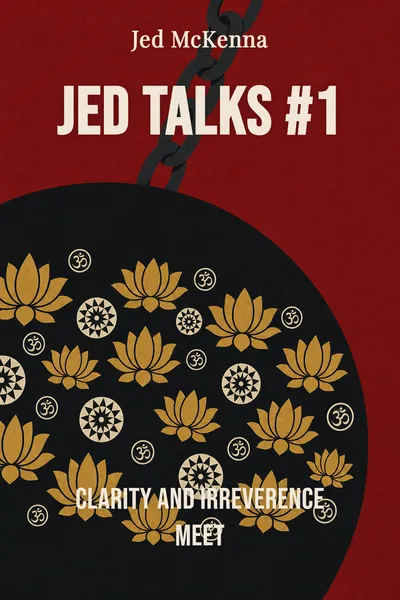
Jed Talks #1
Clarity and irreverence meet
Description
Somewhere in the American Midwest, a man who calls himself Jed McKenna has been writing books about enlightenment for more than two decades, and almost nobody knows who he is. No verified photograph, no confirmed biography, no lecture circuit, no retreat center with a gift shop. Just a run of books published through a small outfit called Wisefool Press, each one written in the voice of a guy who talks like he'd rather be fishing. Jed Talks #1 is the latest, and it picks up exactly where the earlier work left off — no throat-clearing, no reintroduction, as if we'd only stepped out of the room for a minute.
That refusal to perform is the whole point. McKenna built his reputation on two trilogies — the Enlightenment Trilogy, which opened in the early 2000s with Spiritual Enlightenment: The Damnedest Thing, and the later Dreamstate Trilogy — and across all of them he does something the wellness aisle almost never does. He tells the reader that the thing they're chasing isn't the thing they think it is, and that most of what passes for spiritual progress is an elaborate way of staying comfortable. The Jed Talks series keeps that engine running: same dry humor, same charm, same flat refusal to sell hope.
So the interesting thing isn't really the mystery man behind the name. It's the claim the books keep making, book after book, in a genre that runs on reassurance. What would it mean to take spiritual awakening seriously enough to admit it might cost you everything you use to feel like yourself?
The question we’re asking : What is Jed McKenna actually claiming when he separates awakening from the comfort the spirituality market sells as awakening?What we’ll see : A writer who won't be found, a teaching that offers a door instead of a path, and what happens when clarity stops being pleasant.
Table of contents
01 Chapter 1 — The author nobody can find
Start with the obvious question, because everyone does. Who is Jed McKenna? The honest answer is that we don't know, and the books treat that as a feature rather than a gap. Since Spiritual Enlightenment: The Damnedest Thing appeared in the early 2000s, McKenna has published two full trilogies and now the Jed Talks series through Wisefool Press, and in all that time the persona has stayed deliberately thin. There's a voice, a farmhouse, a rotating cast of students who show up with big questions. Beyond that, almost nothing verifiable.
For a genre built on charisma — the guru on stage, the memoir of transformation, the before-and-after glow — this is close to heresy. Modern spirituality runs on personality. The teacher is the product. McKenna removes the teacher from the storefront entirely, and the removal does something to how we read. With no face to admire and no résumé to trust, we're left with only the argument on the page. There's nobody to follow, which is convenient, because following is exactly what the books say we should stop doing.

02 Chapter 2 — No path, only a door
The central move in McKenna's work is a refusal, and it's the same refusal in Jed Talks #1 as in the first trilogy. He declines to offer a path. Paths are what the spirituality industry sells — stages, practices, levels, years of devoted effort leading somewhere better. McKenna says there's no ladder to climb because there was never any height to reach. What he offers instead is closer to a door: something you either walk through or don't, and no amount of preparation on this side changes what's on the other.
This reframes the whole project of seeking. In the usual model, the seeker is building toward enlightenment, accumulating insight the way you'd accumulate savings. McKenna treats that accumulation as the problem. The seeker's identity — the person doing the seeking, keeping the journal, attending the workshops — is precisely what has to go. You can't add your way to awakening because awakening is a subtraction. It's not a richer, wiser version of the self. It's the recognition that the self doing the wanting was never quite what it seemed.
03 Chapter 3 — Truth is a wrecking ball
If there's a single word doing the heavy lifting across McKenna's books, it's truth — but not truth as a warm, harmonizing idea. In Jed Talks #1, truth is closer to a demolition. He draws a hard line between what he calls truth-realization and the softer, more marketable goal most seekers actually pursue, which he'd call comfort with a spiritual vocabulary. The first tears things down. The second redecorates. The two get confused constantly, and McKenna's whole irritable charm comes from refusing to let them stay confused.
The distinction has teeth. Human-life spirituality, in his framing, is about feeling better inside the dream — more peace, more meaning, more balance, a nicer relationship with your own mind. Nothing wrong with wanting that. But it's a different thing entirely from the ruthless business of seeing what's actually true, which offers no guarantee of feeling better and a fairly strong guarantee of feeling worse for a while. He's clear that most people who say they want awakening want the first thing and would flee the second.
04 Chapter 4 — What clarity costs the seeker
Step back from the specific claims and McKenna's whole enterprise reads as a running argument with an entire industry. Modern spirituality, whatever its origins, has largely become a comfort business — a marketplace of practices, teachers, and language designed to help people feel more at peace with their lives. It's a huge, mostly benevolent operation, and McKenna's books exist as a permanent asterisk beside it, insisting that the thing being sold and the thing being named are not the same thing at all.
What makes the position bracing rather than merely contrarian is that he isn't attacking the comfort. He's attacking the label. If people want to feel better, he'd say, they should feel better — meditate, do yoga, find their peace, live well inside the dream. His only objection is calling that awakening, because the conflation quietly closes the door he keeps trying to point at. When the word for a demolition gets used for a renovation, the demolition stops being available. Nobody looks for what they think they already have.
05 Conclusion
The man who calls himself Jed McKenna is still out there somewhere, unphotographed, unverified, publishing books that tell readers the very thing that would sell worst: that what they want probably isn't awakening, and that awakening probably isn't what they'd want. Jed Talks #1 doesn't soften that message for a new audience. It carries the same voice forward from two trilogies — dry, funny, unimpressed by spiritual seriousness — and points, again, at a door rather than a path.
Related books