It Didn't Start with You
Inherited trauma, passed down
Description
A woman in her thirties wakes at 3:30 every morning, heart racing, gripped by a dread she can never quite name. She has done the therapy, tried the medication, kept the journals. Nothing holds. Then, almost in passing, she mentions that her grandmother's first child died at eighteen months — at 3:30 in the morning. Mark Wolynn has spent more than twenty years collecting scenes like this one: people carrying a fear, a pain, a compulsion that seems to belong to no event in their own lives. In his 2016 book It Didn't Start with You, he makes an unsettling proposal — that some of what we suffer was never ours to begin with.
For most of the twentieth century, the story we told about distress ran two ways. Either something happened to us, or something went wrong in the chemistry of our brains. Wolynn adds a third channel, one that runs backward through the family line. Depression, anxiety, chronic pain, phobias, intrusive thoughts — he argues these can be echoes of a rupture that happened to a parent, a grandparent, sometimes a great-grandparent we never met. The original sufferer may be long dead. The story may have been silenced or simply forgotten. And still, he says, the feeling finds a way to keep living.
What makes the claim more than intuition is that the science has started to catch up. Researchers studying survivors of famine, genocide and war have found traces of those events in the biology of children who were never there. Wolynn weaves that research into a working method, built on the idea that our most painful language is a kind of map — one that, read carefully, points back to the moment where the wound began.
The question we’re asking : When a fear or an ache seems to come from nowhere in our own lives, whose story are we actually carrying?What we’ll see : How a symptom without a source leads back through the family line, into biology, into the words we use, and finally into what we think a self even is.
Table of contents
01 Chapter 1 — The symptom that arrives without a story
The people who find their way to Wolynn have usually tried everything first. They arrive with a fear that has no obvious cause, a depression that predates anything they can remember, a body that hurts in ways no scan explains. They have talked it through, named their childhoods, adjusted their medication. Some improvement, maybe. But the core thing stays put, immovable, as if it were rooted somewhere the treatment can't reach.
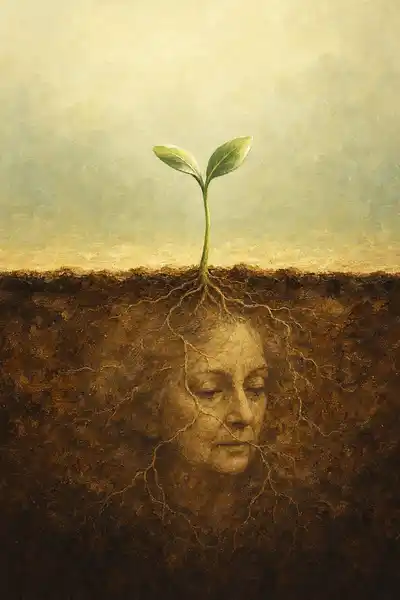
Wolynn's starting suspicion is that the root is exactly there — somewhere the person can't reach, because it isn't theirs. He tells of a man terrified of freezing to death who avoids the cold at any cost, until it emerges that an uncle, before the man was born, froze to death in a snowstorm the family never discussed. A woman with a lifelong dread of being confined turns out to descend from a grandmother who hid in a cramped space during the war. The symptom, in these cases, behaves less like a personal wound than like an inheritance nobody chose.

02 Chapter 2 — When biology carries the memory
The idea that grief can travel down a family is old and easy to dismiss as metaphor. What changed, and what gives Wolynn's book its spine, is that laboratories began finding physical traces of it. The leading figure here is Rachel Yehuda, a neuroscientist at Mount Sinai in New York, who spent years studying the children of Holocaust survivors and of pregnant women who survived the September 11 attacks. She found something strange: patterns in stress-hormone regulation in the children that mirrored the trauma of the parents, in people who had lived through none of it themselves.
The mechanism most often invoked is epigenetics — not changes to the genetic code itself, but changes to how genes are switched on and off, chemical markers that can sit on top of the DNA and, under certain conditions, be passed to the next generation. Animal studies pushed the point further. In one much-cited experiment, mice were taught to fear the smell of cherry blossom; their pups, never exposed to the scent, startled at it too, and were born with more of the receptors used to detect it. The fear had been inherited without a single frightening event.
03 Chapter 3 — Listening for the core language
If the wound predates us, the problem becomes practical: how do we reach a story we were never told? Wolynn's answer is his signature method, the Core Language Approach, and its premise is deceptively simple. When we describe our deepest fear, we tend to reach for words that are strangely intense, oddly specific, and not quite proportionate to our own experience. Those words, he argues, are not random. They are the residue of the original event, surfacing in the only vocabulary we have.
He asks people to complete a few blunt sentences. What is my worst fear? What would happen to me if that came true? The answers arrive in phrases like I'll disappear, I'll be abandoned and no one will come, I'll be cut off forever. Wolynn calls these core sentences, and he treats them as coordinates. The person who fears they will be erased, who cannot say why, may be speaking language that belonged to a grandmother who watched her own family erased. The words point past the speaker to someone else's catastrophe.
04 Chapter 4 — A self that was never only ours
What the book quietly dismantles is a very modern assumption: that the self is a self-contained unit, that our fears and desires are authored inside the boundary of our own skin and our own memory. We treat identity as personal property. Wolynn's cases suggest something more porous — that a portion of who we are was drafted before we arrived, and that the family line is less a background fact than a co-author of the inner life.
This is a real reversal of how therapy usually works. The therapeutic tradition, from Freud onward, tends to look inward and backward into the individual's own childhood, as though the earliest years were the floor beneath which nothing lies. Wolynn keeps digging past that floor. The relevant childhood, in his frame, might not be ours at all. The formative event might have happened to someone whose name we half-remember, in a country we've never seen, to a body that stopped existing decades before we were born.
05 Conclusion
The woman who woke at 3:30 with a nameless dread did not respond to another round of medication or another retelling of her own childhood. What loosened it was the discovery that the hour, and the fear, had belonged to her grandmother's grief — a death she had never been told about, arriving in her body decades later like a message with the sender's name erased. Once the feeling had an owner and a story, it stopped behaving like a symptom and started behaving like a memory that could, at last, be laid to rest.
Related books