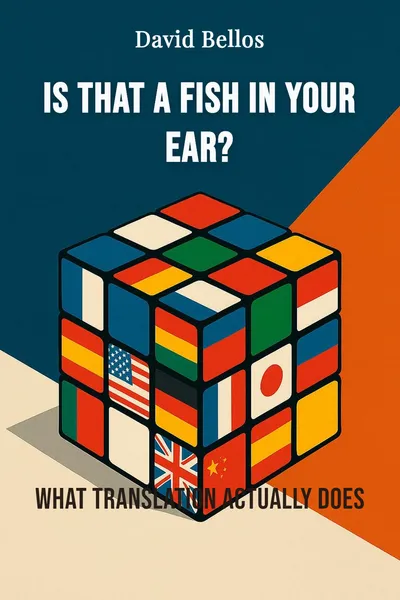
Is That a Fish in Your Ear?
What translation actually does
Description
The title comes from Douglas Adams. In The Hitchhiker's Guide to the Galaxy, you slide a small yellow creature called the Babel fish into your ear, and suddenly every alien language in the universe becomes your own. David Bellos borrows the joke for the cover of a book that spends four hundred pages dismantling it. There is no fish. There never was. And yet, somehow, most of what we read, watch, buy, and vote on has crossed a language border at some point, handled by people whose work we almost never notice. Bellos — a translator himself, best known for bringing Georges Perec and the Albanian novelist Ismail Kadare into English — wanted to know what actually happens in that crossing.
The obvious answer is that translation replaces words in one language with words in another, and that something inevitably gets lost. Bellos finds this answer almost entirely wrong. Not because nothing is ever lost, but because "loss" assumes there was a fixed, weighable original meaning sitting there to begin with, waiting to be poured cleanly from one container into another. Once we look at what translators do all day — subtitling a film, interpreting at the UN, drafting a European regulation in twenty-four languages at once — the tidy container model falls apart. Meaning turns out to be far stranger, and far more portable, than the folklore suggests.
Bellos writes like someone who has done the job and lost patience with the myths that surround it. His book is less a how-to than a demolition of the things everyone believes about translation without ever having thought them through — that poetry is untranslatable, that word-for-word is more honest, that a translation is always a lesser thing than the original. Behind each of these, he finds an assumption about language itself that doesn't survive contact with the evidence.
The question we’re asking : What does translation actually do — and why does almost everything we believe about it turn out to be a myth?What we’ll see : How a word that resists definition opens onto the machinery of subtitles, law and diplomacy, and finally onto the idea we most want to keep believing: that some things simply cannot be said in another tongue.
Table of contents
01 Chapter 1 — The word for "translation" doesn't translate
Bellos opens with a nice paradox. The concept we call translation is not universal — plenty of cultures have gotten along fine without a dedicated word for it, and the ones that have a word don't all mean the same thing by it. English "translation" carries a metaphor of carrying across, from the Latin. Other languages reach for turning, or explaining, or chewing something over. The mental picture baked into the word shapes what we expect the act to be, and different pictures produce different expectations. There is no neutral, culture-free notion of the thing sitting underneath all the words for it.
This matters more than it looks. If we imagine translation as carrying a fixed cargo across a river, we naturally ask what got dropped in the water. But that's only one metaphor among several, and Bellos keeps pointing out how much of our anxiety about translation comes from taking it literally. We assume there is an original meaning, singular and complete, that the translator either delivers intact or damages. Yet even within a single language, meaning is never that stable — we paraphrase, we explain, we say the same thing three different ways to three different people, and nobody calls that a betrayal.

02 Chapter 2 — Nobody can define what a good one looks like
Ask what makes a translation good and you get contradictory folk wisdom. It should be faithful — but faithful to the words, or to the effect? It should read naturally in the new language — but then it hides the strangeness of the original. It should feel foreign enough to remind us it came from elsewhere — but not so foreign that we stumble. Bellos shows that these demands pull in opposite directions, and that no single rule resolves them, because there is no fixed standard of sameness that a translation is failing or succeeding to hit.
He is especially sharp on the cliché that a translation should be as invisible as a pane of glass, letting the original shine through untouched. Nice image, wrong physics. A translator is not a window; a translator makes a new text that does a comparable job for a new set of readers. The two texts are not the same sentence in different clothes — they are different sentences that produce a similar experience. Judging one against the other word by word is like scoring a cover song against the original take by take. It misses what the thing is for.
03 Chapter 3 — The invisible machine behind the news and the law
Most translation is nothing like literature, and Bellos spends some of his best pages down in the machine room. Consider the news. When a foreign leader is quoted in your morning paper, someone translated that quote, usually in a hurry, often from a wire service that had already translated it once. The words in the quotation marks were never actually spoken by the person they're attributed to. We read them as verbatim; they are anything but. An enormous share of what we take to be direct global information reaches us pre-translated, invisibly, by people the byline never names.
Then there is the law. The European Union runs on the principle that its legislation exists equally in every official language, none of them the master version. A regulation is not written in French and then translated; it is drafted so that twenty-plus versions are all equally authentic, all legally binding at once. Bellos treats this as a genuine wonder — an entire body of law with no original. It works because the translators are not chasing the words of a source text but building parallel texts that must produce the same legal effect. Meaning here is defined by consequence, not by wording.
04 Chapter 4 — What comes after Babel
Step back, and the myth Bellos most wants to retire is the myth of the untranslatable. It is a flattering belief. It lets us feel that our language, our poetry, our particular way of naming the world holds something too deep and too singular to survive the crossing. Bellos doesn't buy it. If a thing can be meant, he argues, it can be said again in other terms — perhaps at greater length, perhaps by different means, perhaps losing a rhyme and gaining an image, but said. The untranslatable is not a fact about language; it is a decision to stop trying, dressed up as reverence.
He is careful here. He is not claiming translations are ever identical to their originals, or that nothing shifts in the move. He is claiming that difference is not failure. When we say a poem is untranslatable, we usually mean that no other text will be exactly this text — which is trivially true and true of everything, including a paraphrase in the same language. What survives translation is not the original's fingerprint but its human content: the request, the grief, the argument, the joke. And that content, it turns out, is remarkably willing to travel.
05 Conclusion
By the end, the little yellow fish looks less like a wish granted and more like an alibi — a way of imagining that understanding each other across languages would take a miracle, when in fact it takes translators, and there are millions of them, mostly unpaid attention and mostly unnamed. Bellos's achievement is to make the ordinary act look extraordinary again: the subtitle we half-read, the quoted foreign leader, the contract binding in twenty tongues at once. All of it depends on the same unglamorous conviction that whatever one person means, another can be brought to grasp.
Related books