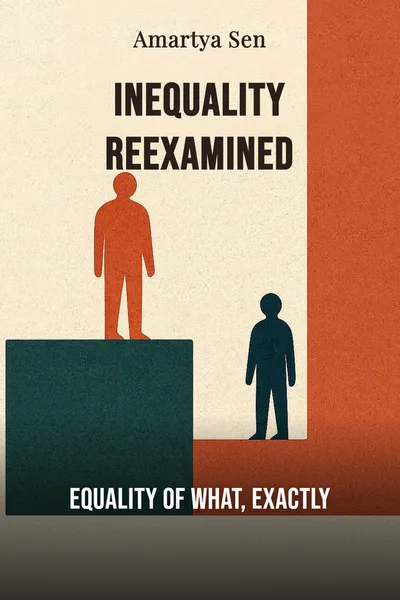
Inequality Reexamined
Equality of what, exactly
Description
In 1992, the economist Amartya Sen published a short, dense book called Inequality Reexamined. Sen had already spent decades on the mechanics of poverty and famine, work that would earn him the Nobel in economics in 1998. But this book was after something slyer than another measurement of who has what. It opened with an observation that sounds almost too simple to build a career on: nearly every serious theory of how a society should be organized demands equality — of something. Libertarians want equal rights over what they own. Utilitarians want everyone's happiness counted the same. Egalitarians want equal incomes or resources. Even the people we file under "anti-egalitarian" turn out to be defending equality of some variable they hold sacred.
If that is true, Sen argued, then the loud, familiar fight between friends and enemies of equality is largely a mirage. The real disagreement is buried one level down. It is not whether to treat people as equals, but in what space that equality is supposed to hold. Equal liberties? Equal wealth? Equal welfare? Each theory picks a variable and insists on parity there — and, having done so, cheerfully tolerates enormous inequality everywhere else. Choose to equalize incomes and you accept that people will end up unequally healthy, mobile, and free. Choose to equalize rights and you accept that some will starve holding them.
So the question that organizes a just society is not the one we usually argue about. It is a prior, quieter question, and once it is asked out loud it refuses to go away. Sen's book is an attempt to answer it — and to show that the answer we default to, income, is the wrong one for surprisingly precise reasons.
The question we’re asking : If almost every political theory demands equality of some variable, which variable should we actually be equalizing?What we’ll see : How Sen turns a familiar debate inside out and relocates the whole argument to the ground he thinks it belongs on.
Table of contents
01Chapter 1 — Everyone wants equality — of something
Sen begins by noticing something that had been hiding in plain sight. The theories that spend their energy attacking equality still smuggle it in through the back door. Robert Nozick, the sharpest libertarian of the era, rejected redistribution — but he did so in the name of equal libertarian rights, held by everyone identically. A utilitarian who scoffs at equalizing incomes still insists that each person's utility count exactly once, no more. Even a theory that ranks people by desert wants the same rule of desert applied to all. Scratch any position and you find a variable it treats as sacred and demands be shared out evenly.
This changes what the argument is really about. "Why equality?" turns out to be the wrong opening question, because almost nobody actually says no to it. The live question is "equality of what?" — and that one splits the room. The reason the choice matters so much, Sen argues, is a fact about human beings that most theories quietly wish away: we are deeply, stubbornly diverse. We differ in health, in age, in metabolism, in climate, in whether we can walk, in how many people depend on us, in what our bodies need simply to keep going.

02Chapter 2 — The trouble with counting incomes
The default variable, in policy and in most of economics, is income — or its close cousins, wealth and command over commodities. It has obvious appeal. Money is countable, comparable, and it seems to stand in for everything else a person might want, since with enough of it you can buy your way toward most goods. Draw a poverty line in dollars, count the people below it, and you have a tidy picture of disadvantage. Sen does not deny that income matters. His objection is that income is a means, and we have quietly mistaken it for the end.
What we actually care about, he insists, is not the coins in someone's hand but what those coins let them become and do. And the rate at which income converts into a decent life varies wildly from person to person. A person with a disability may need far more money than a healthy neighbor to achieve the same mobility — and may also earn less, a double disadvantage that an income count renders invisible. Someone in a malarial region, or an old person, or a pregnant woman, or a laborer doing heavy physical work all need more resources simply to reach the same level of ordinary functioning.
03Chapter 3 — Capability, or what a life can actually be
Sen's answer is built from two linked ideas: functionings and capability. A functioning is anything a person manages to be or to do — being adequately nourished, being in good health, avoiding premature death, but also being able to read, to take part in the life of the community, to appear in public without shame, to move about freely. Functionings range from the elementary and physical to the complex and social. They are the constituent parts of a life, the states and activities that make it the life it is.
Capability is the step that makes the framework distinctive. It is not the functionings a person happens to have achieved, but the set of functionings genuinely available to them — the real alternatives among which they can choose. Two people may both be fasting, thin and hungry; one is starving because there is no food, the other is fasting by choice on a full plate. Their functionings look identical, but their capabilities are worlds apart. One has no option; the other declined an option. Capability captures freedom — the range of lives a person could actually lead — and Sen argues that this freedom, not the particular outcome selected, is what a just society owes its members.
04Chapter 4 — When the yardstick writes the policy
Step back and the reason this argument matters becomes hard to dodge. The choice of the space in which we measure equality is not a preliminary technicality that clears the way for the real politics. It is the real politics, decided in advance and then hidden inside the numbers. When a government tracks poverty in dollars, it has already made a moral ruling — that the extra needs of the sick, the disabled, the old, the burdened do not count as disadvantage until they show up as lost income. The metric quietly draws the line between who is badly off and who is not, and by the time policy arrives the crucial decision has already been made.
This is why Sen treats the "equality of what" question as more than a philosopher's puzzle. Whatever variable a society chooses to equalize becomes the thing its institutions notice, count, and try to fix — and everything outside that variable falls into a blind spot. Equalize incomes and your programs will chase incomes while ignoring whether people can actually convert them into health or participation. Equalize capability and you are forced to see the woman who earns the same as her neighbor but can do far less with it. The yardstick does not just describe the injustice; it decides which injustices the state is even equipped to perceive.
05Conclusion
Sen ends roughly where he began, but the ground has shifted underfoot. The old contest between the champions and the critics of equality turns out to have been a quarrel over which variable to hold sacred, conducted by people who all, in their different ways, wanted equality of something. Once that is clear, the pressure moves onto the question they were avoiding. Equality of what? Sen's wager is that the honest answer is capability — the real freedom people have to live lives they have reason to value — because it is the only space that refuses to look past human diversity, adaptation, and the uneven way resources become living.
Related books