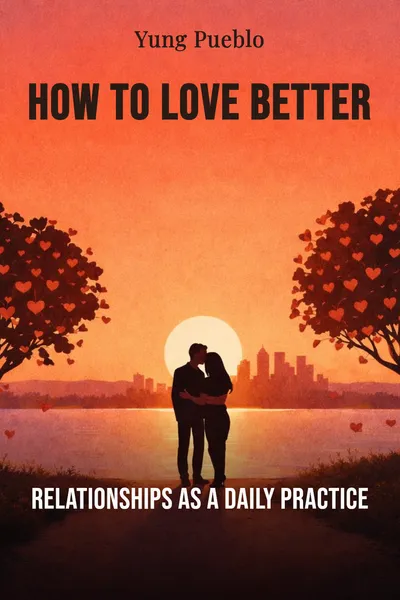
How to Love Better
Relationships as a daily practice
Description
Diego Perez writes under the name Yung Pueblo, and before he wrote anything about love he spent years watching his own mind in ten-day silent meditation retreats. That detail matters, because the book he published in 2024, How to Love Better, doesn't open where most relationship books open. It doesn't start with chemistry, or communication scripts, or the story of how two people meet. It starts inside one person — the one doing the loving — and it stays there longer than we might expect. The premise is quiet and a little inconvenient: the quality of a relationship tracks the inner condition of the people inside it, and inner conditions can be worked on.
He knows this from his own marriage, which he writes about without varnish. Two people who love each other still snap, still project old wounds onto present moments, still misread a tired silence as rejection. What he refuses is the idea that any of this is a verdict. A hard week is not proof the love was wrong. A recurring fight is not a crack in the foundation. In his telling, these moments are the material — the raw stuff a relationship is actually made of once the early rush wears off and something steadier has to take its place.
Which sets up the reframe the whole book turns on. We tend to treat love as a feeling that happens to us, a weather system we can only wait out. Yung Pueblo treats it as something closer to a daily practice — a set of small, repeatable choices about attention, honesty, and repair. The feeling is real, but it isn't the engine. The engine is what we do on the ordinary Tuesday when nobody is swept away by anything.
The question we’re asking : If love isn't mainly a feeling we fall into, what is the daily practice that keeps it alive?What we’ll see : How the book moves the work inward first, then outward into how two people handle the friction between them.
Table of contents
01 Chapter 1 — The feeling is the easy part
The book's first move is to gently demote the feeling. Not deny it — Yung Pueblo is not a cynic about romance — but to notice how little of the work it actually does. Falling in love is largely involuntary. It arrives, it floods the system, it makes another person feel like the answer to a question we didn't know we were asking. And then, reliably, it recedes. Not into nothing, but into something less loud. He argues that most relationship trouble begins in the gap between what the early feeling promised and what daily life delivers.
The mistake we make, in his reading, is to treat the fading of intensity as the fading of love itself. When the electricity dims, we assume something has gone wrong, when in fact something ordinary and expected has happened: the nervous system has calmed down. What replaces the rush isn't decline. It's the opening where a real relationship becomes possible — one built on choice rather than chemistry. But that only happens if we stop waiting for the feeling to come back and do the thing the feeling used to do for us automatically.

02 Chapter 2 — Meeting yourself before you meet them
Having moved love away from feeling, the book makes its more demanding claim: most of what we bring to a relationship, we bring from before it started. The reactivity, the old fears, the reflexes that fire before we've thought — these arrived with us. Yung Pueblo's language for this is direct. We don't just love another person; we love them through the accumulated conditioning of our own history. And that history, unexamined, does a lot of the talking.
He describes his own version honestly. Early in his marriage, he could feel himself reacting to his wife in ways that had nothing to do with her — importing an old wound into a present conversation, defending against a threat that wasn't in the room. The meditation years had given him one useful skill: the ability to watch a reaction rise without immediately obeying it. That small pause, between the feeling and the response, is where he locates most of the freedom a person has in love. Not in controlling the partner, which is impossible, but in noticing our own storm before it lands on them.
03 Chapter 3 — Conflict is data, not damage
If there's a single idea the book keeps circling, it's that conflict is not the enemy of love. Yung Pueblo is blunt about the fantasy so many of us carry — that the right relationship will be conflict-free, that friction is a sign of mismatch. He argues the reverse. Two distinct people with distinct histories and needs will inevitably rub against each other. The absence of conflict usually means someone has gone quiet, not that everything is fine. What matters is not whether couples fight, but what they do with the fight.
His reframe is to treat conflict as information. A recurring argument is not a flaw to be eliminated; it's a message pointing at an unmet need, a tender spot, a misunderstanding that hasn't been cleared. When we approach a fight as a problem to win, we miss what it's telling us. When we approach it as data, the question changes from who's right to what is this actually about. That shift, small as it sounds, is most of the difference between couples who grow through conflict and couples who erode through it.
04 Chapter 4 — Two people who keep choosing
Step back from the individual chapters and the shape of the book's argument becomes clear. Yung Pueblo is describing love not as a thing we find and then have, but as a thing we do, again and again, with no final version. This is why the language of practice runs through everything. A practice has no completion. Nobody arrives at being loving the way they arrive at a destination. There is only the ongoing return — today's attention, today's honesty, today's repair — and then tomorrow's, freshly required.
This reframes what commitment even means. We usually picture it as a one-time decision, sealed at a wedding or a milestone, that then holds by itself. The book replaces that with something more alive and more demanding: commitment as a choice renewed daily, a thousand small yeses rather than one big one. Love, in this view, isn't secured by the past. It's kept alive in the present tense, by two people who keep choosing each other on the ordinary days when nothing forces their hand.
05 Conclusion
Yung Pueblo ends more or less where he began — inside the ordinary marriage, on the ordinary day, where love is decided. The through-line holds from the first page: the feeling matters but doesn't run the show, the inner work comes before the shared work, and the health of a relationship shows up not in the absence of conflict but in the quality of the repair. What he's offered isn't a technique so much as a stance — treat love as something we practice, and the daily texture of a relationship becomes workable rather than fated.
Related books