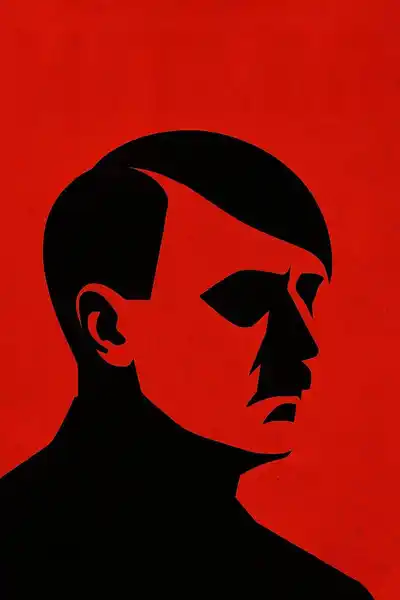
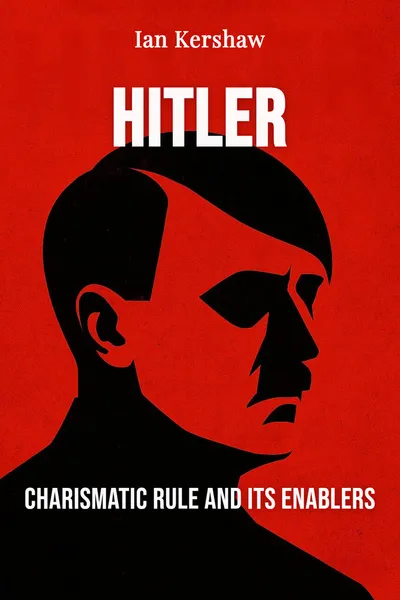
Hitler
Charismatic rule and its enablers
Description
There is a photograph, taken in Munich in August 1914, of a jubilant crowd greeting the outbreak of war. Decades later a magnified corner of it seemed to show a young Adolf Hitler among the faces, mouth open, caught up in the collective ecstasy. Whether it is really him has been doubted, but the image endures because it fits the puzzle. In 1914 Hitler was a failed art-school applicant, a drifter who had slept in a Vienna men's hostel, a man with no profession, no property, no close ties, and nothing that marked him for anything. Twenty years later he governed Germany and was steering Europe toward catastrophe.
The gap between those two men is the problem Ian Kershaw set out to solve across two enormous volumes. The usual explanations either inflate Hitler into a demonic genius or shrink him into a puppet of larger forces, and neither survives contact with the record. The demonic-genius version credits him with a mastermind's plan; the puppet version cannot explain why so many capable people bent their careers, their institutions, and eventually their consciences toward one unremarkable man. Kershaw's answer refuses both. It locates the historical Hitler somewhere stranger: an empty vessel who became indispensable because of what others were prepared to pour into him.
The word Kershaw builds his account around is charisma — not in the loose sense of personal magnetism, but in the precise sense the sociologist Max Weber gave it: a form of authority that rests not on office or law but on followers' belief in an exceptional leader, a belief they act to fulfil. That framing changes the whole question. It stops asking what Hitler wanted and starts asking why a modern state chose to organise itself around wanting it for him.
The question we’re asking : How did an unremarkable man come to command a modern state, and what did that command actually rest on?What we’ll see : The making of a political figure with a single gift, the machinery of belief that grew up around him, and the structures that let it run all the way to ruin.
Table of contents
01Chapter 1 — A nobody with one talent
Kershaw's first volume takes an almost deflationary pleasure in the young Hitler. Born in 1889 in the Austrian town of Braunau, son of a customs official, he coasted through school without distinction and drifted to Vienna hoping to become a painter. The Academy of Fine Arts rejected him twice. He lived on a small inheritance and orphan's pension, then on the proceeds of postcard-sized pictures, sinking for a time into a homeless shelter. There was no early sign of the demagogue. What there was, by every account, was resentment, idleness, and a habit of monologue that exhausted the few people who listened.
The turning point was not a talent Hitler discovered but a stage that appeared. The First World War gave the drifter a role — he served as a message-runner on the Western Front and, for once, belonged to something. Defeat in 1918 and the chaos of postwar Munich gave him an audience. Sent by the army to spy on a tiny nationalist party, he found instead that he could speak, and that beer-hall crowds responded. This was the one gift the record confirms: an ability to voice, with total conviction, the rage and humiliation that thousands already felt.

02Chapter 2 — Working towards the Führer
The heart of Kershaw's interpretation is a phrase he lifted from an obscure Nazi official's speech in 1934: it was the duty of everyone, the man said, to work towards the Führer along the lines he would wish. The remark is offhand and it explains almost the entire regime. Hitler rarely issued detailed orders. He was lazy, kept erratic hours, hated paperwork, and left ministries to fight among themselves. Government under him was chaotic, duplicated, improvised. And yet it moved, relentlessly, in one direction.
It moved because subordinates did not wait to be told. Officials, party men, businessmen, and soldiers competed to anticipate what the leader wanted and to deliver it before being asked. Radicalisation came from below as much as from above: local activists seized Jewish property, drafted harsher measures, invented cruelties, and looked upward for approval that usually came. Hitler set the tone and the goals in the broadest strokes — national revival, racial purity, expansion eastward — and an entire apparatus rushed to fill in the terrible detail.
03Chapter 3 — The gambles that looked like genius
For roughly six years, working towards the Führer seemed to produce miracles, and the run of successes did more than anything else to cement the myth. Hitler pulled Germany out of the League of Nations, rebuilt the military in open breach of Versailles, sent troops into the demilitarised Rhineland in 1936, absorbed Austria in 1938, and dismembered Czechoslovakia while Britain and France stood aside. Each move was a bluff that his own generals thought reckless. Each paid off. To a nation still raw from defeat, it looked like vindication.
Kershaw's reading of this stretch is deliberately unglamorous. The victories were not the fruit of strategic brilliance but of nerve, luck, and opponents unwilling to fight. Hitler gambled where cautious men would not, and for a while the dice fell his way. But every success narrowed the space around him. Generals who had doubted fell silent; the few who resisted were sidelined. The myth of the Führer's infallible instinct hardened, believed most dangerously by Hitler himself, who began to mistake a winning streak for destiny.
04Chapter 4 — The regime as a hollowed state
Step back from the biography and Kershaw's larger claim comes into focus: Hitler is less the story of a man than the story of what happens to a state when it dissolves itself into a person. Weimar Germany was a functioning modern polity with courts, a civil service, an army with its own traditions, and a constitution. Within a few years these institutions had not so much been smashed as hollowed — kept as shells while their authority drained upward into a leader who answered to none of them. That hollowing, more than any single decision, is the condition Kershaw wants us to see.
What made it possible was the willing collaboration of the respectable. Conservatives who thought they could use Hitler as a front, judges who bent the law, industrialists who profited, generals who swore a personal oath of loyalty rather than to a constitution — none were fanatics, and all were essential. Charismatic rule does not survive on true believers alone. It needs the professional classes to treat the exceptional leader as normal politics, to keep their offices running while the ground rules quietly disappear. The enablers were not bystanders; they were the load-bearing structure.
05Conclusion
By April 1945 the man who had absorbed a state into himself was reduced to its opposite: a shaking figure underground, moving armies that no longer existed, blaming the German people for failing him. He killed himself as Soviet troops closed on Berlin, and the apparatus that had spent twelve years working towards his wishes simply stopped. There was nothing left underneath. The regime had never been a set of durable institutions with Hitler on top; it had been the belief in Hitler, and when he was gone the belief collapsed with him, along with the country it had consumed.
Related books