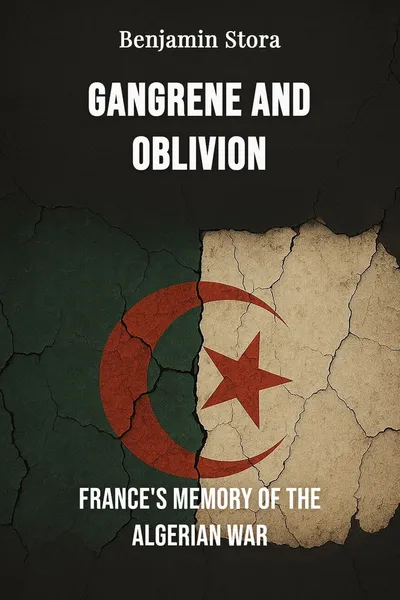
Gangrene and Oblivion
France's memory of the Algerian war
Description
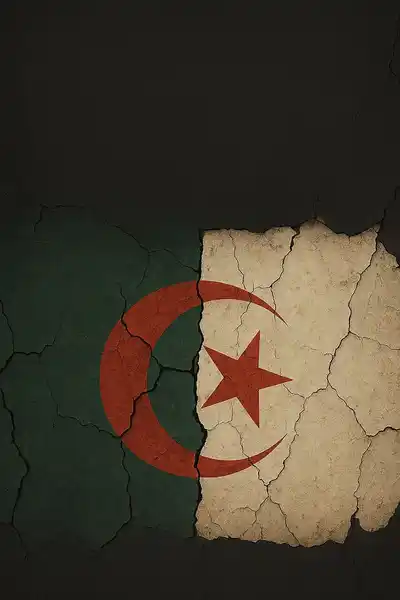
For thirty-seven years, the French state did not admit it had fought a war in Algeria. Between 1954 and 1962, roughly 1.5 million French soldiers passed through a conflict that killed hundreds of thousands, uprooted whole populations, and brought down the Fourth Republic — and the official language called it "the events," "the operations for maintaining order," "the pacification." It was only in June 1999 that the National Assembly voted to let the phrase "war in Algeria" appear in French law. A war that had been over for nearly four decades finally received permission to be named.
That delay is the subject of the historian Benjamin Stora, who traced how a society manufactures its own silence. Stora, born in Constantine in 1950 into an Algerian Jewish family that left for France in 1962, spent his career mapping what he called the gangrene and the oblivion — a wound that never healed because it was never cleaned, and a forgetting that was organised rather than natural. His argument is that France did not simply move on. It built compartments, one for each group with something to bury, and sealed them off from one another so that no shared account of the war could form.
The strange thing is that everyone remembered. The veterans remembered, the pieds-noirs remembered, the harkis remembered, the immigrants from Algeria remembered — each in private, each convinced their memory was the true one, none of them talking to the others. A war fought by more than a million people became a collection of sealed rooms. Stora's question is how that happened, and what it costs a country to keep the doors shut.
The question we’re asking : How does a country that fought a war for eight years manage to spend decades refusing to remember it — and who does that forgetting serve?What we’ll see : How an unnamed war splintered into rival private memories on both sides of the Mediterranean, and why the silence was built rather than fallen into.
Table of contents
01Chapter 1 — A war that refused its own name
The naming problem was not an accident of vocabulary. From the first shootings in the Aurès mountains on the first of November 1954, the French government insisted it was dealing with an internal matter — Algeria was, in law, three French departments, part of the national territory, not a colony and not a foreign country. A state cannot wage war against itself. So the fighting became "maintaining order," the soldiers became a force of "pacification," and the whole enterprise was kept, linguistically, inside the family. The words did real work: if there was no war, there could be no war crimes, no combatants with rights, no negotiated peace between enemies.
Stora shows how the fiction held even as the reality escalated. By 1956 the government had sent in the contingent — the conscripts, ordinary young Frenchmen doing military service — and given the army special powers during the Battle of Algiers in 1957, when torture became a systematic instrument of interrogation. Everyone involved knew what was happening. The euphemisms were not fooling the men on the ground. They were building, in advance, the vocabulary that would later make the whole thing easier to file away.

02Chapter 2 — The compartments of silence
What makes Stora's account sharp is that he does not describe one forgetting but several, each belonging to a different group, each sealed off from the rest. He borrows the image of separate memories that never communicate — a set of watertight compartments, so that the war could be remembered intensely inside each one while remaining invisible to the nation as a whole. The genius of the silence, he suggests, was that it did not require anyone to actually forget. It only required them not to speak across the walls.
Take the army. Career officers carried the memory of a war they believed they had won militarily and been made to lose politically — Algiers pacified, the guerrilla broken, and then de Gaulle handing independence to the enemy. That memory curdled into the attempted coup of April 1961 and the terrorism of the OAS, and afterwards into a resentful silence. The conscripts, the vast majority, carried a different memory: two years of their youth taken, often marked by things they had seen or done, and no language on returning home in which to place any of it.
03Chapter 3 — Two shores, two amnesias
The forgetting was not a French monopoly. Across the Mediterranean, the new Algerian state was building its own version of oblivion, and Stora insists the two amnesias mirrored each other. Independent Algeria needed a founding myth, and it chose a simple one: a whole people rising as one against the coloniser, led by a single party, the FLN, in an unbroken march to liberation. It was a heroic story, and heroic stories cannot afford complications.
So Algeria buried its own uncomfortable memories. The internal violence of the war — the FLN's liquidation of rival nationalists, above all the massacre of the Messali Hadj movement's supporters, and the settling of scores within the maquis — dropped out of the official telling. So did the fate of the harkis, awkward for a narrative of national unity, and so did the bloody power struggles that followed independence. A war of one people against one enemy has no room for Algerians who killed other Algerians.
04Chapter 4 — What a nation chooses not to remember
Step back from the Algerian case and the deeper claim comes into view: forgetting, on this scale, is not something that happens to a society. It is something a society does. Stora's whole method is to treat silence as an artefact — built with materials, laid down in stages, maintained by institutions — rather than as the natural fading of a painful memory over time. Wounds fade on their own; the absence of a memorial, the empty page in the textbook, the missing word in the law do not. Those are decisions, and decisions have authors and beneficiaries.
This is why the metaphor of gangrene matters. A wound left uncleaned does not simply stop hurting. It rots, quietly, under the skin, and the infection spreads to tissue that was never injured in the first place. The organised forgetting of the Algerian war, in Stora's diagnosis, did not spare France the pain. It displaced it — into the tensions of the suburbs, into the raw politics of immigration and national identity, into a far right whose origins run straight back to Algeria and the OAS. What was not spoken did not disappear. It resurfaced, decades later, in forms nobody connected to the original wound.
05Conclusion
The war that could not be named in 1954 was finally named in law in 1999, and the naming changed little overnight — the compartments Stora described did not fly open at the sound of a single vote. But something had shifted. A country that had spent nearly four decades insisting nothing had happened had admitted, on the record, that something had. The gangrene had at last been given its right name, which is the first condition for any wound to be cleaned rather than merely covered.
Related books