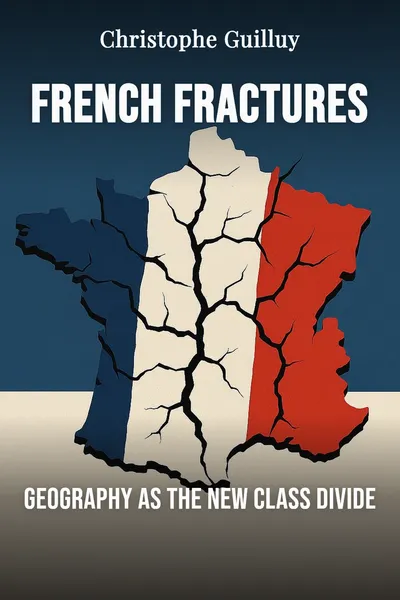
French Fractures
Geography as the new class divide
Description
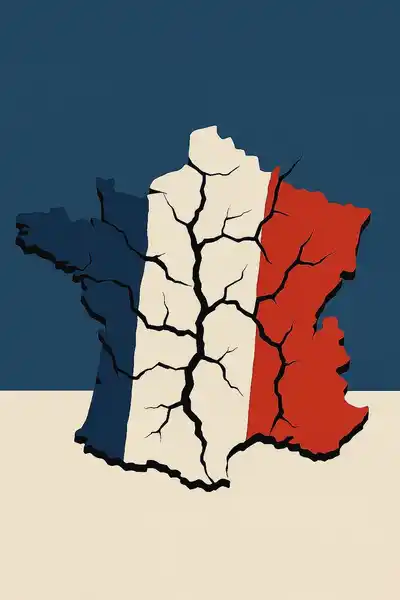
In the early 2010s, a French geographer named Christophe Guilluy started drawing maps that made a lot of people uncomfortable. He plotted employment, income, and property prices onto the shape of France, and what came back wasn't the familiar picture of rich cities and poor suburbs. It was something else: a country splitting along a line most political commentary couldn't see. On one side, a handful of big metropolitan areas — Paris, Lyon, Toulouse, Bordeaux — pulling in jobs, capital, and talent. On the other, a vast stretch of small towns, mid-sized cities, and rural zones quietly falling off the economic grid.
Guilluy called that second France la France périphérique — peripheral France. Not the deprived inner suburbs the media loved to discuss, but the working and lower-middle classes who had drifted, or been priced, out of the winning cities. His argument, laid out across several books and sharpened in the one that carries the idea furthest, was blunt: the real fault line in French society was no longer just about income or origin. It was about where you lived, and whether your address sat inside the globalized economy or outside it.
The thesis landed like a stone in a pond. Some read it as a warning that had gone unheeded; others accused it of flattening a messy reality into a slogan. But the maps kept doing their work, and when the gilets jaunes poured onto roundabouts across France in late 2018, the debate about whether geography had become a class divide stopped being academic. Guilluy's France périphérique was suddenly a name people needed.
The question we’re asking : Has where we live quietly replaced how much we earn as the line that sorts a society into winners and losers?What we’ll see : How a set of maps redrew the story France told about itself, and where the resulting anger went looking for a voice.
Table of contents
01Chapter 1 — The map nobody was reading
The story France told itself for decades placed the social question in the banlieues — the housing estates ringing the big cities, where immigration, unemployment, and unrest concentrated. That map had the virtue of being visible. It had riots, it had cameras, it had a vocabulary. Guilluy's move was to argue that this map, however real, had become a screen. While everyone stared at the suburbs, a much larger population was slipping out of view entirely.
His numbers pointed at a redistribution of economic life. The metropolises that plug into globalization — finance, tech, tourism, high-value services — were capturing the growth. Roughly speaking, a small number of urban areas were producing an outsized share of the country's wealth, while the towns and rural belts that had once housed factories, workshops, and small industry were losing them. When work leaves a place, the young leave next, and what stays behind is a population that owns little, earns modestly, and can no longer afford to move toward the jobs.

02Chapter 2 — How the winners rewrote the story
If the periphery was disappearing from the map, someone was doing the drawing. Guilluy's sharpest and most contested claim is that the metropolitan classes — the graduates, professionals, and managers who thrive in the connected cities — don't just win economically. They also control the language. They write the newspapers, run the institutions, set the terms of what counts as progressive, cosmopolitan, and forward-looking. And they narrate their own success as merit and openness rather than as a geographic sorting they happen to be on the right side of.
This is where the book turns from economics into something closer to a critique of ideology. The winning classes, Guilluy argues, describe themselves as the open, tolerant France while casting the periphery as backward, closed, resentful — the losers who failed to adapt. Concepts like diversity and mobility become, in his telling, the self-flattering vocabulary of people who benefit from the very system that leaves others stranded. The moral high ground and the economic high ground turn out to sit at the same address.
03Chapter 3 — The periphery learns to fend for itself
Cut off from the productive economy and unrepresented in the national story, peripheral France doesn't simply wait. It improvises. Guilluy describes a world that has quietly detached from the metropolitan model and built its own economy of survival — informal work, cash jobs, mutual help, family networks, small arrangements that never appear in official statistics. Where the state and the market both thin out, people reweave something local to fill the space.
One of his more provocative observations is about identity. In the connected metropolis, communities coexist because there is enough economic room to absorb the friction; diversity is comfortable when everyone has a job and a future. In the periphery, where resources are scarce and the horizon is closing, people fall back on the group they trust — and that retreat into local, cultural, sometimes ethnic solidarity is not, in his reading, primarily about prejudice. It's a defensive reflex of populations who feel they've been left to manage on their own.
04Chapter 4 — The geography of who counts
Step back from the maps and Guilluy's real subject comes into focus: representation. Not the size of anyone's paycheck but the question of whose experience gets to count as the national experience. A democracy runs on the assumption that everyone is, in some sense, in the same room. His periphery is the argument that a large part of the country has been quietly shown the door — present in the numbers, absent from the conversation.
This reframes what political anger actually is. When a group has grievances but no legitimate channel to express them — no party that speaks its language, no media that takes it seriously, no vocabulary that isn't handed down as an accusation — the anger doesn't evaporate. It pools. It waits. And it eventually escapes through whatever exit is available, which is rarely the polite one. The rise of the far right, the collapse of the old parties, the abstention, the sudden combustion of a movement over a fuel tax: in Guilluy's frame these aren't separate crises but symptoms of the same blocked pressure.
05Conclusion
Guilluy began with maps, and the maps still make the case better than any slogan. Draw France by income and you get one picture; draw it by proximity to the winning cities and you get another, sharper one, in which the decisive fact about a life is no longer only what you earn but where the economy has decided to happen. The periphery is what falls outside that decision — close enough to see the escalator, too far to step onto it.
Related books