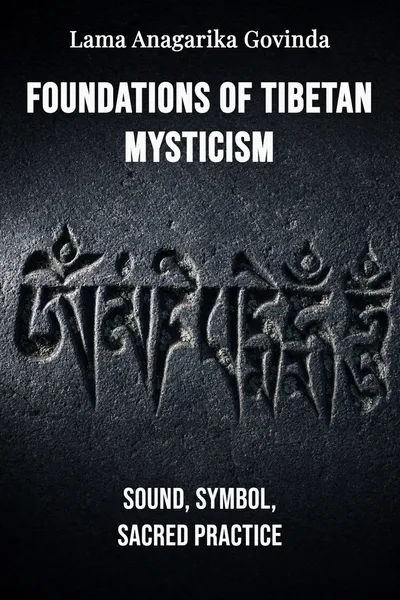
Foundations of Tibetan Mysticism
Sound, symbol, sacred practice
Description
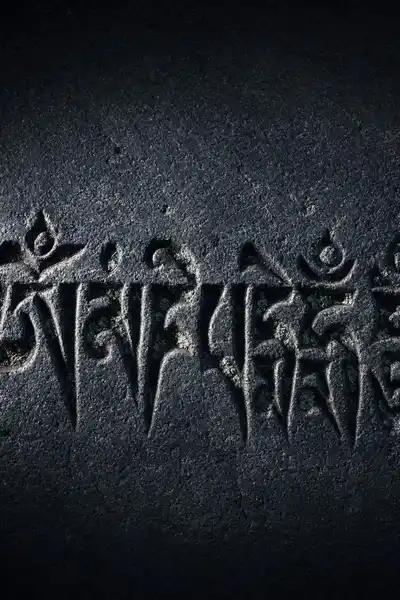
Somewhere on a mountain path in the 1930s, a German-born wanderer who had taken the name Anagarika Govinda kept hearing the same six syllables. Carved into stone, painted on prayer flags, murmured by pilgrims turning wheels, spun into the wind: Om Mani Padme Hum. He had come to Tibet as a student of Buddhism, and he noticed that this formula was everywhere and explained nowhere. People translated it lazily — "the jewel in the lotus" — and moved on, as if a phrase repeated by millions across centuries could be settled in five English words.
Govinda spent decades refusing that shortcut. His book, published in 1960 as Foundations of Tibetan Mysticism, takes those six syllables and treats them not as a slogan to be decoded once, but as a doorway into an entire way of working with the mind. He had trained inside the tradition, initiated by a Tibetan teacher, and he wrote as someone trying to render an experience rather than a creed. The mantra, for him, was where sound, symbol, and consciousness meet and stop being separate things.
What makes the book unusual is its refusal to make Tibetan practice either exotic or reassuringly simple. Govinda insists that the formula does something — that repeating it is closer to tuning an instrument than to reciting a prayer. To follow him is to watch a phrase most of us have seen on a bumper sticker open into a psychology, a cosmology, and a discipline of attention that took a civilization to build.
The question we’re asking : What is actually happening when a Tibetan practitioner repeats Om Mani Padme Hum — and why did Govinda spend a lifetime on it?What we’ll see : How one sacred formula holds together sound, image, and the shaping of consciousness in Vajrayana practice.
Table of contents
01 Chapter 1 — The syllable before the meaning
Govinda begins by dismantling the thing we think we understand. In the West, a mantra is filed under "chant" or "affirmation," something you say to focus or to feel calm. He argues this misses the point entirely. In the Tibetan tradition he studied, sound is not a container for meaning that could just as well be carried by another word. The sound itself does work. Om Mani Padme Hum is not powerful because of what it translates to; it is powerful in the way it is formed, held, and released in the body.
This is why he lingers on the syllable rather than the sentence. Om, in the older Indian tradition that Vajrayana inherited, was never a word with a dictionary entry. It was treated as the primordial vibration, the sound out of which articulated speech emerges and into which it dissolves. To begin a mantra with Om is to start from that pre-verbal ground, before language has divided the world into this and that. Govinda wants us to feel that a mantra reaches back to a layer of experience underneath ordinary thought.

02 Chapter 2 — Om Mani Padme Hum, read from the inside
Only after this groundwork does Govinda turn to the words themselves, and he refuses the tidy translation. "The jewel in the lotus" is not wrong, exactly, but he shows it to be almost useless. Mani, the jewel, and padma, the lotus, are ancient symbols dense with association, and to render them into a single English image is to flatten a chord into one note. His method is to hold each syllable up to the light and turn it, showing how many things it means at once without any of them being the final answer.
The jewel, in the tradition, is the wish-fulfilling gem — but it also stands for the enlightened mind, for the indestructible reality the Vajrayana calls the diamond, for the value that cannot be lost. The lotus is the flower that grows from mud into open bloom without being stained by the water it rises through, the image of purity emerging from the ordinary and the impure. Put together, jewel and lotus do not simply sit side by side. They describe a relationship: the precious thing is found within, and unfolds out of, the very muddiness of ordinary existence.
03 Chapter 3 — Where sound becomes an inner organ
The heart of Govinda's book is the claim that mantra is not something you think about but something you do to your own mind, repeatedly, until it reorganizes how you experience. This is where he connects the six syllables to the wider machinery of Vajrayana. In this tradition, meditation is rarely just quiet sitting. It is active visualization, sound, gesture, and breath woven together, engaging the whole person rather than the intellect alone. The mantra is one strand in that weave, and it is meant to be practiced with the body's subtle centers, the places along the spine that the tradition maps as gates of energy.
Repetition is essential and often misunderstood. Govinda argues that saying the mantra thousands of times is not dull mechanical drill; it is how a sound sinks below the level of deliberate thought and becomes continuous, running under the surface of the mind the way breath does. At that point it stops being an act of will. The practitioner no longer says the mantra; the mantra is simply present, a background against which the ordinary noise of the mind grows quieter and more transparent. Sound has become, in his phrase, something like an inner organ of perception.
04 Chapter 4 — A map of consciousness, not a doctrine
Step back from the six syllables and Govinda's larger argument comes into view. Foundations of Tibetan Mysticism is, underneath its symbolism, a claim about what this whole tradition really is: not primarily a religion of worship but a psychology of experience, a systematic technology for working on the mind from the inside. The gods, the colors, the seed-sounds, the diamond and the lotus — he reads them as a coherent map of states of consciousness, drawn by people who treated the interior life as terrain to be explored with the same seriousness others brought to the outer world.
This is why he keeps insisting on experience over belief. The Vajrayana, in his telling, does not finally ask whether you accept its cosmology. It asks whether you will submit to its practices long enough to find out what they produce in you. The mantra is offered as an experiment the practitioner runs on themselves. That framing is what lets a European wanderer take the tradition on its own terms without either dismissing it as folklore or dissolving it into vague uplift — the two failures he most wants to avoid.
05 Conclusion
The wanderer who kept hearing Om Mani Padme Hum on the mountain paths spent the rest of his life explaining why the easy translation was a trap. Govinda's answer, unfolded across the book, is that the formula is not a phrase to be understood but a practice to be undergone — a fusion of sound, symbol, and sustained attention designed to remake the mind that repeats it. The jewel in the lotus turns out to name the awareness doing the seeking, and the mantra is the instrument that brings it into view.
Related books