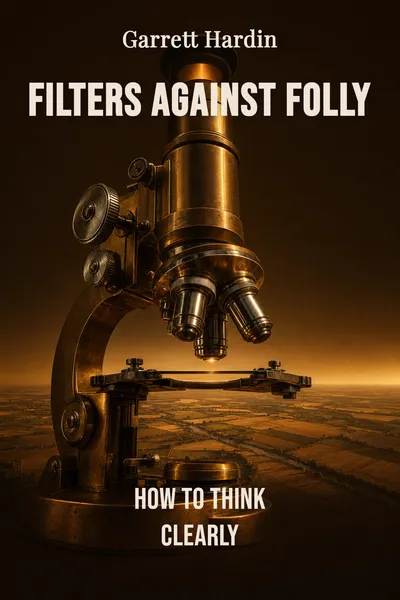
Filters Against Folly
How to think clearly
Description
In 1985, Garrett Hardin was a retired ecologist in his seventies, already famous — and infamous — for a 1968 essay called "The Tragedy of the Commons." He had spent a career watching smart people make catastrophic decisions about population, pollution and shared resources, and watching the rest of us nod along because the smart people had credentials. So he wrote a short, cranky, disarmingly clear book with a title that sounds like a self-help manual and reads like a manual for self-defense: Filters Against Folly.
The premise is almost rude in its simplicity. We are drowning in claims from people who know more than we do — economists, engineers, epidemiologists, activists — and the standard advice is to trust the experts. Hardin's counter-advice is that no expert can be trusted with the whole of a decision, because expertise is narrow by design. The specialist who understands the chemistry of a pesticide may have nothing intelligent to say about what happens to the ecosystem, or the economy, once the pesticide is loosed on the world. And yet these are the same decision.
What Hardin offers instead is not more knowledge but three habits of mind — three ways of interrogating any confident claim before we let it move us. They don't require a degree. They require the nerve to keep judging for yourself when a professional tells you the matter is settled.
The question we’re asking : When everyone claiming authority knows more than we do, how do we keep the right to judge for ourselves?What we’ll see : How a blunt ecologist turned three plain habits of mind into a defense against confident nonsense.
Table of contents
01Chapter 1 — The expert who cannot understand you
Hardin starts from a suspicion most of us feel but rarely say out loud: the more specialized someone becomes, the less able they are to see the thing they're specializing in whole. He calls the ideal that produces this the cult of expertise — the belief that every hard question has a matching professional whose verdict should end the argument. On its face it's reasonable. We can't all learn epidemiology or nuclear engineering, so we delegate. The trouble is that a delegated judgment is still a judgment, and the person we delegated to was trained to look at one slice of the problem and ignore the rest.
His favorite illustration is the language of policy itself. An economist speaks fluent money and is nearly deaf to ecology. An ecologist speaks fluent nutrient cycles and often can't read a balance sheet. A single decision — say, whether to build a dam, or subsidize a crop, or ban a chemical — sits at the intersection of all these languages, and no specialist commands more than one. The expert isn't lying when he says the project is sound. He's telling the truth about his slice and calling it the whole.

02Chapter 2 — Three questions instead of one
The three filters have deliberately homely names. The first is literacy: can we read the words and follow the argument? This sounds trivial until we notice how much rhetoric survives only because nobody parses it carefully. Words like "unlimited," "sustainable" or "safe" slide past us unexamined. Literacy, in Hardin's demanding sense, means refusing to let a sentence pass until we know what it actually claims — and whether it claims anything at all.
The second filter is numeracy, a word popularized by the mathematician Douglas Hofstadter that Hardin adopts with relish. It's the habit of asking "how much?" and "how many?" of any claim built on adjectives. A promise sounds wonderful until we attach numbers to it, at which point the wonder often evaporates. Hardin's recurring weapon here is a single unanswerable question aimed at any scheme of perpetual growth: for how long? Nothing grows forever inside a finite system, and the numerate mind feels that limit in its bones while the innumerate mind cheerfully ignores it.
03Chapter 3 — And then what? The ecologist's reflex
Of the three, ecolacy is where Hardin's own temperament shows, and where the book earns its subtitle. "And then what?" is the ecologist's reflex — the reflex of someone who has spent a lifetime watching well-meant interventions produce the opposite of their intent. It is also, he argues, the question our culture is worst at asking, because it interrupts the pleasant feeling of having solved something.
He returns again and again to the seduction of the single-cause fix. A famine appears, so we ship food. Sensible, humane, obviously right — until we ask the next question. If a region already exceeds what its land can feed, and we ship enough food to let the population keep growing, we haven't ended the famine; we've enlarged the next one. Hardin was blunt, sometimes brutally so, about these conclusions, and readers can find him cold. But the logical move underneath is the filter, not the verdict: don't stop the analysis at the moment it feels good.
04Chapter 4 — The literate citizen doesn't need permission
Step back from the individual filters and Filters Against Folly is really an argument about who gets to judge. Hardin wrote it against a quiet transfer of authority that had been building through the twentieth century — the drift by which more and more public decisions were handed to certified specialists, on the grounds that ordinary people lacked the competence to weigh them. His whole book is a refusal of that premise. The competence to judge, he insists, is not the same as the competence to know, and it is far more widely distributed than the cult of expertise admits.
This is what makes the three filters democratic rather than merely useful. Literacy, numeracy and ecolacy require no laboratory and no license. They are within reach of any attentive adult, and they are precisely the skills that let such an adult stand in a room full of experts and say: I can't check your chemistry, but I can ask how much, for how long, and then what — and your answers don't hold together. Hardin is handing the layperson a way to keep her judgment instead of surrendering it.
05Conclusion
The retired ecologist who wrote this short book was not trying to make us smarter than the experts. He was trying to make us harder to fool. His three questions — can I read the claim, can I count it, and what happens next — are almost embarrassingly plain, which is the point. Folly rarely arrives dressed as folly. It arrives as a confident specialist, a clean promise, an urgent solution that asks us to stop thinking at the moment it feels best to keep going.
Related books