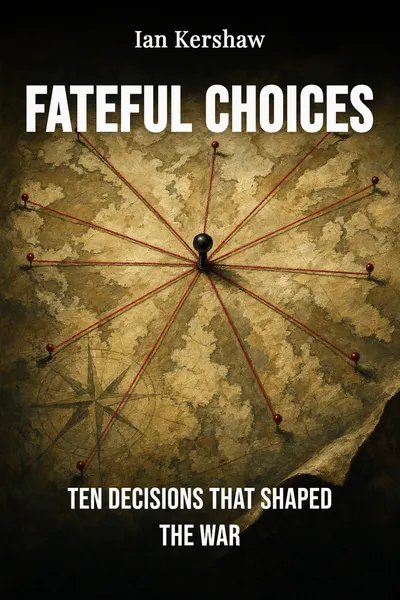
Fateful Choices
Ten decisions that shaped the war
Description
Between May 1940 and December 1941, in roughly nineteen months, a cluster of decisions taken in a handful of rooms — a Berlin chancellery, a Tokyo conference hall, a Washington cabinet meeting, a Kremlin office — set the shape of the rest of the twentieth century. This is the window the British historian Ian Kershaw chose for his 2007 book Fateful Choices. Rather than write another sweeping narrative of the Second World War, Kershaw did something narrower and sharper: he isolated ten specific decisions, each one a fork, and asked what the people who made them actually saw, feared and wanted at the moment of choosing.
The list is deliberate. Britain deciding to fight on in May 1940. Hitler resolving to attack the Soviet Union. Japan choosing to move south and then to strike Pearl Harbor. Mussolini joining the war, Roosevelt steering a reluctant America toward it, Stalin refusing to believe the invasion warnings, Hitler declaring war on the United States, and the slide toward the extermination of Europe's Jews. Ten decisions, mostly taken within a year and a half, each of which could plausibly have gone another way.
Kershaw is best known as Hitler's biographer, and his instinct here is biographical rather than structural. He wants to sit inside the decision as it was being made, before the outcome was known, when the men involved still thought they were being rational. What emerges is less a story of grand design than of pressure, miscalculation, ideology and the slow closing of options — a study of how history narrows.
The question we’re asking : How did a handful of leaders arrive at the specific decisions that locked in the course of the war — and how free were they really?What we’ll see : We follow Kershaw into the rooms where the choices were made, the reasoning that drove them, and what the whole exercise says about chance and constraint at the top.
Table of contents
01Chapter 1 — Ten months that redrew the map
Kershaw's frame is tight by design. The ten decisions cluster in a short span — late spring 1940 to the last weeks of 1941 — because that is when the war stopped being a European affair and became a global one. Each choice, he argues, narrowed the field for the next, so that by the end of 1941 the broad lines of the conflict, and much of its outcome, were effectively set. The book reads less like a chronicle than like a series of close-ups, each one pausing the film at the instant a leader had to commit.
It opens with London. In late May 1940, with France collapsing and the army trapped at Dunkirk, Britain's War Cabinet spent three days debating whether to explore terms through Mussolini. Churchill, newly in office and far from secure, won the argument to fight on. Kershaw treats this not as inevitable British pluck but as a genuine decision, taken against real pressure from Halifax, that kept a western front alive. Had it gone the other way, everything downstream would have looked different.

02Chapter 2 — The logic of the men in the room
What distinguishes Kershaw's account is his refusal to treat these choices as either madness or destiny. At the moment of deciding, each looked defensible to the people making it. His method is to reconstruct that internal logic — the information available, the fears in play, the options that seemed open — and to withhold the hindsight that makes every outcome look foreordained. The result is a kind of suspended judgement, where we watch the reasoning unfold without yet knowing what it will cost.
Take Hitler's turn against the Soviet Union. From inside the Berlin worldview of 1940, it had a grim coherence: Britain refused to quit, and Hitler convinced himself that London's last hope was Soviet entry into the war. Knock out Russia, the reasoning went, and Britain would fold; the vast resources of the east would then make Germany invulnerable to blockade. The assumptions were wrong at almost every point, but they were assumptions, not raving.
03Chapter 3 — Ideology steering the wheel
Rational-sounding calculation, in Kershaw's telling, almost always ran on a deeper current, and in the Axis cases that current was ideology. The decisions were not made by neutral strategists weighing costs; they were made by men whose basic picture of the world dictated which options even appeared on the table. That is where cold logic and fanaticism meet in his account — the calculation is real, but the premises it rests on are supplied by belief.
The invasion of the Soviet Union is the clearest case. Stripped of propaganda, it was strategically reckless — a second front opened while Britain remained undefeated. But for Hitler it was never only strategy. It was the war he had always meant to fight: the conquest of living space in the east and the destruction of what he called Judeo-Bolshevism. The military rationalisations layered on top could not have produced the decision by themselves. Ideology supplied the goal; strategy supplied the excuse.
04Chapter 4 — How much was actually chosen
Step back from the ten episodes and a larger question surfaces, the one Kershaw is really chasing: in high politics, how much is genuinely decided, and how much is simply the working-out of forces no individual controls? His answer is a careful middle. These were real choices made by identifiable people who could have chosen otherwise — but they were choices made inside shrinking rooms, hemmed in by earlier decisions, by national situations, by the moves of rivals.
This is the book's quiet argument against both schools of history. Against those who reduce events to impersonal structures — economics, geography, the system — Kershaw insists that individuals mattered, that Churchill's resolve or Hitler's fixation changed outcomes. Against those who treat leaders as free agents authoring events at will, he insists that every decision arrived pre-loaded with constraints, and that the space for genuine choice was often narrow and shrinking by the day. Neither the great-man story nor the iron-law story survives his close reading intact.
05Conclusion
The nineteen months Kershaw isolates did not just win or lose a war; they fixed its character. By the end of 1941 the conflict had become global, the Soviet Union and the United States were in it, and the machinery of genocide was running. None of that was written in advance. It was assembled, fork by fork, by men reasoning from bad assumptions, strong fears and fixed ideologies, each choice foreclosing the next until the options ran out.
Related books