

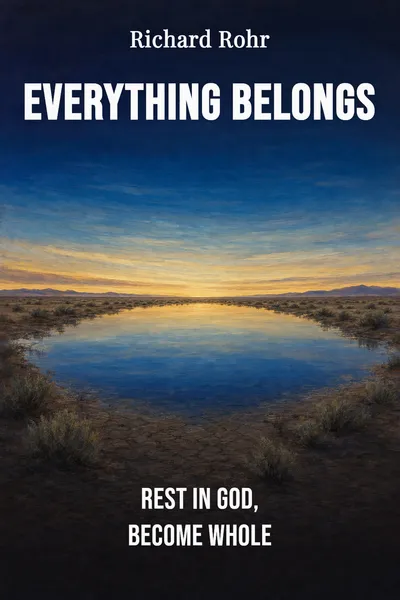
Everything Belongs
Rest in God, become whole
Description
Richard Rohr is a Franciscan friar from New Mexico who has spent decades telling a certain kind of restless, high-achieving Christian something they did not expect to hear: that the spiritual problem is not that they have done too little, but that they are trying too hard. His book "Everything Belongs," first published in 1999 and reissued many times since, grew out of retreats he led for people who had, by most measures, arrived. Successful, capable, often devout. And quietly exhausted by a faith that had become one more thing to perform.
The title is the whole argument compressed into two words. Everything belongs — the failures, the doubts, the parts of ourselves we would rather edit out, the ordinary Tuesday afternoon. Rohr's claim is that the false self spends its life sorting reality into what counts and what doesn't, and that this sorting is precisely what keeps us anxious and half-alive. The remedy he proposes is not more effort. It is a way of paying attention that the Christian tradition once called contemplation, and largely forgot.
For a bestselling book of spirituality, it is unusually unwilling to comfort. Rohr borrows from the desert fathers, from mystics like John of the Cross, from psychology and the Twelve Steps, and refuses to hand the reader a program. What he offers instead is a reorientation — a shift in where a person rests. The book has sold steadily for a quarter-century, which suggests the exhaustion it names is widely shared.
The question we’re asking : Why does a settled, accomplished life so often leave a person feeling that something essential is still missing?What we’ll see : How a Franciscan reads the restlessness of the striving self, and what he says lies underneath it.
Table of contents
01Chapter 1 — The mind that gets in its own way
Rohr begins with a diagnosis rather than a doctrine. The problem, as he sees it, is a self that is constantly busy managing its own image — deciding, moment by moment, what is acceptable and what must be pushed away. He calls this the false self, borrowing the term from Thomas Merton. It is not evil. It is simply the part of us built by ambition, comparison and the need to be right, and it does its work so continuously that we mistake it for who we are.
The false self runs on judgment. It divides the world into worthy and unworthy, success and failure, the people who are in and the people who are out. It does the same thing internally, cutting off the shameful memory, the unimpressive feeling, the parts of a person's history that don't fit the story they want to tell. Rohr's point is that this constant editing is not a moral achievement. It is what keeps us tired, defensive and unable to be surprised by anything.

02Chapter 2 — What contemplation actually is
Contemplation, in Rohr's telling, has almost nothing to do with the images the word conjures — robes, silence for its own sake, a spiritual elite retreating from the world. He defines it plainly as a way of seeing reality without the immediate need to judge it, use it, or fit it into an argument. It is the practice of letting a moment, a person, or oneself simply be there, fully, before the mind rushes in to label it. The tradition once knew this well; Rohr argues the Western Church largely lost it after the late medieval period, trading a contemplative Christianity for a moralistic and intellectual one.
The obstacle is the same mind described in the first chapter. The false self cannot tolerate not knowing, not controlling, not evaluating. Contemplation asks it to stand down — not permanently, but long enough for a person to encounter what is actually in front of them rather than their commentary on it. This is why Rohr calls prayer, in its deepest form, less a matter of talking to God than of getting the noisy, calculating self out of the way so that something can be received.
03Chapter 3 — The place where the opposites meet
The deepest move in the book concerns how a person holds contradiction. The striving mind, Rohr argues, is fundamentally dualistic — it thinks in either/or, right and wrong, us and them, and it experiences ambiguity as a threat to be resolved as quickly as possible. Contemplation trains a different capacity, one he calls nondual seeing: the ability to hold two things that seem opposed without collapsing them into a winner and a loser.
This matters because the most important realities refuse to sit on one side. A person is both broken and beloved. God is both intimate and beyond grasp. Life is both suffering and gift. The dualistic mind cannot handle this and so it picks a side and defends it, which is how faith curdles into rigidity and how good people become certain of things that leave no room for mercy. Rohr treats the ability to stay in the tension, without forcing a premature resolution, as a mark of spiritual maturity rather than weakness.
04Chapter 4 — A spirituality of imperfection
Step back from the practices and the theology, and the book is making a claim about the whole arc of a life. We tend to assume that becoming more mature, more spiritual, more accomplished means adding — more knowledge, more virtue, more security, more of the self. Rohr proposes almost the reverse. The second half of life, in his framework, is about subtraction: the slow, often involuntary shedding of the identities and certainties the first half was busy building. Wholeness comes not from acquiring the missing piece but from no longer needing to be complete on one's own terms.
This is why he calls it a spirituality of imperfection, and why the Twelve Steps interest him so much. The recovering addict who admits powerlessness has stumbled onto the same threshold as the contemplative — the point where the managing self gives up, and something truer can take its place. Rohr's Franciscan lineage runs through this: Francis of Assisi built a movement on downward mobility, on choosing the position of the poor, the small, the ones who have nothing to protect. The gospel, in this reading, is not a ladder to climb but a series of necessary descents.
05Conclusion
The book opened with the exhausted, accomplished believer, and it ends by handing that person a strange kind of good news: the exhaustion was never the problem to be fixed but the door to be walked through. Everything belongs because nothing has to be sorted first — not the failure, not the doubt, not the unremarkable stretch of a life that looked, from outside, like it had arrived. What Rohr offers instead of a program is a place to rest, and the claim that the resting is where wholeness comes from, not the striving.