

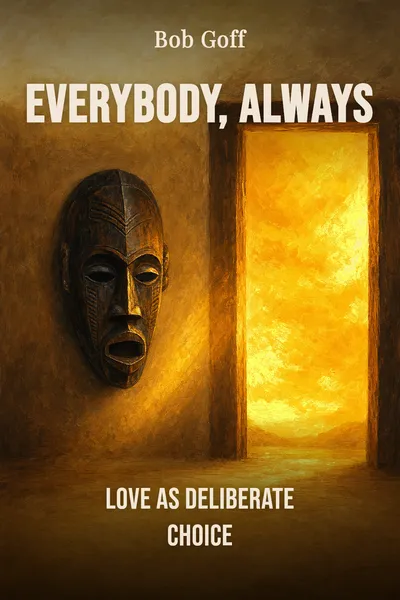
Everybody, Always
Love as deliberate choice
Description
Bob Goff tells a story about a witch doctor in Uganda. Not a metaphor — a man who, Goff came to believe, had been involved in the sacrifice of children, and whom Goff eventually found himself trying to reach rather than simply prosecute. Goff is a lawyer, a former diplomat, the founder of a nonprofit that works on justice cases for kids overseas, and by his own account a man who once had a tidy sense of who deserved his kindness and who did not. The witch doctor sat well outside that circle. Everybody, Always, published in 2018, is largely the record of what happened when Goff decided the circle was the problem.
The book follows his earlier bestseller, Love Does, and it sharpens a claim that ran underneath the first one. Goff's premise is that most of us practice a selective kindness so natural we barely notice it: we love the people who are easy, familiar, grateful, on our side. We build a quiet list of exceptions — the difficult relative, the person who wronged us, the stranger whose politics or manner sets our teeth on edge — and we tell ourselves that loving them is optional, or at least postponable. The title is his rebuttal. Not everybody sometimes. Not the deserving, always. Everybody, always.
What gives the argument its charge is that Goff refuses to treat this as a lofty ideal to admire from a distance. He tells it through airports, jail visits, a house he opens to strangers, a phone number he prints in his own books so anyone can call. The love he describes is rarely convenient and often faintly ridiculous. It is also, in his telling, the whole point of a faith he had spent years mostly agreeing with rather than doing.
The question we’re asking : What changes when love stops being something we feel toward the deserving and becomes something we choose toward everyone?What we’ll see : How one man traded a comfortable, well-defended kindness for a messier and more demanding way of being in the world.
Table of contents
01Chapter 1 — The people we quietly decide not to love
Goff opens with a confession most of us would recognize if we were honest. He is good at loving people who are easy to love. His friends, his family, the person who agrees with him, the stranger who is polite at the counter — all of that comes naturally, and he had long mistaken that ease for virtue. What he had not examined was the other list, the one everybody keeps and nobody admits to: the people we have quietly filed under 'later,' or 'not my job,' or 'they had it coming.' The difficult coworker. The ex-friend. The person whose behavior we find genuinely appalling.
His insight is that this second list is where the real question lives. Loving the lovable, he points out, costs nothing and proves nothing — everybody does it, including people who claim no faith at all. The instruction he keeps circling back to, the one attributed to Jesus, was not 'love the people who are like you.' It was to love your neighbor, and then, more pointedly, to love your enemies. Goff notices that we tend to read that as inspiration rather than instruction, something to nod at rather than schedule.

02Chapter 2 — Love as a verb, not a feeling
The engine of the book is a reframing Goff had been building for years: love is not primarily something you feel, it is something you do. Feelings are unreliable weather. They come and go, they favor the people who please us, and they cannot be commanded. If love depended on feeling loving, the instruction to love everybody would be absurd — nobody can manufacture affection for a person who repels them. Goff's escape from the absurdity is to move love out of the emotions and into the calendar.
This is why the book is built out of actions rather than reflections. Goff doesn't tell you love is powerful; he tells you about getting on a plane, showing up at someone's door, learning a name, staying in a conversation past the point of comfort. In one running thread he describes literally putting his cell phone number into his books so that strangers can call him — and then actually answering when they do, at all hours, from all over the world. It is an almost comically concrete demonstration of the principle: availability as a form of love.
03Chapter 3 — The ones who are hard to be near
The heart of the book is what happens when Goff tests his principle on the hardest cases, and the witch doctor becomes his central story. Goff's nonprofit works on justice for children in East Africa, and in the course of that work he encountered a man he believed had participated in horrific crimes against kids. Every instinct — legal, moral, human — pointed toward opposition. And Goff did pursue justice. But alongside the prosecution he did something stranger: he kept showing up, kept engaging the man as a person, kept refusing to reduce him entirely to his worst acts.
Goff is careful here, and the care is what saves the story from sentimentality. Loving everybody does not mean approving of everybody, excusing harm, or abandoning justice. He does not soften what the man had done, and he does not pretend the relationship was comfortable. What he insists on is that even a person capable of terrible things remains a person, and that treating him as beyond love was a line Goff no longer felt entitled to draw. The love and the accountability, in his telling, were not opposites.
04Chapter 4 — What becoming love actually costs
Step back from the individual stories and Goff is proposing something larger than a set of better behaviors. He wants love to become an identity rather than an activity — not something you do on good days but something you are, steadily, toward whoever happens to be in front of you. The phrase he returns to is 'becoming love.' It reframes the whole project: the goal is not to accumulate loving acts like merit badges, but to be so shaped by the practice that the acts stop requiring a decision each time.
This is where the book's demand becomes clear. A love aimed only at the deserving can stay under our control; we grant it, withhold it, ration it according to who has earned it. A love aimed at everybody, always, hands over that control entirely. There is no more sorting, no perimeter, no list of exceptions to fall back on. Goff frames this not as a burden reluctantly accepted but as a kind of freedom — the exhausting work of deciding who is worthy of us simply falls away when the answer is always 'everyone.'
05Conclusion
The witch doctor story ends without the tidy resolution a reader might hope for — Goff is more interested in what the encounter did to him than in a clean redemption arc. He came away not with a technique for loving difficult people, but with a suspicion that the difficulty had always been more about his own boundaries than about them. The list of exceptions he started with, the defensible perimeter of easy kindness, turned out to be the one thing standing between his beliefs and his life.