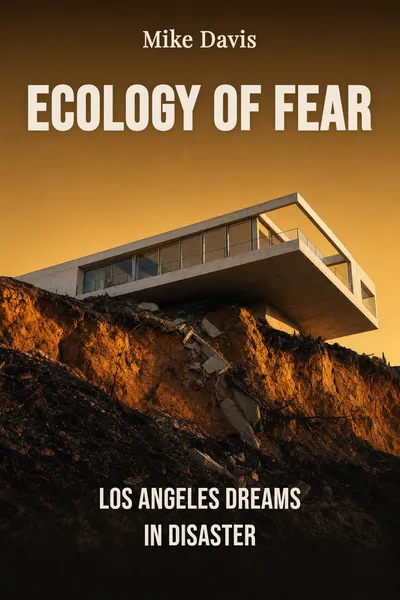
Ecology of Fear
Los Angeles dreams in disaster
Description
Los Angeles has been destroyed on film more times than any other city on earth. Earthquakes swallow it, tidal waves flatten it, aliens vaporize its landmarks, and lately the fires and floods arrive without needing a script at all. Somewhere around the late 1990s, Mike Davis sat down to count the destructions — the novels, the disaster movies, the pulp fantasies in which the city is scoured off the map — and found the tally ran into the hundreds. No other American metropolis inspires quite this appetite for its own annihilation. New York gets rebuilt; Los Angeles gets erased, and audiences seem to enjoy watching.
Davis, a historian who had already unsettled the city's self-image with an earlier book on its dark underside, wanted to know why. His answer, published in 1998 as Ecology of Fear, refused the easy reading that Angelenos are simply morbid. The disasters on screen, he argued, are the flip side of a very real relationship the city has with catastrophe — a place built on fault lines, fire-prone hillsides, and floodplains that its boosters spent a century pretending were paradise. The fantasies and the facts feed each other.
What emerges is less a book about earthquakes than a book about who lives where, who pays when the ground gives way, and how a city decides which dangers to fear and which to ignore. Davis treats the wildfire and the monster movie as versions of the same story — a story about land, money, and the long habit of building beautiful things in the worst possible places.
The question we’re asking : Why has Los Angeles become the capital of the American apocalyptic imagination, and what does its taste for its own destruction reveal about the real city?What we’ll see : How Davis reads a century of fire, flood, and cinematic ruin as a single argument about the land Angelenos chose and the neighbours they chose to forget.
Table of contents
01 Chapter 1 — The city that gets destroyed on screen
Davis opens Ecology of Fear with an inventory that reads like a joke until the numbers pile up. He counts the ways Los Angeles has been wiped out in fiction and film — by earthquake, nuclear blast, comet, plague, mudslide, gang war, alien invasion, and the wrath of God — and arrives at well over a hundred distinct annihilations across a century of pulp novels and Hollywood spectacle. The city is not merely a backdrop for disaster. It is the preferred victim, a place American culture seems to want to see punished.
The pattern, he notes, is not neutral. When Los Angeles burns on screen, the story often carries a moral charge: the city is decadent, artificial, over-reached, and the catastrophe is a kind of judgment. This is the frontier fantasy inverted — the paradise that was always too good, too easy, too full of the wrong people, finally getting what it deserved. Davis traces the strain back through Nathanael West's The Day of the Locust and forward into the disaster cycles that studios reliably profit from.

02 Chapter 2 — The disasters we choose not to see
The real history of Los Angeles, Davis argues, is a long negotiation with hazards its developers preferred to ignore. The region's Mediterranean climate delivers most of its rain in short, violent bursts; its mountains rise and crumble at some of the fastest rates on the planet; its chaparral is not just flammable but dependent on fire to reproduce. None of this was a secret to the people who lived there before. It was a secret the boom manufactured, because acknowledging it would have complicated the sale.
Davis reconstructs how the city was marketed as a place of perpetual mildness, its floods rebranded as freak events and its fire seasons treated as bad luck rather than clockwork. When the Los Angeles River drowned neighbourhoods, the answer was to entomb it in concrete rather than to stop building in its path. When the hills burned, the answer was to rebuild in the same canyons, often at public expense. The hazard was never eliminated; it was deferred, subsidized, and pushed onto the future.
03 Chapter 3 — Malibu burns, the projects flood
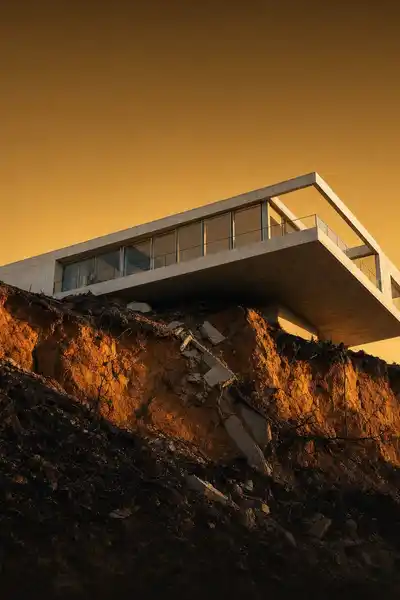
The most cited chapter of Ecology of Fear puts two places side by side: Malibu, the celebrity coastline that burns again and again, and the older working-class neighbourhoods left exposed to flood and neglect. Malibu, Davis notes, sits in one of the most fire-prone corridors in North America, where the Santa Ana winds drive flames through chaparral that is engineered by evolution to ignite. It has burned repeatedly across the twentieth century, and each time the mansions go up, they are rebuilt — larger, and with a great deal of public help.
Davis's argument is not that the wealthy deserve their fires but that the response to them reveals a politics. Firefighting resources, insurance backstops, and rebuilding permits flow generously toward the hillside estates, treating recurrent, predictable disaster as an accident worthy of endless rescue. The land keeps burning, the owners keep rebuilding, and the cost of that stubbornness is quietly socialized across the wider public.
04 Chapter 4 — The politics of who gets saved
Step back from the fires and the floods, and Ecology of Fear becomes an argument about geography as destiny — not the destiny of nature, but the destiny written by money. Davis's deeper claim is that disaster in Los Angeles is never simply natural. It is filtered through decades of decisions about where to build, whom to protect, and which risks to absorb collectively and which to leave to the people who cannot move. The fault lines that matter most, in his telling, are social as much as geological.
This reframes the apocalyptic movies from Chapter 1. The city fantasizes about being destroyed, Davis suggests, partly because it half-knows that its arrangement is unjust and unsustainable — that the fortified hillside villas and the neglected flatlands cannot both be innocent. The disaster spectacle offers a purge, a way of imagining the whole precarious edifice swept clean so that no one has to answer for how it was built. Destruction on screen is a confession the city cannot make out loud.
05 Conclusion
Davis ended Ecology of Fear where he began, with a city that keeps rehearsing its own end. The hundreds of fictional destructions and the recurring real ones are, in his reading, two expressions of a single unresolved fact: Los Angeles was built in defiance of the land it sits on, and the bill for that defiance keeps coming due in fire, water, and shaking earth. The apocalyptic imagination is not a morbid quirk. It is the city dreaming about the reckoning it has spent a century deferring.
Related books