Don't Shoot the Dog
Reward behavior, reshape habits
Description
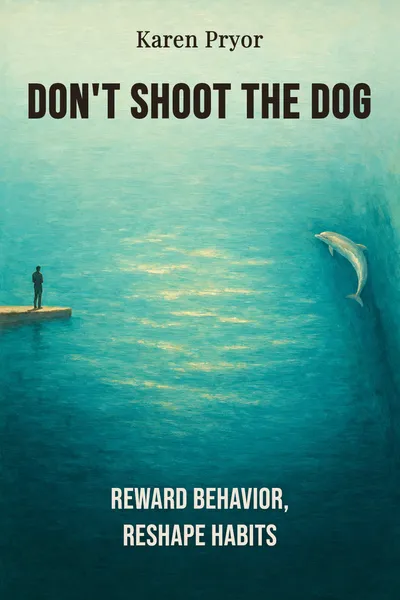
Karen Pryor spent the 1960s training dolphins at Sea Life Park in Hawaii, and dolphins taught her something no textbook had. You cannot punish a dolphin. If you try to correct it, it simply swims away to the far side of the tank, and there is nothing you can do to make it come back. A leash won't work. A raised voice won't work. Force of any kind is off the table, because the animal is faster, stronger, and entirely free in its own element. The only thing that works is making the dolphin want to do what you're asking. So Pryor had to learn, out of sheer necessity, how to shape behavior using nothing but rewards and precise timing.
What she discovered in the water turned out to apply almost everywhere else. The laws of reinforcement — the same principles B.F. Skinner had worked out in the lab — govern how a dog learns to sit, how a child learns to clean a room, how a spouse learns to stop nagging, and how we ourselves pick up and drop habits every day, mostly without noticing. Pryor gathered all of it into a slim, plainspoken book in 1984, gave it the deliberately provocative title Don't Shoot the Dog, and turned a corner of behavioral science into something a reader could use by Tuesday.
The title is a joke with a point. When a dog, or a person, keeps doing something we hate, our instinct is to reach for the harshest tool available — to yell, to threaten, to metaphorically shoot the dog. Pryor argues that this instinct is almost always the wrong one, and that there is a gentler, more reliable way to change what living creatures do.
The question we’re asking : How do rewards, well-timed, actually reshape behavior — in animals and in the people around us?What we’ll see : How a trainer's toolkit built on reinforcement quietly outperforms the shouting, threatening, punishing reflex we reach for first.
Table of contents
01 Chapter 1 — The dolphin that couldn't be scolded
The central premise of Pryor's book grows out of a constraint most trainers never face. A dolphin in a tank is a free agent. There is no collar, no fence, no way to physically compel it. If the animal decides it would rather not perform, it withdraws, and the session is over. This forced Pryor to abandon the entire vocabulary of correction and start again from a single question: how do you get a creature to repeat a behavior when the only leverage you have is what it finds pleasant?
The answer is reinforcement. A reinforcer is anything an animal will work to get — a fish, a scratch, a moment of play, a word it has learned to associate with good things. When a behavior is followed immediately by something the animal wants, that behavior grows more frequent. When it isn't, the behavior fades. That is the whole engine. It sounds almost too simple, and Pryor's gift is refusing to complicate it while still respecting how much skill it takes to use well.

02 Chapter 2 — The click that marks the moment
The timing problem has a beautiful solution, and it is the idea that made Pryor famous well beyond dolphin tanks. If you can't always deliver the reward in the exact instant a behavior occurs, you deliver a signal instead — a sound that the animal has already learned means a reward is coming. Pryor's tool of choice was a small toy clicker, but a whistle or a specific word works the same way. The click doesn't feed the animal. It marks the moment, telling it precisely which action, out of everything it was doing, earned the fish that follows.
This is what behaviorists call a conditioned reinforcer, and it solves two problems at once. It buys the trainer time, because the reward can arrive a beat later without breaking the link. And it achieves a precision no clumsy handful of food ever could. The instant a dolphin's tail clears the water, the instant a dog's haunches touch the floor — click — and the animal knows exactly what it did right. Pryor describes the click as a kind of camera shutter, freezing one frame of behavior and stamping it as the thing that pays.
03 Chapter 3 — Building a behavior nobody knew was possible
The technique that fills that gap is shaping, and it is the heart of Pryor's craft. Shaping means reinforcing successive approximations — rewarding small steps that gradually approach the behavior you want, rather than waiting for the finished performance to appear by luck. You want the dolphin to jump through a hoop held high above the water. You do not start there. You reinforce it for swimming near the hoop, then for touching it, then for passing through it at the surface, then for a small jump, raising the bar only when each stage is solid.
The skill lies in choosing the size of the steps. Too large a jump and the animal fails, gets nothing, and grows frustrated. Too small and progress crawls. Pryor treats shaping almost as an art form with its own rules of thumb: raise the criteria in increments the learner can meet, keep sessions short, and if a step falls apart, go back to one that worked before moving on. She frames these as laws learned the hard way in the tank, not abstractions, and they read like the notes of someone who has watched a thousand sessions go right and wrong.
04 Chapter 4 — The trouble with punishment
The title of the book is really an argument about punishment, and it is the argument Pryor most wants to land. When behavior we dislike persists, punishment feels like the natural remedy, and it is the tool most of us reach for first — the raised voice, the fine, the withdrawal of affection, the shot at the dog. Pryor's case against it is not primarily moral. It is that punishment is a bad technology. It tends not to work, and when it does, it works at a cost that usually outweighs the result.
The core problem is that punishment tells a creature what not to do without telling it what to do instead. A scolded dog learns to fear the scolder, not to behave. A punished employee learns to hide mistakes, not to make fewer of them. Punishment also has to be delivered every time to hold, and it breeds avoidance, resentment, and a partner who slips to the far side of the tank whenever it can. Reinforcement, by contrast, builds something: it grows a behavior you can point to, and it leaves the relationship intact.
05 Conclusion
Karen Pryor never left the water behind. The dolphin that could swim away, immune to every threat, remains the governing image of the whole book — a creature that forced her to discover, out of necessity, what actually changes behavior when force is off the table. What she found there she carried onto dry land and into the ordinary rooms where the rest of us live, and the clicker she made famous eventually became a standard tool in kitchens and dog parks around the world.
Related books