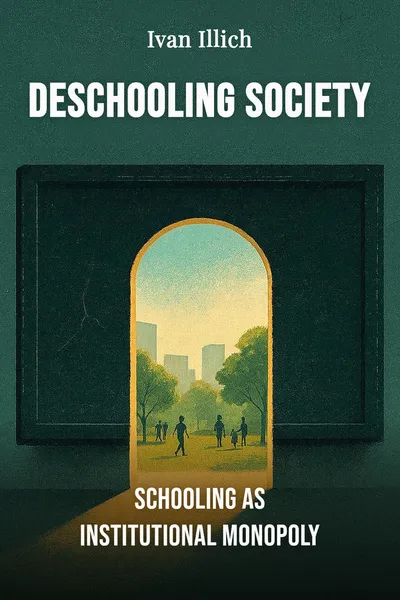
Deschooling Society
Schooling as institutional monopoly
Description
In 1971, a former Catholic priest named Ivan Illich published a short, furious book arguing that the problem with schools was not that they were failing. It was that they were succeeding — at something nobody had agreed to. Illich had spent years in Latin America, running a center in Cuernavaca, Mexico, where he watched development programs pour money into building classrooms as if education were a plumbing problem. More schools, more teachers, more years of attendance. And the gap between the credentialed and everyone else kept widening. Something, he decided, was wrong at the root.
The book was called Deschooling Society, and its central claim was deliberately provocative: compulsory schooling had quietly become a monopoly. Not a monopoly on buildings or textbooks, but on something stranger — on the very idea of learning itself. Illich argued that schools had convinced an entire civilization that knowledge is a product, that it must be delivered by certified professionals, in graded doses, inside institutions, and that anything learned elsewhere barely counts. We had, in his phrase, confused the process of being taught with the fact of learning. And once a society makes that confusion, it stops being able to imagine education arriving any other way.
That is a large accusation, and Illich pressed it without much hedging. He was not writing a reform proposal. He was not asking for smaller classes or better funding. He wanted to pull the institution out of its assumed place at the center of modern life and ask what it was actually doing there — who it served, what it manufactured, and what it quietly made impossible.
The question we’re asking : What exactly does a school teach beyond its subjects, and why did Illich think the institution itself had become the problem?What we’ll see : How a critique born in 1970s Cuernavaca turned the classroom inside out — and what Illich wanted to put in its place.
Table of contents
01Chapter 1 — The confusion machine
Illich opens with a distinction that the rest of the book never lets go of: there is learning, and there is schooling, and we have fused them in our heads until they feel like the same thing. Learning, for Illich, happens constantly and almost everywhere — a child picks up a language by living inside it, a mechanic learns an engine by taking engines apart. None of this needs a curriculum. Yet modern societies had come to believe that real knowledge only counts if it was delivered by a teacher, measured by a grade, and stamped by a diploma. That belief, he argued, is manufactured, and the school is the machine that manufactures it.
The core trick is what he calls the confusion of process with substance. The school teaches us to confuse teaching with learning, grade advancement with education, a diploma with competence, and fluency with the ability to say something new. Once a student has internalized this, the confusions start generating themselves. More attendance comes to mean more learning. More spending on schools comes to mean a more educated population. The institution becomes self-justifying: whatever it does is, by definition, education, because education is whatever happens in schools.

02Chapter 2 — The hidden curriculum of attendance
Beneath the official subjects, Illich argues, every school teaches a second curriculum that no syllabus lists and no one examines. He calls it the hidden curriculum, and it is the same in every classroom on earth regardless of what is written on the board. Its first lesson is that learning is the result of being taught — that you become educated by submitting, year after year, to the attentions of a certified adult in a designated room, on a fixed schedule, graded against your peers. The content varies by country. The ritual does not.
The ritual itself does the teaching. Children learn to sit, to wait, to be ranked, to accept that someone else decides what is worth knowing and when it has been learned adequately. They learn the quiet equation at the heart of the system: time plus attendance equals worth. Spend enough years inside and you accumulate value measurable in credentials. The hidden curriculum trains people, Illich thought, to be lifelong consumers of institutional service — to assume that any human need, from health to justice to knowledge, is best met by a professional inside an institution rather than by one's own effort or one's neighbors.
03Chapter 3 — The monopoly nobody voted for
The word Illich keeps returning to is monopoly, and he means it almost literally. A school does not merely offer education among other options; it has captured the exclusive right to certify that education has occurred. Employers do not test whether you can do the work — they ask for your diploma. Advancement, status, the better job, the professional door: all of it runs through credentials that only schools can issue. What the institution actually sells is not knowledge, which is everywhere, but certification, which it alone controls. That is the monopoly, and it is worth more than any subject in the catalog.
This produces a strange economy. Since the credential is the prize, people pursue the credential rather than the competence it supposedly represents. More and more years of schooling become necessary to secure the same position, not because the work grew harder but because the diploma inflated. Illich watched the threshold of required schooling creep upward and saw a treadmill: everyone must run faster to stay in the same place, and the people who cannot afford to keep running are left permanently behind. The monopoly thus deepens inequality while advertising itself as the great equalizer.
04Chapter 4 — What a society learns when it stops schooling
Step back from the classroom and Illich's target gets larger. Deschooling Society is the opening move in a lifelong argument about institutions that promise one thing and mainly deliver their own expansion. Schools promise learning and deliver credentials. Health systems, he would argue in later books, promise health and deliver dependency on medicine. The pattern Illich saw in the school — a service that becomes a monopoly, then redefines the need it was meant to serve so that only the institution can satisfy it — was for him the signature move of modern life. The school was simply the clearest case, because it got to us first and shaped how we expect every other need to be met.
So his remedy is not a better school but a different architecture for learning. In the book's constructive half, Illich sketches what he calls learning webs — networks that give people direct access to the resources of learning without routing them through an institution. He imagines reference services that catalog the actual tools and places of a city, so anyone could find a workshop, a library, a laboratory to use. He imagines skill exchanges, where people list what they can teach and seek out what they want to learn. He imagines peer-matching networks that connect people who want to study the same thing, and a loose pool of experienced mentors available to those who ask.
05Conclusion
Illich wrote Deschooling Society not as a plan to be implemented tomorrow but as an attempt to break a spell. The spell was the quiet certainty that becoming educated and going to school are the same event, and that the institution standing at the center of modern childhood belongs there by nature. Pull that certainty loose, he thought, and the monopoly loses its grip — not the buildings, but the hold the idea of schooling has on how we picture any kind of learning at all.
Related books