Covering Islam
How the press got Islam wrong
Description
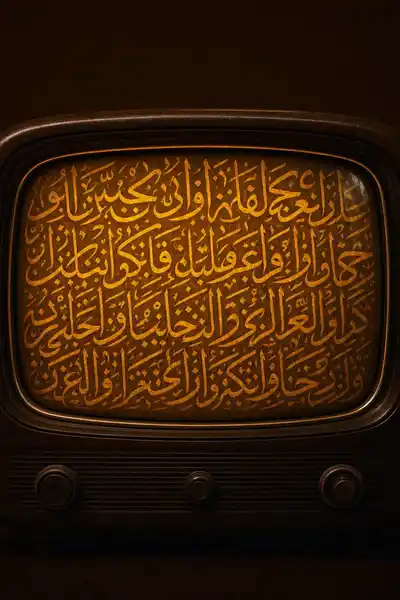
In November 1979, a crowd stormed the U.S. embassy in Tehran and took fifty-two Americans hostage, and for four hundred and forty-four days American television had a nightly subject. The networks ran countdown clocks. Anchors said the word "Islam" the way one might say a weather front moving in from somewhere unmapped. Edward Said, a literature professor at Columbia who had grown up between Jerusalem, Cairo and the United States, watched the coverage with a particular unease. He knew the region the cameras were pointing at, and he barely recognized it.
Out of that unease came a short, angry, precise book. Covering Islam appeared in 1981, the third panel of a trilogy that had begun with Orientalism, and its title carried a deliberate double meaning. The press was covering Islam the way it covers an election or a fire. It was also covering Islam the way a lid covers a pot — sealing it off, keeping the contents from view. Said argued that the vast machinery of American reporting and expertise, aimed for years at one fifth of humanity, had produced something closer to a caricature than a picture.
The charge was not that journalists were lazy or that individual correspondents lied. It was subtler and harder to shake: that a whole way of knowing had settled into place, one in which "Islam" became a single thing that explained everything and therefore explained nothing. The book asks how a society that prized information had managed to be so consistently, so confidently wrong about a subject it discussed every night.
The question we’re asking : How did the American press and its experts manage to talk about Islam constantly and understand it almost not at all?What we’ll see : How a loaded word, a class of on-call experts, and one televised crisis combined to seal off a fifth of the world from the people watching it.
Table of contents
01 Chapter 1 — A word that stopped explaining anything
Said begins with the word itself. "Islam," as it circulated in American newspapers and broadcasts around 1980, was doing an extraordinary amount of work. It named a religion of roughly eight hundred million people spread across dozens of countries, languages and political systems — and it was being used to explain a hostage crisis in Iran, a war in Lebanon, oil prices, the behavior of the Saudi monarchy and the mood of a Cairo street, often in the same bulletin. No comparable shorthand, he notes, would ever be tolerated for "Christianity" or "the West." Nobody explained an American recession by invoking the Sermon on the Mount.
The trouble is that the label pretends to be neutral while carrying a whole freight of assumption. To say a bombing happened "in the name of Islam" is to imply that the religion is the cause, that its adherents are moved by it in some uniform and slightly irrational way, and that a fourteen-century-old faith is the natural key to a very recent, very local political event. Said calls this a kind of magical thinking dressed as analysis. The word floats free of any particular fact and settles wherever the coverage needs a cause.

02 Chapter 2 — The expert who was always available
If the word did the framing, someone had to supply the authority behind it. Said turns to the figure the networks reached for whenever the region flared up: the expert. In principle, expertise should be the corrective to caricature. In practice, he argues, a particular kind of expert had grown up in symbiosis with the media and the government, and his usefulness depended precisely on confirming what everyone already believed.
The expert Said has in mind is not the patient scholar of Persian poetry but the man who can be reached by phone before the evening broadcast and will say something quotable about "the Islamic mind." His credentials are real; his incentives are the problem. He is invited back when his analysis fits the policy mood and the news cycle, and quietly dropped when it complicates them. Over time this selects for a certain reassuring confidence — the ability to pronounce on a fifth of humanity in ninety seconds without hesitation or qualification.
03 Chapter 3 — Iran, live and misread
The Iranian revolution and the hostage crisis are the book's central case, because they were covered more intensely than almost any foreign story before them and covered, in Said's reading, almost entirely wrong. When the Shah fell and Ayatollah Khomeini returned from exile in early 1979, American reporting was caught flat. The Shah had been a client, praised for years as a modernizer; his sudden collapse could only be narrated as chaos, as a slide backward into medieval fanaticism, because the frame had no slot for a modern revolution carried in religious language.
So the coverage reached for the mask it had ready: Islam resurgent, reason in retreat, a whole nation seized by irrational hatred of America. Said does not deny that the revolution was harsh or that the hostage-taking was a genuine outrage. His point is that the reporting substituted a single explanation — religious fanaticism — for the tangled, knowable reasons a country might feel that way: decades of American backing for a repressive monarch, the 1953 coup that had toppled an elected government, a secret police trained with Western help. These facts were available. They were mostly absent from the screen.
04 Chapter 4 — The knowledge that already knew its answer
Step back from Tehran and the deeper claim comes into focus. Said's real target is the comfortable idea that there is such a thing as neutral knowledge about Islam — reporting and scholarship that simply transmit the facts, untouched by who is paying, who is asking, and what the answer is expected to serve. There is no view from nowhere, he argues. All knowledge about other societies is produced by someone, situated somewhere, in a particular relation of power to the thing being known.
This does not collapse into the lazy conclusion that everything is bias and nothing can be trusted. Said's position is more demanding. He distinguishes between interpretation that hides its interests behind a mask of objectivity and interpretation that openly declares where it stands, what it can see and what it cannot. The first kind is the more dangerous, precisely because it presents a partial, interested picture as the plain truth. Honest knowledge about Islam would begin by admitting it is knowledge held by outsiders, with stakes, and would treat the people it describes as capable of speaking back.
05 Conclusion
The countdown clock stopped in January 1981, when the hostages came home, and the intense American attention to Iran drifted elsewhere. But the apparatus Said had dissected did not go away. The word kept doing its work; the experts kept their phones on; the frame waited for the next flare-up to point it through. Covering Islam is, in that sense, less a book about one crisis than a description of a habit of seeing — one that outlived the events that occasioned it and has recognizably survived into every decade since.
Related books