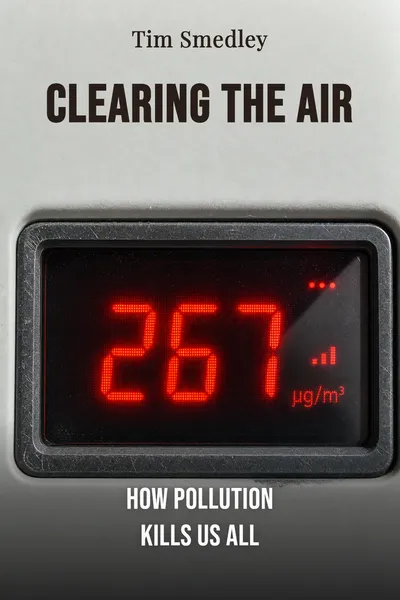
Clearing The Air
How pollution kills us all
Description
Tim Smedley, an environmental journalist, spent several years doing something most of us never do on purpose: paying attention to the air. He carried monitors through Delhi, London, Beijing and Los Angeles, watched the numbers spike on a school run or beside a diesel bus, and turned what he found into a 2019 book called Clearing the Air. The premise is disarmingly simple. The air is not a neutral backdrop to our lives. It is a substance we consume roughly twenty thousand times a day, and in most of the world it is contaminated with things that shorten the lives of the people breathing it.
The scale is hard to hold in the head. The World Health Organization has estimated that outdoor and indoor air pollution together are linked to around seven million premature deaths a year — more than road accidents and malaria combined. And unlike most public health crises, this one has no opt-out. We can change what we eat and whether we smoke. We cannot, day to day, decide not to breathe. Smedley's book keeps returning to that fact, because it is the reason air pollution is both the most democratic killer we have and the easiest one to ignore.
What makes Clearing the Air more than a catalogue of alarming statistics is Smedley's refusal to end on despair. He tracks the tiny particles into the bloodstream, follows the money into the industries that resisted cleanup, and then does something the genre rarely bothers with: he goes looking for the places that fixed it. There are cities on the map that used to look like Delhi and no longer do, and their stories are the spine of the argument.
The question we’re asking : If the air is killing us on a scale that rivals our worst diseases, why does it stay so invisible — and can anything actually clear it?What we’ll see : How a substance we never think about turns out to be measurable, harmful, defended by powerful interests, and, in a handful of real places, already cleaned up.
Table of contents
01 Chapter 1 — The thing we breathe without noticing
Smedley's book opens with a personal jolt, the kind that reframes an abstraction into something bodily. He describes becoming a father and starting to wonder, with a new and slightly obsessive attention, what exactly his children were inhaling on the walk to nursery. The honest answer was that he had no idea, and neither did most people. Air pollution had drifted out of the public mind since the great visible smogs of the mid-twentieth century, precisely because the modern version is harder to see. The killer today is often colourless and odourless, which is a large part of why it kills so quietly.
The villain that recurs throughout is a category called particulate matter, and in particular the fraction known as PM2.5 — particles smaller than 2.5 micrometres across, roughly thirty times finer than a human hair. Size is everything here. Larger particles get caught in the nose and throat; PM2.5 is small enough to travel deep into the lungs, and the finer particles cross into the bloodstream itself. These come from combustion of nearly every kind: diesel engines, coal power, wood burners, industrial furnaces, and the friction of tyres and brakes. Alongside them sit gases like nitrogen dioxide, much of it from the diesel vehicles that European governments once actively encouraged.

02 Chapter 2 — What the particles actually do inside us
Once the particles are inside, the story gets more disturbing, and Smedley walks through the medical research with the care of someone who knows the numbers will do the persuading. For a long time air pollution was understood as a respiratory problem — asthma, bronchitis, the wheeze of a bad-air day. That framing turned out to be far too narrow. PM2.5 that crosses from the lungs into the blood triggers inflammation throughout the body, and inflammation is implicated in a startling range of conditions that have nothing obvious to do with breathing.
The heart is the biggest surprise. A large share of pollution-linked deaths are cardiovascular — heart attacks and strokes rather than lung failure. The fine particles appear to thicken the blood, stiffen arteries and destabilise the fatty plaques that cause heart attacks. Smedley reports the research linking exposure to higher rates of diabetes, low birth weight, and premature births, as the particles reach even the placenta. Perhaps the most unsettling thread concerns the brain: studies he cites associate long-term exposure with cognitive decline and dementia, and researchers have found the same magnetic particles from combustion lodged in human brain tissue.
03 Chapter 3 — The industries that kept the air dirty
If clean air is achievable, the obvious question is why it has taken so long, and here Smedley follows the money. A recurring case in the book is diesel, and specifically the way European policy talked itself into a disaster. In the effort to cut carbon dioxide and hit climate targets, governments across Europe spent years encouraging drivers into diesel cars through favourable taxes, on the grounds that diesel burns more efficiently. The trade-off was buried: diesel engines emit far more nitrogen dioxide and fine particles. A well-meaning climate policy quietly worsened the air people breathed in cities every day.
Then came the moment that crystallised the whole dynamic. In 2015, Volkswagen was caught fitting so-called defeat devices to millions of diesel vehicles — software that detected when a car was being tested and switched on the emissions controls, then switched them off on the open road, where the cars pumped out many times the legal limit of nitrogen oxides. Smedley uses the scandal not as a tale of one rogue company but as evidence of a deeper pattern: an industry that treated the regulated limits as an obstacle to be gamed rather than a public health floor to be respected.
04 Chapter 4 — The cities that decided to breathe again
Having laid out the harm and the resistance, Smedley makes the move that gives the book its argument rather than just its warning: he goes to the places that succeeded. London's own history is his first exhibit. The Great Smog of December 1952 killed thousands of people in a matter of days, and the shock produced the Clean Air Act of 1956, which shifted the city off coal fires and cleared the pea-souper smogs that had defined it for a century. Dirty air, in other words, was never a law of nature. It was a decision, and it could be un-decided.
The modern examples are the heart of it. Beijing, whose air became a global symbol of toxicity, cut its PM2.5 levels dramatically over a few years through sheer regulatory force — closing coal plants, controlling traffic, relocating industry. It is far from clean, but the improvement was real and fast enough to surprise the sceptics. Smedley points to cities that reclaimed streets from cars: to congestion charging, low-emission zones, and the quieter revolution of walking and cycling infrastructure. The recurring lesson is that the effective tools are unglamorous and already exist. What varies is the political will to use them.
05 Conclusion
Smedley ends roughly where he began, with a father watching his children breathe, but the anxiety has hardened into something more like a demand. The evidence he assembles is unambiguous: the air in most of the world carries particles that reach our hearts, our blood and our brains, and it does so most heavily to those least able to escape it. Yet the same book that documents seven million deaths a year also documents London after 1956, Beijing after its crackdown, and street after street reclaimed from the exhaust pipe. The harm is real, and the remedy is proven.
Related books