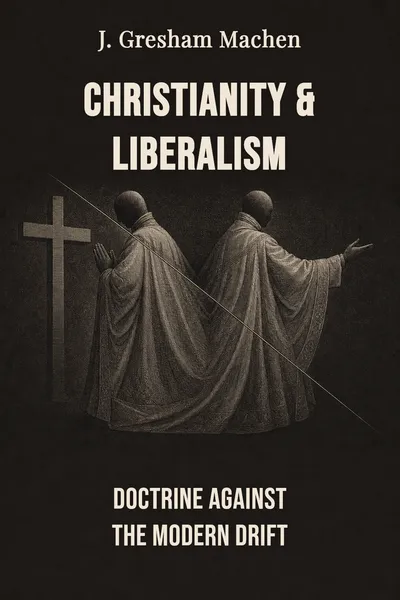
Christianity & Liberalism
Doctrine against the modern drift
Description
In 1923, a New Testament scholar at Princeton Theological Seminary named J. Gresham Machen published a short, hard-edged book with a title that sounded like a partnership: Christianity and Liberalism. Machen was in his early forties, trained in Germany, fluent in the modern critical scholarship that was then reshaping how Protestant seminaries read their own scriptures. He was not an outsider throwing stones at ideas he had never met. He had sat in the lecture halls where those ideas were taught, and he knew exactly how attractive they were to a generation that wanted its faith to feel at home in the twentieth century.
The word liberalism in his title did not mean politics. It meant a movement inside the churches — the effort to keep Christianity while quietly setting aside the supernatural parts that modern people found hard to believe: the virgin birth, the miracles, the bodily resurrection, the idea that Christ's death actually paid for sin. The liberals of Machen's day presented this as saving the faith, translating it for a scientific age, keeping the spirit while shedding the outdated shell. Machen looked at the result and drew a conclusion that made him few friends: what was left was not a modern version of Christianity. It was a different religion wearing Christian clothes.
That is the whole provocation of the book, and it has kept the book alive for a century. Machen was not interested in whether liberalism was nice, or reasonable, or well-meaning — he granted that it was often all three. He was interested in whether it was the same thing. And he thought the honest answer, the one that respected everyone involved, was no.
The question we’re asking : When a faith keeps its old vocabulary but empties out its old claims, is it still the same faith, or a new one hiding behind familiar words?What we’ll see : How Machen sets orthodoxy and liberalism against each other point by point — over doctrine, scripture, and Christ — and why he thought the kindest move was to call the disagreement what it was.
Table of contents
01 Chapter 1 — Two religions under one name
Machen's opening move is the one everything else hangs on. The modern world, he grants, has produced extraordinary things — the sciences, the machines, the comforts. But it has also produced a flattening of thought, a preference for the vague and the practical over the precise and the doctrinal. And into that mood, liberalism arrived with a soothing offer: religion is not really about beliefs at all. It is about a feeling, an experience, a way of living. Doctrine is the husk; the life is the kernel. Keep the life, drop the arguing over creeds, and Christianity can survive anything the modern age throws at it.
Machen's answer is that this gets Christianity exactly backward. Christianity, he insists, is founded not on a program for living but on an account of something that happened — that God acted, in history, in the death and resurrection of Jesus. Strip out the claim about what happened and you have not purified the religion, you have abolished it. The 'life' the liberals wanted to keep grew out of the doctrine they wanted to discard; cut the root and the flower does not become freer, it dies. A Christianity that is only ethics is, in his phrase, a Christianity without a gospel — good news that reports no event.

02 Chapter 2 — The Bible, and what a fact costs
The split runs first through the Bible, and it runs deeper than the old caricature of literalists versus skeptics. For the liberal, Machen observes, scripture is a record of religious experience — the noble, uneven, sometimes mistaken groping of ancient people toward God. Its value is inspirational; its authority is that of any great literature that lifts the spirit. Errors of history or science do not trouble this view, because the Bible was never meant to deliver facts. It was meant to deliver a mood, a heritage, a sense of the divine.
For orthodoxy, Machen says, the Bible does something a mood cannot do: it reports. It claims that certain things are true — that Christ rose, that his death dealt with sin — and if those things did not happen, no amount of uplift can substitute. Here he draws his sharpest distinction between the two systems. Liberalism, he argues, is a religion of general principles, of truths about God and goodness that are supposedly always available to any thoughtful person. Christianity is a religion of a particular event: something occurred at one time, in one place, that would otherwise not be known at all. Take away the event and the principles that survive were never distinctively Christian to begin with.
03 Chapter 3 — A Christ who saves, or a teacher who inspires
The disagreement reaches its center at the person of Christ, and again Machen shows that a shared name conceals a chasm. Liberalism, he grants, honored Jesus — often more warmly than orthodoxy did. But it honored him as the supreme religious personality, the man whose faith in God was so pure that he becomes our example and our inspiration. The liberal Jesus is a figure to imitate: we look at his trust, his love, his courage, and we try to live as he lived. He is the great teacher of a way, the pioneer of the God-conscious life.
Orthodoxy, Machen argues, does not primarily imitate Jesus at all. It trusts in him. The difference is the whole matter. In the liberal picture, Jesus has faith and we copy it; in the Christian picture, Jesus is the object of faith — not a man whose religion we share but a Savior in whom we believe. One offers an example, the other offers a rescue. And a man who only sets an example, however perfect, cannot help a person who has already failed to follow it. The gospel, on Machen's reading, is not advice about how to live but news about what has been done for people who could not.
04 Chapter 4 — The line Machen refused to blur
Step back from the individual arguments and the striking thing about Machen is what he does with disagreement itself. The pressure of his moment, and arguably of ours, was to smooth conflict over — to say that orthodox and liberal believers were fellow travelers with different emphases, that the differences were matters of temperament, that unity mattered more than definition. Machen thought that move, however kindly meant, was a kind of dishonesty. To call two different things by one name is not tolerance. It is confusion dressed up as generosity, and it cheats everyone by denying them a real choice.
His book is, at bottom, an argument for the dignity of a genuine distinction. He would rather two people know precisely where they part and respect each other across that line than pretend the line is not there. This is why he keeps insisting that liberalism, whatever its merits, should stop borrowing the Christian name — not out of spite, but because a movement confident in its own convictions ought to state them plainly rather than trade on the authority of a tradition it has left behind. Clarity, for Machen, was the courteous thing. Vagueness was the insult.
05 Conclusion
Machen lost the institutional fight he was in. Within a decade of the book, the tensions it named would push him out of Princeton and into founding a new seminary and, eventually, a new denomination; he died in 1937, worn down and, by the measures of church politics, defeated. But the book did not go with him. It has stayed in print for a century because it did something rare in a controversy: it refused the easy peace. It insisted that the two sides were not quarreling cousins but strangers, and it laid out the case term by term — God, the Bible, Christ, salvation, the church — so that a reader could see the fork in the road rather than a family squabble.
Related books