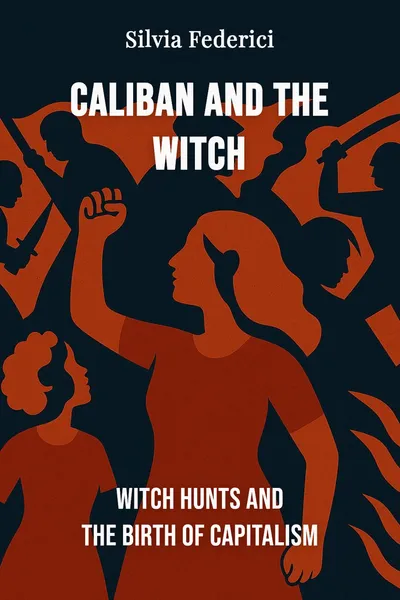
Caliban and the Witch
Witch hunts and the birth of capitalism
Description
Between roughly 1450 and 1750, tens of thousands of people across Europe were tried for witchcraft, and most of the ones who were burned, hanged, or drowned were women. The standard story treats this as a spasm of superstition — a medieval hangover of ignorance and fear that the modern world eventually outgrew. Silvia Federici, an Italian-American scholar writing in "Caliban and the Witch" in 2004, refuses that framing entirely. The witch hunts, she argues, did not peak in the dark ages. They peaked exactly when Europe was inventing the economic system we still live inside.
Her claim is deliberately jarring. The centuries of the trials are also the centuries of the enclosures — when common land was fenced off and the peasants who had lived on it were pushed into wage labor. They are the centuries of the first factories, the first colonial plantations, the first systematic attempts to treat human labor as a resource to be measured and squeezed. Federici's book insists these things belong together. Reading Marx against the grain and pulling in the historians he ignored, she treats the persecution of women as a chapter in economic history, not a footnote to religious history.
The book takes its title from Shakespeare's Tempest — Caliban the rebellious servant, and the witch Sycorax whose power the play erases. Federici uses the pairing to name what she thinks the birth of capitalism required: the disciplining of the body that works, and the subjugation of the body that reproduces the worker. It is an argument that changes what the fire in the town square was actually for.
The question we’re asking : Why did Europe's most intense witch hunts happen at the exact moment capitalism was being born, and what were they really doing?What we’ll see : How enclosure, the reordering of work, and the war on women's bodies were, in Federici's reading, one connected process — with a cost that never quite ended.
Table of contents
01Chapter 1 — The transition nobody puts in the textbooks
Federici starts by picking a fight with the way the shift from feudalism to capitalism usually gets told. In the classic version, including Marx's own, capitalism arrives through what he called primitive accumulation — the violent early phase when peasants were stripped of their land and turned into workers with nothing to sell but their labor. Marx focused on the enclosures in England, the plundering of colonies, the theft of common resources. Federici accepts all of this and then asks the question he left hanging: if you separate people from the land, who feeds, births, and raises the next generation of workers, and under what terms?
The enclosures were brutal and concrete. Across the fifteenth and sixteenth centuries, land that villages had used collectively — for grazing, gathering wood, growing food — was fenced off and privatized. The commons had been a safety net, and for women especially it had been a source of independence: widows and single women could survive on shared land without a husband's wage. Enclosure removed that floor. It pushed the rural poor toward wage work in towns, and it made the family, rather than the village, the unit that had to absorb everyone the new economy could not directly employ.

02Chapter 2 — The body becomes a machine, and the woman its engine
The early capitalist period was obsessed with the body — with making it regular, productive, and controllable. Federici draws on Foucault here but pushes past him, arguing that he described the disciplining of bodies without noticing that it fell unequally on women. The new economy needed a workforce that showed up on time, worked to the clock, and reproduced itself reliably. That meant the body could no longer be left to its own rhythms. It had to be turned, in effect, into a machine for producing labor — the worker's body for the factory, the woman's body for the worker.
The most direct evidence is demographic panic. Europe's population had been devastated by plague and by the crises of the fourteenth and fifteenth centuries, and elites feared there would not be enough workers or soldiers. In response, across the sixteenth and seventeenth centuries, a wave of laws recast reproduction as a matter of state. Contraception and abortion, which had often been women's own knowledge, were criminalized with new severity. Infanticide was prosecuted with a ferocity it had never had before. Midwives — women who had controlled birth and knew how to manage it — were pushed aside by a male medical profession and, in many places, actively suspected.
03Chapter 3 — The witch as the enemy capitalism needed
The great European witch hunts were not a medieval relic. Their most intense decades ran from roughly the 1560s to the 1660s — the heart of the period Federici is describing. That timing is her strongest card. The trials clustered in the very regions and years where the old collective economy was being torn apart and the new one imposed. Estimates of the dead vary widely and honest historians keep them uncertain, but the tens of thousands executed were overwhelmingly women, and often poor women: widows, beggars, healers, the old and the landless.
Look at who was accused, Federici says, and a pattern emerges that superstition alone cannot explain. The typical target was a woman on the margins of the new order — dependent on charity the enclosures had made scarce, or holding knowledge the new professions wanted to monopolize, or simply refusing to be governed. The accusations themselves are telling: witches were charged with making men impotent, with causing miscarriages, with killing infants, with blighting crops and cattle. They were charged, in other words, with attacks on exactly the fertility — of women, of fields, of the workforce — that the new economy was desperate to secure.
04Chapter 4 — What the trials built that never went away
Step back from the fires and the question Federici's book leaves us with is larger than the trials themselves. If the persecution of women was woven into the founding of capitalism, then the exploitation of women's unpaid labor is not a leftover from an older, more sexist world that the market will eventually modernize away. It is part of the foundation the market was built on. That reframing is the real payload of the book, and it explains why she reached back four centuries to make a point about the present.
The enclosures fenced off the land and called it private property. Federici's argument is that something similar happened to women's bodies. The reproductive labor that had once been embedded in the shared life of the village — birth, care, feeding, healing — was enclosed too: pulled out of the commons, stripped of the knowledge that had made women its stewards, and turned into a resource the new economy could draw on without paying. Women's capacity to produce and sustain life became, in effect, a new commons — one the system could tap for free, indefinitely, because it had been redefined as nature rather than work.
05Conclusion
Federici wrote "Caliban and the Witch" out of the feminist movements of the 1970s, when activists around the campaign for wages for housework were already insisting that unpaid domestic labor was the hidden ground beneath the visible economy. The book gave that intuition a history. It reached back to the enclosures and the trials to argue that the invisibility of women's work was not an accident or an oversight — it was manufactured, deliberately and violently, at the moment the modern economy took shape.
Related books