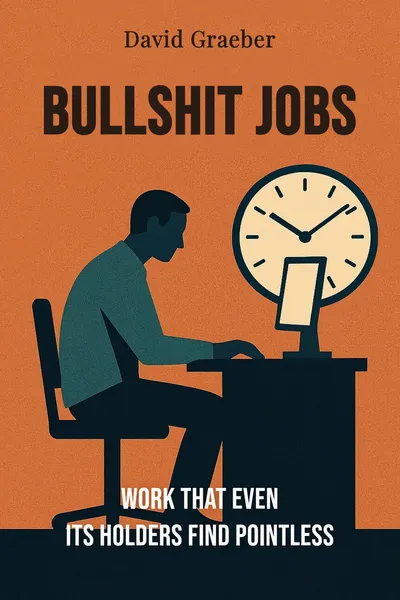
Bullshit Jobs
Work that even its holders find pointless
Description
In the summer of 2013, an anthropologist named David Graeber wrote a short, irritated essay for a small radical magazine called Strike!. Its title asked a blunt question: why, if technology has made us so productive, are we all still working forty-hour weeks? Keynes had predicted back in 1930 that his grandchildren would work fifteen-hour weeks by the century's end. The prediction was, in a narrow sense, achievable. We got the productivity. We just didn't get the leisure. Graeber's answer was that a whole category of work had quietly expanded to fill the gap — work that produces nothing, that its own holders privately suspect should not exist.
The essay was meant to be a provocation, not a study. It went viral instead. The Strike! website crashed under the traffic. Within weeks it had been translated into more than a dozen languages, pinned up in office kitchens, and passed around by people who felt, reading it, that someone had finally named the thing eating their days. In 2015 a polling firm asked British workers a version of Graeber's question directly: did their job make a meaningful contribution to the world? Thirty-seven percent said no. Another thirteen percent weren't sure.
Five years after the essay, Graeber turned it into a full book, built partly on hundreds of testimonies sent to him by people describing, sometimes with relief and sometimes with shame, the elaborate nothing they were paid to do. The result is less a management critique than an anthropology of a strange modern suffering: being trapped inside a job you cannot justify, in an economy that supposedly has no room for waste.
The question we’re asking : If the market punishes waste, why does it keep inventing jobs that even the people doing them believe are pointless?What we’ll see : How Graeber names this work, sorts it into kinds, traces the private damage it does, and asks what it reveals about what work is actually for.
Table of contents
01 Chapter 1 — The email that started it
Graeber is careful, early on, to say what he does not mean. A bullshit job is not simply a bad job, a badly paid job, or a degrading one. Cleaners, nurses, bus drivers, care workers — the people whose absence we notice within hours — have hard and often poorly rewarded jobs, but nobody doubts the work is real. His category is stranger and almost the reverse. A bullshit job, in his definition, is one so completely pointless that even the person holding it cannot justify its existence, though the terms of employment oblige them to pretend otherwise.
That last clause is the whole argument. Graeber's evidence is not a manager's audit or an economist's model. It is the private verdict of the worker. He is not walking through offices declaring which jobs are useless; he is collecting the testimonies of people who have concluded, quietly and on their own, that if their position vanished tomorrow the world would be no worse off, and possibly a little better. The judge is the one being judged.

02 Chapter 2 — Five ways to be paid for nothing
Out of the testimonies, Graeber builds a taxonomy — five species of pointless work, sorted not by industry but by the specific kind of nothing each one performs. The first he calls flunkies. These exist mainly to make someone else look important. Receptionists at firms that get almost no visitors, assistants to assistants, whole layers of staff whose presence signals a superior's status. A boss with an entourage matters more than a boss without one, so the entourage is hired, and the entourage sits.
The second species he names goons, using the word loosely for jobs that exist only because rival organizations have them too. Corporate lobbyists, telemarketers, much of PR, whole armies of brand managers. Graeber's point is not that these people are aggressive but that their work is purely defensive and mutually cancelling: a company needs its lobbyists only because competitors have theirs, and if all sides disarmed nothing of value would be lost.
03 Chapter 3 — The wound nobody talks about
Graeber's most original stretch is not the taxonomy but what he does with it: he takes the misery seriously. We assume that being paid decently to do very little is a fantasy — the dream of getting away with it. The testimonies say otherwise. Again and again, people describe pointless work as one of the more corrosive experiences of their lives, producing anxiety, depression, a strange psychosomatic ache, and a shame they could barely explain to friends who envied their easy salaries.
To make sense of this, Graeber reaches back to a body of psychology about agency. Experiments as far back as the 1970s, with young children, found that being able to produce a visible effect on the world is a source of deep satisfaction in its own right — and that when an effect a child had learned to cause is suddenly denied, the reaction is not boredom but something closer to rage and withdrawal. Being able to act meaningfully on the world, Graeber argues, is close to the core of what it feels like to be a self. A bullshit job attacks exactly there.
04 Chapter 4 — Why a market that hates waste keeps making it
Here Graeber presses the question the whole book has been circling. Economists have a ready reply to inefficiency in the public sector: bloat is what you get without competition. But bullshit jobs flourish inside private firms, ferociously competitive ones, whose entire ideology is the elimination of waste. A profit-seeking company that pays people to do nothing should, in theory, be outcompeted by a leaner rival. The lean rival mostly never arrives. Whole industries have added administrative layers for decades while insisting they were cutting fat.
His explanation refuses the easy exits. This is not simple inefficiency, and it is not quite a conspiracy. It is closer to what he calls managerial feudalism: an economic order that increasingly distributes not goods but status, loyalty, and hierarchy. Executives are rewarded, socially and financially, for the size of the retinue beneath them. Political and economic elites, meanwhile, have little interest in a genuinely liberated, under-employed population. A workforce with time on its hands is a workforce with time to think, organize, make trouble. Full, exhausting employment is more governable than freedom.
05 Conclusion
The book ends where the essay began, with Keynes's broken promise. We reached the productivity that should have bought us leisure and spent it, instead, on inventing work. Graeber's answer to his own opening question is not that some cabal engineered this, but that a whole civilization decided a life without visible toil could not be a respectable life — and then built an economy loyal to that belief rather than to the efficiency it claims to worship. The flunkies and box tickers are what that loyalty looks like from the inside.
Related books