

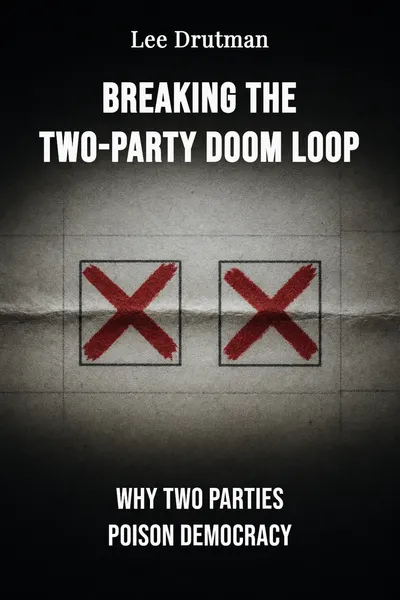
Breaking the Two-Party Doom Loop
Why two parties poison democracy
Description
In the spring of 2020, a political scientist at the New America think tank named Lee Drutman published a book with a title that sounded almost cartoonish for a work of institutional analysis: Breaking the Two-Party Doom Loop. The phrase stuck because it named something a lot of Americans felt without a vocabulary for it — the sense that politics had become a machine that only knew how to make itself worse. Every election raised the stakes, every side treated the other as an existential threat, and the system seemed to have no gear for cooperation, only for escalation.
Drutman's argument is that this is not an accident of personality or a bad decade. It is a structural condition, and its root is a number: two. The United States runs on a rigid two-party system that most Americans treat as a fact of nature, roughly as permanent as the Constitution itself. But Drutman, who spent years studying lobbying, Congress, and the plumbing of American elections, argues that two parties competing in a country this large and diverse produce a predictable outcome — a binary contest that curdles, over time, into tribal warfare.
What makes the book more than a complaint is where it goes next. Drutman is not content to describe the dysfunction and sigh. He treats the doom loop as an engineering problem with an engineering solution, and he looks abroad, and backward into American history, for evidence that the loop is not inevitable at all. The provocation is that the fix might be less exotic than it sounds.
The question we’re asking : Why does a country running on two parties keep sliding toward paralysis and mutual contempt — and is the number the actual cause?What we’ll see : How a binary contest turns diverse disagreement into tribal warfare, and why Drutman thinks the way out runs through the machinery of elections rather than better people.
Table of contents
01Chapter 1 — The trap America built for itself
Drutman starts from a diagnosis that reframes the whole conversation. When we talk about polarization, we usually reach for explanations rooted in people — cable news, social media, cynical politicians, a coarsening culture. Those things matter, but Drutman argues they are accelerants, not the fuel. The fuel is the structure: a system in which almost every meaningful contest comes down to one of two teams. In that arrangement, politics stops being an argument among many positions and becomes a war between two sides, where every issue gets sorted onto one team or the other until there is nothing left to negotiate over.
The mechanism he describes is what political scientists call binary sorting. A generation ago, the two American parties were sprawling, incoherent coalitions — there were liberal Republicans in the Northeast and conservative Democrats across the South, and that messiness, oddly, was a feature. It meant the two parties overlapped, that a member of one could find allies in the other, that coalitions had to be rebuilt issue by issue. Over the second half of the twentieth century, that overlap disappeared. The parties sorted cleanly by ideology, geography, and eventually identity, until they lined up as two tidy, opposing armies.

02Chapter 2 — How two became a war of two
To make the case that two is the problem, Drutman spends real time on how America ended up locked into exactly two. Nothing in the Constitution mandates two parties; the founders famously distrusted parties altogether. What produces the number is the electoral machinery underneath — above all, the single-member district with winner-take-all rules. When a seat goes to whoever gets the most votes and everyone else gets nothing, voters learn quickly that backing a third choice wastes their vote, and the field collapses toward two viable contenders. Political scientists have a name for this tendency, Duverger's law, and Drutman leans on it heavily.
The deeper point is that this machinery interacts badly with a genuinely diverse country. America is not naturally a two-camp society; it holds a wide spread of views on economics, culture, religion, and national identity that do not fold neatly into two boxes. But the two-party structure forces them to fold anyway. People with very different priorities get packed into the same coalition and told to see the other coalition as the enemy. The result is that the two parties come to feel less like political programs and more like rival identities, almost rival nations sharing a border.
03Chapter 3 — The math that keeps everyone stuck
Having diagnosed the disease, Drutman turns to why it resists ordinary cures. The usual reform proposals — calls for civility, better candidates, campaign-finance limits, appeals to bipartisanship — leave the underlying math untouched. As long as there are two teams and control flips on razor-thin margins, the incentive to treat the other side as an enemy remains rational. You cannot moralize your way out of a structural trap; the players are responding sensibly to the game they are in.
This is where the comparative evidence enters. Drutman looks at other wealthy democracies and notices that many of them run on more than two parties, and that they tend to escape the worst of the binary spiral. In a multiparty system, no single opponent is the enemy, because today's rival on one issue is tomorrow's coalition partner on another. Governing means assembling shifting alliances, which keeps lines of communication open across the whole field. Losing an election is survivable, because your party still exists, still holds seats, still bargains. The stakes come down because power is shared rather than seized whole.
04Chapter 4 — When two parties stop being enough
Step back from the specific reforms and Drutman's book is making a larger claim about how we think of our own political system. Most Americans treat the two-party arrangement as part of the constitutional furniture — inherited, sacred, roughly as fixed as the three branches of government. Drutman's whole framing insists that it is nothing of the kind. The number of parties is a downstream consequence of electoral rules, and electoral rules are choices. They can be examined, questioned, and redesigned, the way you would redesign any piece of infrastructure that had stopped doing its job.
That reframing matters because it moves the conversation from character to design. If polarization is a failure of virtue, the only remedies are exhortation and despair — be better, or give up. If polarization is a failure of design, it becomes a solvable problem, the domain of engineers rather than preachers. Drutman is asking us to look at democracy the way we look at plumbing or traffic flow: not as an expression of national soul, but as a system with inputs and outputs that can be tuned. The doom loop is what the current system is built to produce, so the honest response is to rebuild the system.
05Conclusion
Breaking the Two-Party Doom Loop lands on a paradox that runs through the whole book. The feature Americans are proudest of — the clean, decisive, two-party contest — is, in Drutman's telling, the very thing pulling the country apart. The binary that once looked like clarity now functions as a trap, sorting a sprawling and disagreeing nation into two hostile camps and then rewarding them for the hostility. The loop tightens on its own, and no amount of goodwill loosens it, because goodwill was never the missing ingredient.