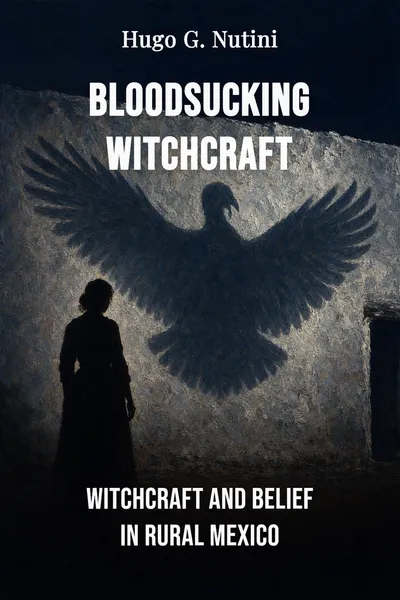
Bloodsucking Witchcraft
Witchcraft and belief in rural Mexico
Description
In the rural municipalities of Tlaxcala, a small highland state east of Mexico City, a woman found her infant dead in its crib one morning, the skin bruised around the neck, the body drained of color. The family did not reach for illness or accident as the explanation. They reached for the tlahuelpuchi — a bloodsucking witch, human by day, who takes animal form at night and feeds on the blood of babies. Between the 1960s and the 1980s, the anthropologist Hugo G. Nutini and his collaborators recorded dozens of such deaths in these communities, each attributed with striking consistency to the same nocturnal figure.
Nutini spent decades in the region, and the book he built from that fieldwork, Bloodsucking Witchcraft, is not a collection of eerie folktales. It is a patient anatomy of a living belief. He treats the tlahuelpuchi the way one might treat any social institution: mapping who is suspected, how a death is diagnosed, what the family does with the tiny corpse, and how the whole apparatus of dread and ritual holds a community together. The witch, in his account, is real — not as a creature of the night, but as a fact of social life that shapes how people grieve, suspect, and protect one another.
What makes the study more than a regional curiosity is Nutini's insistence that this belief is neither a leftover to be pitied nor a superstition on its way out. It is a coherent worldview, layered from Mesoamerican and Iberian sources, doing real work in the present. To take it seriously as anthropology means asking what the belief accomplishes for the people who hold it.
The question we’re asking : How does belief in a bloodsucking witch actually function inside the communities that hold it, and what does its persistence reveal?What we’ll see : A fieldwork account of a living supernatural belief in rural Mexico — its origins, its logic, its social uses, and what it tells us about folk religion under pressure.
Table of contents
01 Chapter 1 — The tlahuelpuchi comes at night
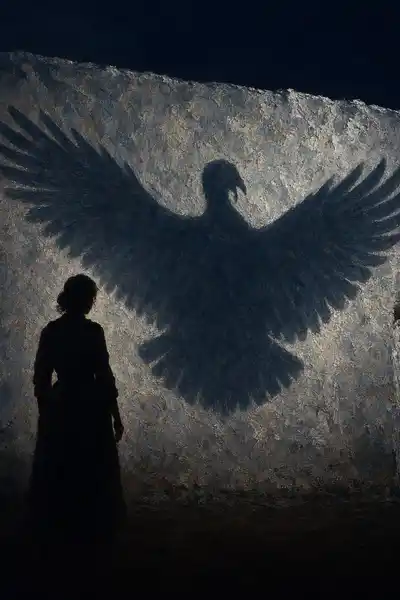
The tlahuelpuchi, in the accounts Nutini gathered, is not a distant monster but a neighbor. She is a person — most often a woman — born with the affliction rather than choosing it, condemned to hunt human blood, and especially the blood of infants, once a month or she will herself weaken and die. By daylight she lives an ordinary life in the village. At night she detaches her legs, or takes the form of a turkey, a buzzard, a flea, a cat, and glides toward the house where a baby sleeps. A luminous glow is said to trail her flight across the fields.
The victims are almost always very young. Nutini's records concentrate the deaths in the first months of life, and the diagnosis follows a recognizable pattern: an infant found lifeless in the morning, bruising at the neck or chest, sometimes marks read as the print of the witch's mouth. What a coroner would file as sudden infant death, or as suffocation in a shared bed, the community reads through a different and older grammar. The cause is not medical. It is predatory and supernatural, and everyone in the household knows the name of the thing that did it.

02 Chapter 2 — A syncretism four centuries deep
The tlahuelpuchi did not arrive whole. Nutini reads her as a genuine hybrid, a figure assembled over roughly four centuries from two distinct traditions that met at the Spanish conquest. On the Mesoamerican side stand the nahual, the shape-shifting sorcerer of Nahua belief, and older ideas of humans who transform into animals and draw power from the night. On the Iberian side arrives the European witch — the bruja of Spanish folk Catholicism, with her pacts, her flights, her nocturnal malevolence, and her fear-soaked place in colonial religious life.
Neither tradition simply won. Nutini's argument is that they fused into something new, coherent, and specific to central Mexico, with the blood-drinking attack on infants as its sharpest feature. The result carries Catholic elements — the protective saints, the sign of the cross, the moral framing of good and evil — braided into a substrate that predates the friars by centuries. This is what anthropologists mean by syncretism: not a shallow mixing but a deep integration in which the seams eventually disappear and the belief feels, to those who hold it, entirely their own.
03 Chapter 3 — What the community does with a dead infant
The most human part of Nutini's study concerns what happens after a death is attributed to the witch. The event does not stay private. It moves through the extended family and the wider community according to a set of understood responses, and it is here that the belief reveals its social machinery. The grief is real; so is the need to place it somewhere that the bereaved can bear.
One of Nutini's sharpest observations is that the diagnosis protects the parents. An infant who dies in the night, in a household where babies sleep beside adults, could easily invite suspicion — of neglect, of accidental smothering, of a mother's exhaustion. Attributing the death to the tlahuelpuchi lifts that weight. No one is to blame; a supernatural predator struck, as it strikes, and the family are its victims rather than its cause. The belief absorbs guilt that might otherwise fracture a household or a marriage, and it does so quietly, without anyone naming the function out loud.
04 Chapter 4 — The anthropology of a belief that will not die
Step back from the crib and the garlic, and Nutini's tlahuelpuchi becomes an argument about how supernatural belief works in general. His whole method refuses the condescending frame in which such beliefs are errors waiting to be dispelled by education or medicine. He asks instead what the belief does — and once that question is on the table, the witch looks less like ignorance and more like functioning social technology, tuned over centuries to a specific set of human needs.
This is the study's broader contribution to the comparative understanding of folk religion. Beliefs endure, Nutini suggests, not because people cannot access better explanations but because the folk explanation does more work: it names the unnamable, it shields the grieving, it draws moral boundaries, it gives a community a shared script for catastrophe. A germ theory of sudden infant death explains the mechanism but consoles no one and blames the parents. The tlahuelpuchi explains, consoles, and exonerates at once. Measured by what a community actually requires, the older belief can be the more complete.
05 Conclusion
The morning discovery that opens so many of Nutini's case files — a still infant, a family reaching for the name of the witch — is where his long study begins and, in a sense, ends. He never asks us to believe in the tlahuelpuchi. He asks us to see what she holds together: the grief that needs a cause, the parents who need to be spared blame, the community that needs a boundary between the trusted and the suspect. Read that way, the bruise at the neck is a social document as much as a physical one.
Related books