Black Skin, White Masks
Colonialism inside the psyche
Description
In 1952, a twenty-seven-year-old psychiatrist from Martinique published a strange, restless first book. Frantz Fanon had trained in Lyon, treated patients in French hospitals, and read Freud, Hegel, Sartre and Adler the way a doctor reads charts — looking for what is actually wrong with the body in front of him. The body in front of him was his own, and the bodies of everyone he had grown up with in the French Caribbean. The book was called Black Skin, White Masks, and it did not read like a clinical study or a political tract. It read like someone thinking out loud, furious and precise, trying to name a wound that had no name in the textbooks he had been handed.
The wound was this: colonial racism does not stay outside a person. It gets in. A Black man raised inside a French colony grows up absorbing a culture that treats whiteness as the human norm and Blackness as a deviation — in the schoolbooks, the films, the language, the small daily verdicts. He learns to see himself, at least partly, through eyes trained to devalue him. Fanon's claim was that this produces a specific psychic split that no purely individual therapy could resolve, because its cause was not in the patient. Its cause was in the world the patient had to survive.
What Fanon built from that claim is not a comfortable book. It moves between memoir, case notes, philosophy and outright anger, refusing the reassurance that understanding a problem is the same as fixing it. Seventy years later it is read as a founding text of anticolonial thought. But before it was a classic it was a young doctor's attempt to describe something he lived every day and could not find in his training.
The question we’re asking : How does a system of domination lodge itself inside the mind of the person it dominates, and what does the mask cost the one who wears it?What we’ll see : How Fanon traced colonial racism from the street and the schoolroom into the split it leaves in the self — and why he refused to treat that split as a private illness.
Table of contents
01 Chapter 1 — The man who spoke and was not heard
Fanon opens not with theory but with language. In the French Antilles, he observes, a Black man's standing rises in proportion to how well he speaks French — proper metropolitan French, the accent of Paris, cleansed of any Creole trace. To master the colonizer's language is to move closer to being counted as fully human. "To speak," Fanon writes, is to take on a world, a civilization. The language becomes both a ladder and a trap: the more fluently one climbs, the more one has agreed, silently, that one's own tongue was a lesser thing to be left behind.
He watches how this plays out in the smallest interactions. A Black man returns from France having acquired the right vowels, and his neighbors treat the change as an accomplishment. Meanwhile the white speaker, faced with a Black interlocutor, often slides into a simplified, sing-song register — the way one addresses a child. The message is constant: you are not quite an equal partner in this conversation. Fanon catches the humiliation, but also the way the humiliated party can end up policing his own speech, straining to prove he belongs.

02 Chapter 2 — The white mask as a way to breathe
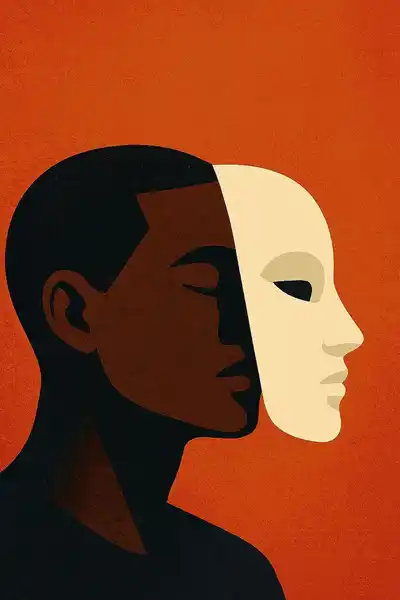
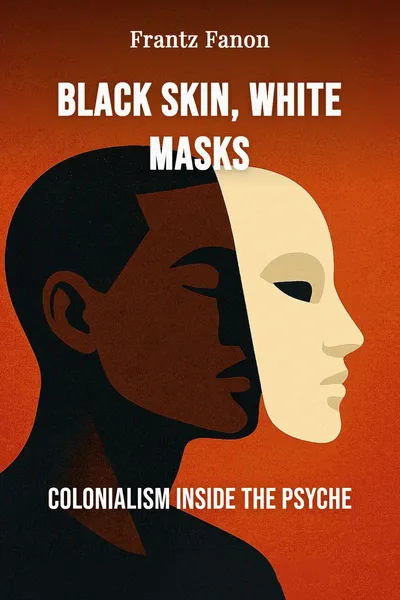
The title's image is not decorative. For Fanon, the mask is a real psychic strategy: to survive in a world that treats whiteness as the measure of the human, the colonized subject learns to wear whiteness — its speech, its tastes, its judgments, its way of desiring — over a skin the same world has taught him to devalue. He devotes two of the book's sharpest chapters to how this works in intimate life, in the fantasies people build around love across the color line.
He is unsparing, including with figures he might have been expected to defend. He reads a memoir by a Black woman drawn to white men and a novel by a Black man drawn to white women, and in both finds the same underlying wish: to be lifted, through the white partner, into legitimacy. To be loved by a white person can feel, inside the colonial logic, like being certified as fully human at last. The desire is genuine and the person feeling it is not a fool — but Fanon insists we see the machinery underneath, the way domination has crept into who and how people long to be loved.
03 Chapter 3 — The scene that fixes the self from outside
The most quoted passage in the book is a single scene on a train in France. A child sees Fanon, points, and cries out: "Look, a Negro!" — again and again, half in fear. In that instant, Fanon writes, he is not encountered as a person with a history and an inner life. He is sealed into an image assembled from outside, made of every legend and dread the culture has attached to his skin. He describes himself being fixed the way a chemical fixes a slide: pinned, made into a specimen, handed a body already interpreted before he can say a word.
He borrows a phrase for it — the corporeal schema, the ordinary sense we each carry of our body moving through the world. Under the child's gaze that schema shatters and is replaced by what he calls a racial-epidermal schema: a self experienced not from the inside out but through the skin as others read it. Suddenly he is responsible not for his own actions but for a whole invented lineage — cannibals, slaves, savages, everything the myth has piled onto Blackness. He is asked to answer for a fantasy built without him.
04 Chapter 4 — Alienation is not a private wound
Fanon was a clinician, and the temptation of his profession was obvious: treat the fracture as a neurosis, put the patient on the couch, work through it as any private complex. He refuses. The alienation he describes is not the accidental damage of an unhappy childhood. It is the ordinary result of a specific social order. A man who cannot recognize himself except through white eyes is not sick in the way psychiatry usually means; he is responding, rationally almost, to a world that made those the only eyes that count.
This is the book's decisive turn, and why it outgrew the clinic. If the cause of the split lies in the colonial structure — the schools, the economy, the images, the law that ranks human beings by skin — then no amount of individual insight will dissolve it. You can help a single patient understand his suffering and send him back into the same street that produced it. Fanon's diagnosis pushes relentlessly outward: the disorder is in the situation, and the situation is what has to change. Later, in his more explicitly political work, he would follow this logic all the way to the necessity of anticolonial struggle.
05 Conclusion
Fanon ends not with a program but with a wish — famously, that his body might always make him a man who questions. He asks to be freed from the weight of the past, from the demand that he answer for a history he did not choose, and to meet others as a self among selves rather than as a specimen fixed by a look. It is a strange note for a book so full of anger: something close to an open hand. He has spent two hundred pages showing how domination gets under the skin, then closes by refusing to let it have the final say over who he might become.
Related books