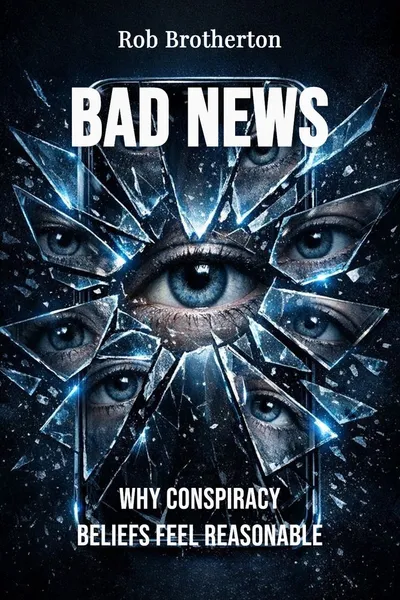
Bad News
Why conspiracy beliefs feel reasonable
Description
Picture a rumor moving through a village long before anyone had a word for misinformation. A crop fails, a child falls sick, a stranger passed through last week — and a story assembles itself, connecting the pieces into a shape that feels like an explanation. Rob Brotherton, an academic psychologist who writes about the workings of belief, opens his book Bad News with a wager that runs against our instincts: the person spreading that rumor is not broken, gullible, or stupid. They are running the same mental software we all run, just aimed at a target we happen to find alarming. His claim is that susceptibility to bad information is not a defect in a few odd people. It is a standard feature of a normally functioning human mind.
That framing changes the conversation entirely. We tend to talk about misinformation as if it were a battle between the smart and the credulous — as if the fix were simply more facts, delivered more loudly, to the people who lack them. Brotherton spends the book dismantling that comfortable picture. Drawing on decades of research in cognitive and social psychology, he shows that the mental habits which make us competent — pattern-finding, trusting the right people, filling gaps with plausible stories — are the very habits that misinformation exploits. The bug and the feature turn out to be the same thing.
What makes the book unsettling is that it refuses to hand us a villain. There is no special breed of gullible person to point at, no simple line between us and them. There is only the ordinary equipment we carry around, doing roughly what it evolved to do, in an environment it was never built for.
The question we’re asking : Why do beliefs we'd call irrational feel so reasonable from the inside — and does that tell us anything about how to push back?What we’ll see : How the everyday machinery of a normal mind, meeting an information environment it was never designed for, quietly manufactures conviction.
Table of contents
01 Chapter 1 — The mind that never stopped hunting patterns
Brotherton starts where the trouble starts: with pattern detection. The human brain is relentless about it. We see faces in clouds, hear meaning in static, and read intention into random events. This is not a flaw we can switch off; it is closer to the thing the brain is for. A mind that noticed too few patterns — that failed to connect the rustle in the grass with the predator, the spoiled meat with the illness — did not tend to leave descendants. So we inherited machinery tuned to err on the side of seeing connections, even where none exist.
The technical name Brotherton uses is patternicity, a term drawn from the science writer Michael Shermer: the tendency to find meaningful patterns in meaningless noise. Its close cousin is what psychologists call the intentionality bias — our readiness to assume that when something happens, someone meant it to happen. Children display it early, attributing purpose to almost everything. Adults never fully outgrow it. When an important event has a small or accidental cause, this machinery balks. A lone gunman, a stray virus, a random market crash — these feel disproportionate, unsatisfying, as if the explanation were missing a piece.

02 Chapter 2 — The proportion problem
One of the sharpest threads in the book concerns what Brotherton calls the appetite for proportion. We carry a quiet expectation that big effects should have big causes — that the scale of an event should match the scale of what produced it. It is an intuition that serves us well most of the time, and betrays us at the extremes. When something enormous happens, a small or mundane explanation feels like an insult to the event itself.
The research he draws on is striking. In experiments, people are more willing to suspect a hidden plot behind a presidential assassination that succeeds than behind an identical attempt that fails — same act, same intent, but the larger outcome pulls harder for a larger cause. The death of a princess, the fall of towers, a pandemic that reorders the world: the sheer weight of the consequence makes the official story feel too flimsy to bear it. Surely, the mind insists, something this big cannot come down to chance, incompetence, or a handful of ordinary people.
03 Chapter 3 — Who counts as a source
No one verifies the world from scratch. Almost everything we know, we take on trust — from teachers, reporters, scientists, friends, the label on a bottle. Brotherton makes the point that this is not laziness but necessity. A single person cannot personally confirm the shape of the Earth, the safety of a medicine, or the events of a war on another continent. We survive by outsourcing belief to sources we deem credible. The whole system runs on trust.
Which means the real question is rarely what is true, but whom to believe. And here the research turns uncomfortable. We do not assess credibility with cool neutrality. We lean toward sources that share our group, our values, our prior commitments. A message lands differently depending on who carries it; the same claim can be dismissed from one mouth and embraced from another. Brotherton connects this to how tightly belief is bound up with identity. To accept certain facts can feel like defecting from your side, and few of us are eager to defect.
04 Chapter 4 — Living in the age of too much
Step back from any single false belief and a larger picture comes into view. The mind Brotherton describes — pattern-hungry, proportion-seeking, trust-dependent — was assembled for a world of scarce, local, mostly reliable information. It now operates in the opposite condition: an endless torrent, global, unfiltered, engineered to capture attention. Bad News is finally a book about that mismatch. The equipment has not changed. The environment has changed beyond recognition, and misinformation is what happens in the gap.
This reframing matters because it dissolves the usual moralizing. If bad information were simply a problem of stupid or wicked people, the answer would be to correct or shame them. But if the same reasoning that produces good beliefs also produces bad ones, then contempt is useless and probably counterproductive — it just confirms, for the believer, that the other side sneers rather than listens. Brotherton keeps returning to a kind of humility here. The habits we are tempted to mock in others are running quietly in ourselves.
05 Conclusion
Return to the village and the rumor. The person assembling that story out of a failed crop and a passing stranger is doing what minds do — finding the pattern, matching the cause to the size of the harm, trusting the neighbor who whispers the warning. Brotherton's achievement in Bad News is to make that figure recognizable rather than alien. The distance between the rumor-monger and the careful skeptic turns out to be smaller than either would like to admit, because both are working with the same borrowed equipment.
Related books