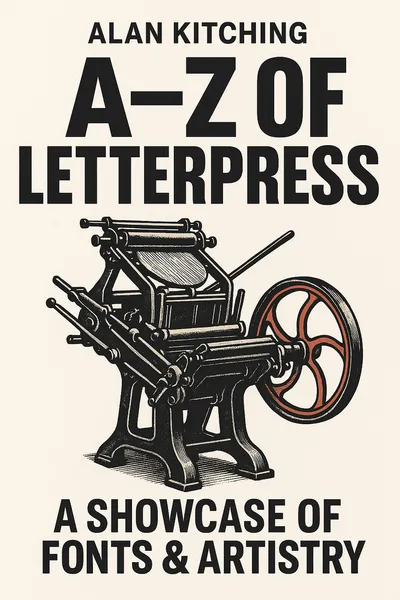
A–Z of Letterpress
A showcase of fonts & artistry
Description
Alan Kitching's "A–Z of Letterpress" emerges within a contemporary design landscape increasingly dominated by digital typography, positioning itself as both historical archive and practical reference. The work reflects Kitching's extensive experience as a practitioner and educator in traditional printing methods, situated at the intersection of craft preservation and design innovation. This publication addresses the growing interest among contemporary designers in tactile, handcrafted approaches to typography while serving as a comprehensive documentation of Kitching's personal font collection accumulated over decades of practice.
The central research question driving this work is: How can traditional letterpress typography be preserved, celebrated, and integrated into contemporary design practice? The defended thesis maintains that the systematic presentation of letterpress fonts serves as both historical documentation and creative catalyst for modern designers seeking authentic typographic expression. The main stake is to demonstrate that traditional letterpress techniques remain relevant and valuable in contemporary graphic design while preserving endangered typographic heritage.
Kitching's work succeeds in demonstrating that traditional typographic practices retain significant relevance for contemporary design while requiring thoughtful preservation and transmission. The publication's systematic approach to documentation creates a valuable resource that serves multiple constituencies: historians interested in typographic heritage, practitioners seeking authentic materials, and educators working to maintain traditional skills. Its greatest strength lies in its integration of historical consciousness with practical accessibility, avoiding both antiquarian nostalgia and superficial appropriation.
Table of contents
01 The Archaeology of Typography
Kitching's methodical approach to cataloguing letterpress fonts reveals a profound archaeological sensibility toward typographic heritage. The work functions as an excavation of printing history, where each typeface represents a material artifact embedded with cultural and technological significance. The author's systematic documentation transcends mere collection, operating as a form of cultural preservation that recognizes typography as both functional tool and historical document.
The theoretical framework underlying this approach draws from material culture studies, positioning letterpress types as physical objects that embody specific historical moments, technological capabilities, and aesthetic philosophies. Kitching's curatorial methodology suggests that fonts are not merely visual elements but archaeological specimens that require careful preservation and contextualization. This perspective challenges contemporary digital typography's tendency toward dematerialization, asserting the irreplaceable value of physical, tactile typographic forms.

02 The Politics of Craft Revival
The publication emerges within broader cultural movements seeking to reclaim traditional crafts as antidotes to digital homogenization and mass production. Kitching's work participates in what might be termed the "artisanal turn" in contemporary design, where manual skills and traditional techniques acquire renewed cultural capital. This positioning carries significant political and economic implications, as it challenges prevailing narratives of technological progress and efficiency that dominate contemporary design practice.
The author's emphasis on letterpress typography as a continuing practice, rather than historical curiosity, suggests a critique of technological determinism that assumes newer methods necessarily supersede older ones. This stance aligns with broader movements in sustainable design and local production that question the social and environmental costs of digital culture's apparent immateriality. The work implicitly argues for the value of slow, deliberate making processes against the acceleration and automation characteristic of contemporary design workflows.
03 Documentation versus Creation
The work navigates complex tensions between historical preservation and contemporary creative practice. While functioning as a comprehensive archive, the publication simultaneously encourages active engagement and reinterpretation of traditional forms. This dual purpose creates productive ambiguities about the relationship between past and present, tradition and innovation, preservation and transformation.
Kitching's collaborative approach with contemporary designers suggests that historical documentation need not result in static preservation but can catalyze new creative possibilities. The work demonstrates how traditional techniques can be integrated into contemporary design practice without sacrificing their essential character or reducing them to mere stylistic effects. This balance requires sophisticated understanding of both historical context and contemporary needs.
04 The Ethics of Cultural Transmission
The publication raises important questions about cultural transmission and the responsibilities of practitioners in preserving and sharing traditional knowledge. Kitching's position as both keeper of traditional techniques and active contemporary practitioner creates unique ethical obligations regarding how this knowledge is preserved, presented, and transmitted to future generations.
The work's emphasis on practical application rather than museumification suggests an ethics of living tradition, where preservation occurs through continued practice rather than static documentation. This approach recognizes that traditional skills remain viable only when they continue to evolve and adapt to contemporary conditions while maintaining their essential characteristics.
05 Critical Assessment and Future Directions
Despite its considerable strengths, the work remains somewhat limited by its focus on visual presentation over deeper historical and cultural contextualization. While the fonts are beautifully documented, readers seeking understanding of their original contexts, intended uses, or cultural significance may find the treatment somewhat superficial. The emphasis on visual appeal, while understandable given the target audience, occasionally overshadows opportunities for deeper analysis of typography's social and political dimensions.
The work contributes to broader discussions about the role of traditional crafts in contemporary culture, particularly regarding questions of sustainability, authenticity, and cultural continuity. Its approach suggests models for preserving and transmitting traditional knowledge that maintain vitality while respecting historical integrity.
Related books