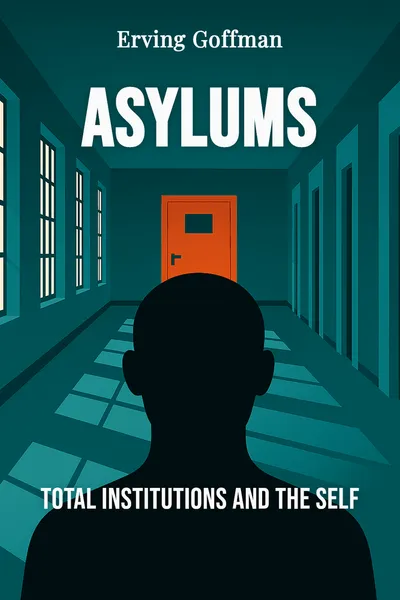
Asylums
Total institutions and the self
Description
In the mid-1950s, a young sociologist named Erving Goffman took a job as an assistant to the athletic director at St. Elizabeths, a federal mental hospital in Washington with more than seven thousand patients. The cover role gave him a reason to move through the wards without being read as a doctor or an inspector. For about a year he watched how life actually worked inside — not the treatment charts, but the daily texture of it: who ate where, who could shut a door, what happened when a man was admitted, how a person filled the empty hours. He was not interested in whether the patients were ill. He was interested in what the hospital did to them regardless.
The book that came out of it, Asylums, appeared in 1961, and its argument reached far past psychiatry. Goffman noticed that the mental hospital shared a deep structure with the prison, the monastery, the army barracks, the boarding school, the ship at sea. He gave the family a name: the total institution — a place where a large number of people, cut off from the wider world, lead an enclosed and formally administered life together. Once he had the category, the details of any single one of them stopped looking like accidents. They looked like the working parts of a machine that does something specific to the people fed into it.
And what it does, in Goffman's telling, is act on the self. Not the body only, though the body too — the self, the sense each of us carries of being a particular person with some room to maneuver. The interest of the book is that it treats identity not as a thing you have but as something an arrangement of people can build, dismantle, and rebuild. The asylum simply makes the process visible because it runs it hard and fast, in the open.
The question we’re asking : What does an enclosed, administered life actually do to the person living it?What we’ll see : How the total institution takes an ordinary person apart and what the process reveals about the self anywhere.
Table of contents
01Chapter 1 — The place where sleep, work, and play collapse
Goffman starts with a feature so basic it usually goes unnoticed. In ordinary life we sleep in one place, work in another, and play in a third, each with different people, different authorities, no overall plan tying them together. We move between spheres, and the movement itself is a kind of freedom — the boss does not follow us home, the family does not sit in on the meeting. The total institution erases these boundaries. Sleep, work, and leisure all happen in the same place, under the same single authority, in the immediate company of the same large batch of other people, all treated alike and required to do the same things together.
This batch living is the first thing that marks the institution off from the outside world. Every phase of the day is scheduled from above, one activity leading to the next by explicit rulings and a body of officials whose job is to keep the block moving. The whole sequence is imposed to serve the institution's official aims, whatever they are — cure, punishment, training, worship. What gets lost in the arrangement is the small autonomy of an adult who decides, on an ordinary Tuesday, to skip lunch or take a walk or answer a letter later. Those decisions are no longer available.

02Chapter 2 — The stripping down at the door
A person arriving at a total institution comes with a self already built on the outside — a home, a set of roles, a face they are used to presenting, a name that means something. The institution's first work is to take that self apart. Goffman calls the sequence a series of abasements, degradations, and profanations, and he lays them out with a coldness that mirrors the process. Admission procedures — photographing, weighing, fingerprinting, assigning numbers, searching, listing personal possessions for storage, undressing, bathing, issuing house clothing — are less about hygiene than about programming. The new arrival is trimmed and shaped into an object that can be fed into the administrative machine.
The heart of it is what he names the mortification of the self. On the outside, a person controls the props of their identity: clothes, cosmetics, a comb, a wallet, the objects that let them keep a personal front. Inside, these are confiscated or standardized. Stripped of a private wardrobe and issued a uniform, the inmate loses the ordinary means of presenting a chosen self to others. Even one's name may go. Goffman treats these dispossessions not as incidental cruelties but as the mechanism by which the outside self is systematically detached.
03Chapter 3 — How the self learns to work the system
Having a self taken apart is not the end of the story, and this is where Goffman's account turns from bleak to genuinely subtle. He tracks what he calls the moral career of the inmate — the regular sequence of changes in belief about oneself and others that the institution produces over time. The career is not chosen; it is a social product, common to people who pass through the same machine. Its early stages are the shocks of admission and mortification. Its later stages are the quieter, more interesting adjustments a person makes once they understand where they are.
Goffman lays out several lines of adaptation. Some inmates practice situational withdrawal, pulling attention inward until almost nothing outside the body registers. Some take the intransigent line, openly defying staff and refusing to cooperate — a stance that usually cannot be held for long. Some undergo colonization, deciding that life inside is tolerable, even preferable, and settling in. Some convert, adopting the staff's view of the ideal inmate and playing the part with enthusiasm. Most people, most of the time, do none of these purely and instead practice what he calls playing it cool — a shifting, opportunistic mix that maximizes the chance of getting out physically and psychologically undamaged.
04Chapter 4 — What the walls reveal about the self outside them
Goffman never lets the reader treat the asylum as a curiosity behind a fence. His deeper claim is that the total institution is an experiment the world runs for us, showing under harsh light what is true, more gently, everywhere. If a stable self can be dismantled by admission procedures and rebuilt through smuggled cigarettes and a private corner, then the self was never the solid, portable possession we take it to be. It was always propped up by arrangements — by the clothes we choose, the doors we can close, the roles others let us play, the information we control about ourselves. The hospital simply removes the props and shows us how quickly the structure sags.
This is the book's quiet radicalism. The identity each of us carries in ordinary life feels like our private core, the one thing that is unmistakably ours. Goffman's asylum suggests it is instead something like a settlement between a person and their situation, continuously negotiated. Outside, the negotiation is so smooth we mistake its outcome for a fixed essence. Inside, where the terms are dictated, we can watch the negotiation happen — the stripping, the resistance, the make-do's, the slow rebuilding — and we see that the same components were in play on the outside all along.
05Conclusion
Goffman walked the wards of St. Elizabeths as a fake athletic assistant, watching thousands of people live an administered life he suspected was doing something to them beneath the level anyone was recording. What he came away with was not a case against psychiatry so much as an anatomy of what enclosure does. Admission strips the outside self; the moral career runs its stages; the underlife grows in the cracks; and out of the make-do's a person reassembles some margin of their own. The asylum, prison, barracks, and convent all run the same procedure with different names on the door.
Related books