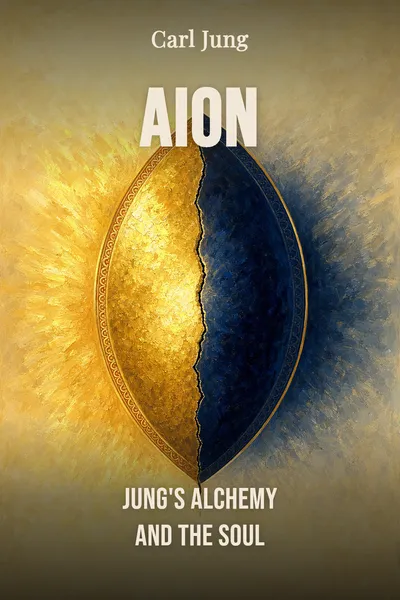
Aion
Jung's alchemy and the soul
Description
In 1951, a seventy-five-year-old psychiatrist in Zurich published a book that opens as a study of the self and ends deep inside medieval alchemy, gnostic cosmology, and two thousand years of Christian symbolism. Carl Jung called it Aion, after the Greek word for an age, a span of cosmic time. It is not an easy book, and it was not meant to be. By the early 1950s Jung had broken with Freud decades earlier, built his own school of analytical psychology, and turned his attention to the strangest corner of his own map: the symbols that human beings had produced without quite knowing why, and kept producing for centuries.
Aion sits inside a run of late works — alongside Answer to Job and the vast Mysterium Coniunctionis — in which Jung kept circling the same territory: the border where psychology, alchemy, and religion stop being separate subjects and start looking like one long conversation the psyche has been having with itself. He was convinced that the images cultures fight over are not decoration. They are data. A god, a fish, a philosopher's stone — each one, read carefully, tells us something about the structure of the mind that made it.
The book's argument runs against the grain of how we usually think about faith and reason. Jung is not asking whether Christ existed or whether alchemists could turn lead into gold. He is asking what the human psyche was doing when it produced those figures, held onto them, and let them evolve across an entire age. The answer he proposes reframes some of the most familiar symbols in Western culture as maps of an inner process most of us never notice we are undergoing.
The question we’re asking : What was the psyche actually doing when it produced the great religious and alchemical symbols, and why did Jung read them as a record of the self rather than a matter of belief?What we’ll see : How a study of the self led Jung through Christ, the figure it excludes, and the alchemists who, in his reading, were quietly working on the same problem.
Table of contents
01 Chapter 1 — A self that isn't the ego
Aion begins with a distinction that carries the whole book. The ego, in Jung's account, is the part of us that says "I" — the center of waking consciousness, the thing that plans, remembers, and takes credit. We tend to assume it is the whole of who we are. Jung argues it is a small lit room in a much larger house. Around it, beneath it, is everything the personality contains but consciousness has not claimed: forgotten experience, disowned impulse, material that was never conscious in the first place. He calls the unconscious not a basement of repressed shame but a structured region with contents of its own.
The larger totality — conscious and unconscious together — Jung names the self. It is not a thing we possess but a center we are decentered around. The ego belongs to the self the way a single town belongs to a country it cannot see the borders of. What makes this more than a diagram is Jung's claim that the self is not static. Over a lifetime it tends toward integration, a slow drawing-together of split-off parts, which he had earlier called individuation. Aion is, in one sense, the book where he asks what symbols the psyche uses to picture that process.

02 Chapter 2 — Christ as a symbol of the psyche
The figure Jung reads most closely is Christ. He approaches him not as an object of devotion or doubt but as a psychological symbol of extraordinary reach — the Western world's dominant image of the self for two thousand years. Christ is the whole, complete man; the one in whom the human and divine are joined; the redeemer who unifies what was scattered. Every one of these attributes, Jung notes, is also a description of the integrated self. For an entire age, the psyche's drive toward wholeness found its clearest picture in a single figure.
This gives Jung the frame that names the book. Aion is about an age, and the age he means is measured by the astrological symbol of the fish — the Pisces era, running roughly across the two millennia of the Christian epoch. The early Christians had themselves taken the fish as a secret sign, and Jung traces the coincidence with real learning: the sign of the fishes is double, two fish, and he reads that doubling as a clue. The symbol of the self that dominated the age was, from the start, quietly split.
03 Chapter 3 — The shadow the symbol left out
The excluded part has a name in Jung's vocabulary: the shadow. It is the sum of everything the conscious personality refuses to own — not evil in some cosmic sense, but the disowned, inconvenient, frightening material we would rather believe belongs to someone else. On the collective scale, a culture's shadow is whatever its official image of itself cannot admit. In the Christian symbolic world, Jung argues, the shadow of an all-good Christ took on a specific and famous shape: the Antichrist, and behind him the problem of evil itself.
This is where Aion becomes genuinely uncomfortable, and deliberately so. Jung notes that Christian theology had struggled for centuries with the status of evil, largely defining it as privatio boni — a mere absence of good, with no substance of its own. He finds this unconvincing as psychology. In the actual life of the mind, evil is not an absence; it is a felt, active reality, and treating it as nothing only guarantees that it operates unseen. A symbol of the self that files evil under "not real" leaves the psyche without a way to face its own darker half.
04 Chapter 4 — Alchemy as the missing half
Why does a book about Christ and the self spend so long among alchemists? Because Jung had come to believe they were working, in a coded and half-conscious way, on precisely the problem Christian doctrine had set aside. While the official symbol of the self was purified into pure light, the alchemists were producing an image that unified the opposites — bright and dark, spirit and matter, above and below. Their goal, the philosopher's stone, was described in language uncannily like the language used of Christ: a redeemer, a uniter of divisions, born from base and rejected material.
This is the pivot of the late Jung. He read alchemy not as failed chemistry but as projection: unable to look directly at their own unconscious, the alchemists saw its contents in their flasks and furnaces, describing the transformation of the soul as though it were a transformation of metals. Where the dominant religious symbol had left evil and matter outside the sacred, alchemy quietly gathered them back in. The stone was made from what the world despised — a symbol of the self that had room for the shadow the age had exiled.
05 Conclusion
Aion ends where it began, with the self — but a self now seen through two thousand years of images. The distinction Jung drew in the first pages, between the small lit ego and the larger totality it belongs to, turns out to be the key to everything that follows. Christ, the doubled fish, the Antichrist, the philosopher's stone: read as symbols, they become stages in a single process — the psyche's attempt to picture and eventually integrate its own wholeness across the span of an age.
Related books