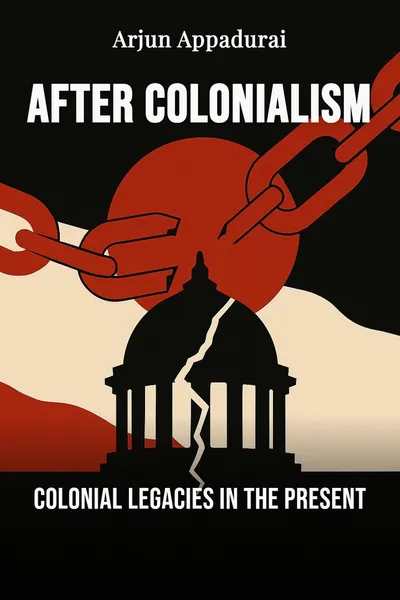
After Colonialism
Colonial legacies in the present
Description
In 1995, a slim volume appeared under the title After Colonialism, edited by the anthropologist Arjun Appadurai and gathering scholars who had spent years watching what former empires left behind. The book did not read like a triumphant closing of a chapter. Its very title carried a small ambiguity that most readers picked up on immediately: "after" as in later than, and "after" as in still shaped by, still trailing. The contributors — historians, anthropologists, literary critics working across South Asia, Africa and the Caribbean — shared a suspicion. The word "post" in postcolonial suggested a clean break, a before and an after separated by a flag-raising ceremony and a new anthem. What they saw on the ground was messier.
The flags had changed. The maps, mostly, held. But the administrative categories, the census forms, the property laws, the languages of government, the way a person had to prove who they were at a border — these had been drawn up by colonial administrations and simply inherited by the states that replaced them. Independence had transferred power without dismantling the architecture that power ran through. So the book set out to ask a harder question than "how did the empires fall." It asked what, exactly, survived their falling, and why the categories built to govern subjects kept governing citizens.
Appadurai's assembly of essays refused a single triumphant story. Instead it laid out a set of tools for reading the present — for seeing the colonial past not as a closed episode but as a structure still doing work in customs halls, refugee camps, and the imagination of nations that no longer had an empire to define themselves against. What emerged was less a verdict than a way of looking, and it has aged into one of the more durable lenses we have for making sense of a world in motion.
The question we’re asking : What did colonialism actually leave behind once the flags came down, and why does it keep shaping how nations, borders and belonging work?What we’ll see : How a set of postcolonial thinkers assembled a way of reading modernity, and why they came to treat displacement as the world's default rather than its accident.
Table of contents
01 Chapter 1 — An edited volume with a quiet argument
After Colonialism is not a single-author treatise, and that matters to how it works. Appadurai gathered contributors from different disciplines and different corners of the formerly colonized world, and the effect is less a thesis than a conversation among people who have each watched the same afterlife from a different angle. An edited volume can feel scattered. This one is held together by a shared conviction: that the categories colonialism used to know its subjects — race, tribe, caste, nationality, the neat rows of a census — did not evaporate when the colonizers packed up. They stayed, quietly, doing the work of the state.
The wager of the book is that you understand the present better by treating these inherited categories as active machinery rather than as historical residue. A census that once sorted a population for a colonial administration becomes the census that assigns quotas, defines minorities, and decides who counts. A border drawn in a European office becomes the border a person must cross with the right document or not at all. Appadurai and his contributors keep pointing at the seam where the colonial tool becomes the national one, and asking us not to look past it.

02 Chapter 2 — The nation-state after empire
The most persistent object in the book is the nation-state, and the contributors treat it with a certain wariness. The nation-state is often presented as the natural successor to empire — the form that decolonization was supposed to produce, a people governing themselves inside a bounded territory. But the essays keep noticing that the postcolonial nation-state inherited more from the empire than it liked to admit. Its borders, its bureaucracies, its habit of classifying populations by fixed ethnic or religious labels, its very idea that a territory should contain a single coherent people — much of this came from the colonial toolkit, repurposed rather than reinvented.
The trouble is that the fit is imperfect. Colonial powers had drawn lines across regions that held many peoples, many languages, many overlapping loyalties. When independence handed those lines to new governments, the governments faced a population that did not always match the map. The response, again and again, was to lean harder on the inherited categories — to insist on the nation as a unity, and to treat the people who did not fit as problems to be managed. Minorities, migrants, and border populations became the recurring casualties of a form built to demand a coherence that the actual society never had.
03 Chapter 3 — When the archive can't hold the person
One of the sharpest threads in After Colonialism concerns knowledge itself — how colonial administrations came to know the people they ruled, and how that way of knowing outlived them. Empires ran on documentation. They surveyed land, counted heads, fixed names, drew maps, wrote reports, built archives. To govern a distant population, you first had to render it into records a clerk in a capital could read. This was not neutral bookkeeping. The act of recording decided what a person was: which tribe, which caste, which category of subject, which line on which form.
The contributors show how these ways of knowing became self-fulfilling. A colonial census that invented rigid categories where fluid identities had existed did not merely describe society; it hardened it, because people learned to claim the categories the state recognized in order to get anything from it. Identities that had been loose, layered, situational were pressed into administrative boxes. And when the colonizers left, the boxes remained — in the law, in the paperwork, in the shared assumption that a person has one fixed, documentable identity that the state can verify.
04 Chapter 4 — Displacement as the ground, not the exception
Step back from the individual essays and the collection points toward a larger claim, one that Appadurai would develop across his later work: that displacement is not an interruption of the normal order but the condition of the modern world itself. We tend to imagine settlement as the baseline — people rooted in a place, with a stable identity and a single home — and to treat migration, exile, and refugeehood as disturbances of that baseline. After Colonialism inverts the picture. Movement, mixture, and the loss of a fixed origin are not the exceptions. They are the ground on which the present stands.
This is where the postcolonial framing does its widest work. Colonialism itself was a vast machinery of displacement: it moved labor across oceans, redrew who belonged where, uprooted populations and planted others, and left behind societies whose composition was the product of forced and unforced movement. To read the world after colonialism is to read a world where nobody stands entirely at home — where the categories of native and foreigner, citizen and migrant, are the unstable residue of centuries of motion rather than natural facts. The nation-state's demand for rootedness runs against a history that was never rooted.
05 Conclusion
After Colonialism began with a small ambiguity in its own title — later than, and still shaped by — and the whole book turns out to be an argument for the second reading. The flags came down, the anthems changed, but the machinery of governing kept running on colonial parts: the census that hardens identity, the border that demands a document, the nation-state that insists on a coherence its population never had. Appadurai's contributors do not tell us the past is over. They show us where it is still working, in the customs hall and the refugee file and the map that does not fit the people beneath it.
Related books