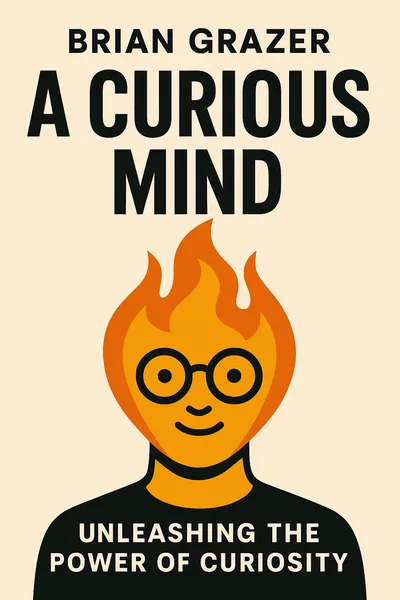
A Curious Mind
Unleashing the power of curiosity
Description
Brian Grazer's exploration emerges from his unique position as a Hollywood producer who systematically engaged intellectual leaders across disciplines through structured conversations spanning decades. This work represents an intersection between entertainment industry insights and broader philosophical inquiry into human motivation. The author leverages his professional access to prominent figures to construct a framework understanding curiosity as both personal catalyst and societal force. The book positions itself within contemporary discussions of creativity, innovation, and human potential.
The central research question that drives this analysis is: How does curiosity function as the primary mechanism for personal transformation and societal advancement? Grazer defends the thesis that curiosity represents the essential human capacity that drives innovation, builds meaningful connections, and generates both individual fulfillment and collective progress. The main stake of this argument is demonstrating that cultivating curiosity constitutes the most effective strategy for navigating complexity and achieving significance in contemporary life.
Grazer's comprehensive framework establishes curiosity as the central mechanism through which individuals navigate complexity and generate value in contemporary society. The argument successfully integrates personal anecdotes with broader philosophical implications, creating a coherent vision of human potential realized through systematic questioning. The work's intellectual contribution lies in democratizing curiosity, presenting it as an accessible capacity rather than rare talent. The author's entertainment industry perspective provides unique insights into how curiosity functions across diverse contexts while maintaining practical relevance for general audiences.
Table of contents
01 Curiosity as Epistemological Foundation
Grazer constructs curiosity as more than mere inquisitiveness, positioning it as a fundamental epistemological stance that reshapes how individuals process information and construct knowledge. This conceptualization draws implicitly from pragmatist philosophy, suggesting that knowledge emerges through active engagement rather than passive absorption. The author's framework challenges traditional educational and professional models that prioritize expertise over exploration, arguing instead that sustained questioning generates more valuable insights than accumulated facts.

02 Social Architecture and Relational Dynamics
The examination of curiosity's social dimensions reveals how questioning behaviors reshape interpersonal relationships and organizational structures. Grazer demonstrates that curious individuals consistently generate more meaningful connections by approaching others with genuine interest rather than transactional objectives. This analysis exposes the limitations of networking models based on mutual utility, suggesting instead that authentic inquiry creates sustainable professional and personal relationships.
03 Innovation Mechanisms and Creative Disruption
Grazer's analysis of curiosity's role in innovation reveals systematic patterns underlying creative breakthroughs across industries and disciplines. The author demonstrates that transformative ideas emerge from cross-pollination between seemingly unrelated fields, facilitated by individuals willing to explore beyond their specialization boundaries. This framework challenges linear models of innovation that assume expertise concentration produces optimal results.
04 Existential Implications and Life Architecture
The philosophical dimensions of Grazer's argument address curiosity's relationship to meaning-making and life satisfaction. The analysis suggests that individuals who maintain active questioning throughout their lives experience greater fulfillment than those who settle into predetermined patterns. This positioning challenges cultural narratives that equate stability with success, proposing instead that continuous exploration generates more authentic satisfaction.
05 Critical Assessment and Future Directions
The work's limitations emerge from its reliance on successful individuals whose curiosity aligned with favorable circumstances, potentially overlooking structural barriers that constrain questioning behaviors for marginalized populations. The analysis lacks systematic examination of how economic inequality, educational access, and social positioning affect individuals' capacity to pursue curiosity-driven paths. Additionally, the framework may underestimate the psychological costs of sustained uncertainty and questioning for individuals lacking sufficient social support systems.
Related books