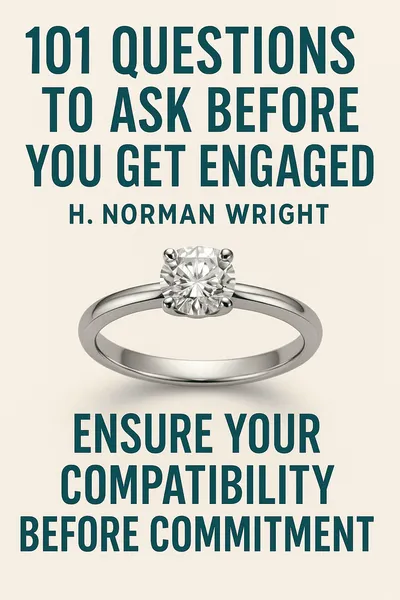
101 Questions to Ask Before You Get Engaged
Ensure your compatibility before commitment
Description
H. Norman Wright's '101 Questions to Ask Before You Get Engaged' emerges from decades of therapeutic practice and academic research in marriage dynamics, positioning itself within the preventative counseling paradigm. The work's central thesis argues that successful marriages require intentional premarital exploration through systematic questioning that unveils fundamental compatibility across emotional, spiritual, financial, and relational dimensions. Wright challenges the cultural narrative of love as sufficient foundation for marriage, instead proposing compatibility as measurable through systematic inquiry.
The author's central research question examines how couples can systematically evaluate their compatibility and readiness for marriage through structured self-examination. His defended thesis maintains that deliberate questioning before engagement prevents marital discord by revealing fundamental differences and fostering honest communication. The main stake involves transforming casual romantic relationships into intentional partnerships through rigorous compatibility assessment.
Wright constructs a methodological framework that transforms premarital conversation from superficial romance into systematic examination. The questioning structure reflects contemporary relationship psychology while maintaining evangelical theological underpinnings. This approach draws from cognitive-behavioral therapy principles, emphasizing that conscious examination of beliefs, values, and expectations can predict relationship success. The work synthesizes relationship psychology, Christian theology, and practical counseling methodology to create a preventative intervention tool that addresses multiple relationship dimensions often overlooked during courtship.
Table of contents
01 The Architecture of Relational Inquiry: Methodology and Framework
Wright constructs a methodological framework that transforms premarital conversation from superficial romance into systematic examination. The questioning structure reflects contemporary relationship psychology while maintaining evangelical theological underpinnings. This approach challenges the cultural narrative of love as sufficient foundation for marriage, instead proposing compatibility as measurable through systematic inquiry. The author's methodology draws from cognitive-behavioral therapy principles, emphasizing that conscious examination of beliefs, values, and expectations can predict relationship success.
However, this rational approach potentially undervalues emotional intelligence and intuitive compatibility, creating tension between analytical assessment and relational spontaneity. The framework assumes couples possess self-awareness and emotional maturity to engage honestly with challenging questions, possibly excluding those lacking sophisticated communication skills or psychological insight. The methodology assumes that identifying differences automatically leads to skill development and behavioral change, which may underestimate how deeply ingrained patterns reflect family-of-origin dynamics and cultural conditioning.

02 Economic and Domestic Power Dynamics
The work extensively addresses financial compatibility and domestic role expectations, revealing how economic factors interweave with gender dynamics and family structures. Wright's treatment of money management reflects broader societal tensions regarding financial autonomy within marriage, particularly as women's economic participation has transformed traditional household models. The questioning framework exposes assumptions about breadwinning responsibilities, spending philosophies, and financial decision-making authority.
These inquiries illuminate how couples navigate the intersection of romantic partnership and economic unit formation. The author's approach recognizes that financial discord represents one of marriage's primary stressors, yet his solutions remain largely procedural rather than addressing systemic economic pressures affecting modern couples. The framework may inadvertently reinforce traditional gender roles while attempting to promote transparency, particularly regarding domestic labor distribution and career prioritization decisions.
03 Spiritual and Ideological Convergence
Wright's examination of religious and philosophical compatibility reveals fundamental tensions within pluralistic society regarding shared meaning-making systems. The questioning process demands couples confront differences in worldview, spiritual practice, and moral frameworks that often remain implicit during courtship. This approach acknowledges that ideological alignment affects decision-making processes, child-rearing philosophies, and community participation patterns.
The author's evangelical perspective emphasizes spiritual unity as marriage's foundation, potentially marginalizing couples with diverse or secular worldviews. The framework struggles to accommodate interfaith relationships or evolving spiritual journeys, suggesting static religious identity rather than dynamic spiritual development. Additionally, the emphasis on ideological convergence may discourage intellectual diversity within marriage, promoting conformity over constructive theological or philosophical dialogue that could enrich the relationship.
04 Communication Patterns and Conflict Resolution
The work addresses communication styles and conflict management as predictive factors for marital success, emphasizing emotional regulation and dialogue skills. Wright's approach recognizes that couples often enter marriage without explicit discussion of communication preferences, conflict resolution strategies, or emotional processing methods. The questioning framework attempts to surface these patterns before they become entrenched marital dynamics.
However, the methodology assumes that identifying communication differences automatically leads to skill development and behavioral change. The author underestimates how deeply ingrained communication patterns reflect family-of-origin dynamics and cultural conditioning that resist conscious modification. Furthermore, the framework may pathologize normal relationship tensions by suggesting that all conflicts stem from communication failures rather than recognizing that some differences require acceptance rather than resolution.
05 Critical Analysis and Contemporary Relevance
Wright's comprehensive questioning framework represents a systematic attempt to rationalize mate selection through structured compatibility assessment. The work synthesizes relationship psychology, Christian theology, and practical counseling methodology to create a preventative intervention tool. The author's central argument that intentional premarital preparation reduces marital failure rates reflects broader cultural anxiety about relationship stability in contemporary society. The methodology challenges romantic idealization while promoting realistic relationship expectations through transparent communication.
The work's primary limitation stems from its mechanistic approach to relationship compatibility, reducing complex human dynamics to questionnaire responses. Wright's framework assumes that conscious knowledge of differences automatically translates into relationship skills and emotional maturity. Additionally, the author's evangelical framework limits applicability for diverse populations, particularly regarding sexuality, gender roles, and spiritual expression.
Related books