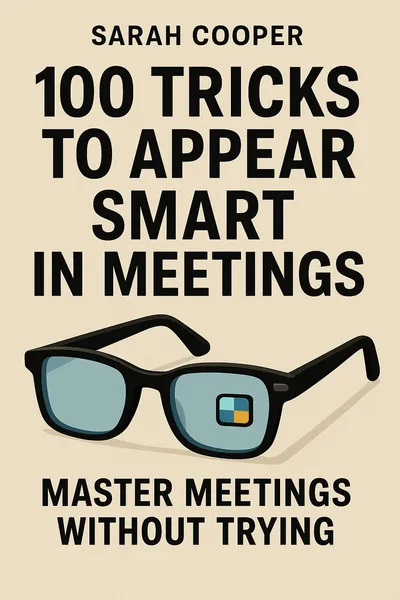
100 Tricks to Appear Smart in Meetings
Master meetings without trying
Description
Sarah Cooper's "100 Tricks to Appear Smart in Meetings" emerges from the intersection of corporate ethnography and satirical commentary, positioning itself as both humor and social critique. Drawing from her extensive experience in Silicon Valley's tech giants, Cooper constructs a systematic analysis of contemporary meeting culture through the lens of performative behavior. The work situates itself within broader discussions of workplace dynamics, professional identity construction, and the theatrical nature of corporate environments in late capitalist societies.
The central research question asks: How do professionals navigate the performative demands of meeting culture while maintaining career advancement? Cooper's defended thesis posits that corporate meetings function as theatrical spaces where perceived competence supersedes actual contribution, creating systemic dysfunctions in organizational decision-making. The main stake is to expose the absurdity of contemporary workplace performance while providing practical navigation tools for professionals trapped within these systems.
Cooper's work constructs a comprehensive critique of contemporary corporate culture through the microcosm of meeting dynamics. Her analysis demonstrates how seemingly trivial performative behaviors reflect and reinforce fundamental organizational dysfunctions around competence evaluation, resource allocation, and professional advancement. The author successfully bridges individual experience with systemic analysis, revealing how personal survival strategies within corporate environments both respond to and perpetuate institutional problems. The work's strength lies in its ability to make visible the invisible labor of professional performance while simultaneously providing practical guidance for navigating these systems. Cooper achieves a delicate balance between critique and complicity, acknowledging the absurdity of meeting theater while recognizing its practical necessity for career survival within existing organizational structures.
Table of contents
01 The Architecture of Performative Intelligence
Cooper's analysis reveals how corporate meetings have evolved into elaborate performances of intelligence rather than venues for substantive exchange. The author demonstrates how participants engage in sophisticated signaling behaviors designed to project competence independent of actual expertise or contribution. This performative dimension transforms meetings into theatrical productions where success depends on mastering specific gestural vocabularies, timing interventions strategically, and deploying carefully calibrated displays of engagement.

02 Economic Implications of Meeting Theater
The economic dimensions of Cooper's critique extend beyond individual career strategy to encompass organizational resource allocation and productivity questions. The author demonstrates how performative meeting culture generates substantial hidden costs through time misallocation, decision-making delays, and the privileging of presentation skills over domain expertise. Organizations inadvertently create incentive structures that reward theatrical competence while potentially marginalizing genuine innovation and problem-solving capabilities.
03 Power Dynamics and Social Reproduction
The work exposes how meeting performances serve to reinforce existing hierarchical structures within organizations. Cooper demonstrates how different performative strategies become associated with various organizational levels, creating implicit codes that signal and maintain professional status distinctions. Senior participants employ different theatrical techniques than junior colleagues, suggesting that meeting performance serves as both gateway and maintenance mechanism for organizational advancement.
04 Psychological and Ethical Consequences
Cooper's examination reveals the psychological toll of sustained performative behavior on individual professionals and organizational culture. The constant requirement to project intelligence through theatrical means creates authenticity conflicts that may generate stress, impostor syndrome, and professional alienation. Participants must maintain elaborate facades while potentially doubting their genuine contributions or feeling disconnected from meaningful work engagement.
05 Critical Assessment and Future Directions
Cooper's analysis, while incisive in its observational accuracy, remains primarily descriptive rather than prescriptive regarding systemic solutions. The work's focus on individual adaptation strategies may inadvertently reinforce the very systems it critiques by providing more effective participation tools rather than challenging fundamental organizational structures. Additionally, the author's tech industry background may limit the analysis's applicability across different corporate sectors or professional contexts with distinct cultural dynamics.
The work's satirical approach, while engaging, potentially diminishes its analytical depth regarding underlying power structures and economic forces driving these performative demands. Cooper's analysis would benefit from deeper engagement with organizational theory, workplace sociology, and critical management studies to contextualize meeting culture within broader patterns of contemporary capitalism.
Related books