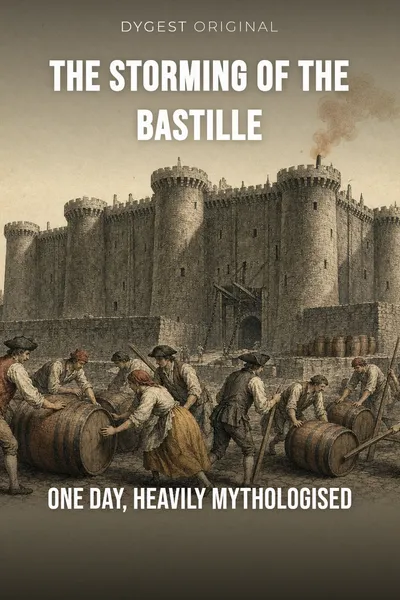
The Storming of the Bastille
One day, heavily mythologised
Description
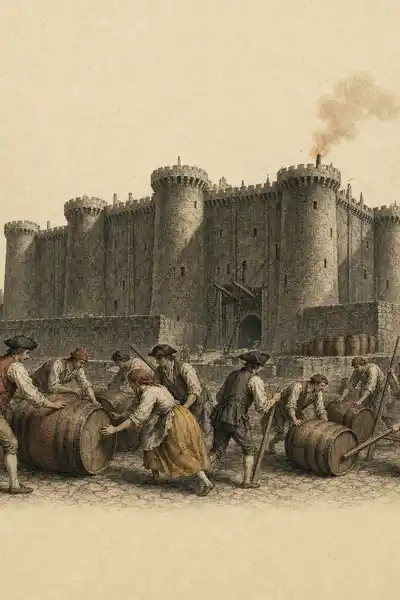
On the morning of 14 July 1789, the Bastille held exactly seven prisoners. Four were forgers, two were men declared insane, and one was an aristocrat locked up at his own family's request. The fortress that would, within a generation, become the symbol of royal despotism overthrown was by then a half-empty military building that the government had already been planning to demolish, on the grounds that it cost too much to maintain and served almost no purpose. Its commander, the marquis de Launay, had under a hundred and fifty men, many of them elderly invalids, to defend eight towers rising thirty metres above a nervous eastern Paris.
By nightfall, de Launay was dead, his head carried through the streets on a pike, and the Bastille was in the hands of the crowd that had taken it. Within days, the event had a name, a date that would become a national holiday, and a meaning far larger than anything that had actually happened in the courtyard that afternoon. The number of prisoners freed barely mattered. What mattered was that ordinary Parisians had attacked a royal fortress and won — and that the king, learning the news, is said to have asked whether it was a revolt, only to be told it was a revolution.
The distance between what occurred and what came to be remembered is unusually wide here, even by the standards of founding national moments. The storming of the Bastille is one of the most painted, re-enacted and celebrated days in modern history, and also one of the most misremembered. Returning to the hours themselves — who was in the crowd, what they wanted, how the fighting actually unfolded — turns out to be a far stranger story than the one carved onto the monuments.
The question we’re asking : What actually happened at the Bastille on 14 July 1789, and how did a confused, half-accidental afternoon become the founding day of a republic?What we’ll see : We go back to the fortress hour by hour, follow the crowd that came looking for something other than freedom, and watch a legend form almost as the smoke was still clearing.
Table of contents
01Chapter 1 — A fortress with seven prisoners
The Bastille had been built in the fourteenth century as a defensive gate in the walls of Paris, and by 1789 the city had long since grown past it. For most of the seventeenth and eighteenth centuries it had functioned as a state prison, a place where the king could hold people by lettre de cachet — a sealed order requiring no trial. That power made it a potent symbol. Voltaire had been locked inside twice. The marquis de Sade had been a prisoner there until just days before the storming, bellowing from a window that the guards were slaughtering inmates, which got him transferred to an asylum on 4 July.
By the time the crowd arrived, though, the Bastille was barely a prison at all. Reform-minded ministers had reduced its use to almost nothing. The government of Louis XVI had drawn up plans to tear it down and replace it with a public square, partly to save money. The seven men inside were a motley group with no political significance: a handful of forgers, two held for mental illness, and the comte de Solages, imprisoned at his own father's request for scandalous conduct. None of them was a victim of tyranny in the way the legend would soon suggest.

02Chapter 2 — The crowd came for gunpowder
To understand why thousands of Parisians converged on the Bastille, you have to go back two days. On 11 July, Louis XVI dismissed Jacques Necker, the popular finance minister widely seen as sympathetic to reform. The news reached Paris on the 12th and set off panic. The city feared the king was preparing to use the troops massing around the capital to crush the newly declared National Assembly by force. Crowds gathered, barricades went up, and the search for weapons began in earnest.
On the morning of 14 July, a vast crowd stormed the Hôtel des Invalides, the military hospital, and seized some thirty thousand muskets from its cellars. But muskets without powder are clubs. The gunpowder had been moved, for safekeeping, into the Bastille. So the crowd that gathered outside the fortress later that morning was not an abstract mob rising against despotism. It was a city that had just armed itself and now needed the one thing that would make those arms useful. The Bastille was, in the most literal sense, where the ammunition was.
03Chapter 3 — The surrender that nobody had planned
The decisive element arrived in the afternoon: detachments of the gardes françaises, royal soldiers who had defected to the people, dragging several cannon with them. They positioned the guns in the courtyard and aimed them at the main gate. This changed de Launay's calculation entirely. His invalids could hold off a crowd behind thirty-metre walls indefinitely, but trained gunners with artillery at close range were another matter. The fortress could be breached, and everyone inside knew it.
De Launay faced an impossible choice. He briefly threatened to blow up the entire Bastille — and its gunpowder — which would have taken a good part of the neighbourhood with it. His own men, terrified of being massacred and with no appetite for a suicidal last stand, pressured him to surrender. He wrote a note demanding safe passage for the garrison, pushed it through a gap in the gate, and when the crowd gave no credible guarantee, he lowered the drawbridge anyway. The crowd surged in. There had been no dramatic breach, no scaling of the walls. The Bastille fell because the men inside gave up.
04Chapter 4 — How a riot became a founding day
The myth-making began almost before the blood had dried. The attackers quickly started calling themselves the vainqueurs de la Bastille — the conquerors of the Bastille — and a list of around nine hundred and fifty names was drawn up, granting them a formal status and a pension. The event needed heroes, so heroes were named. An entrepreneur named Pierre-François Palloy bought the right to demolish the fortress, employed hundreds of workers to dismantle it stone by stone, and sold the rubble as souvenirs — carving miniature Bastilles from its stones and shipping them to the provinces as sacred relics of liberty. The demolition itself became theatre.
What makes the process striking is how fast the gap opened between the thing and its symbol. A siege driven largely by the search for gunpowder, won when a frightened garrison surrendered to defecting soldiers with cannon, was recast within weeks as the people rising up to shatter the dungeon of tyranny and free its wronged captives. The seven unremarkable prisoners became, in the telling, a multitude groaning in chains. The arsenal became a torture chamber. De Launay's hesitation became the cruelty of a despot getting his due.
05Conclusion
By the standards of the decade that followed, 14 July 1789 was a small event. Fewer than a hundred and fifty defenders, seven prisoners, a few hours of poorly aimed fighting, and a surrender forced by the arrival of cannon. The Terror, the wars, the guillotine and the empire were all still to come, and they would reshape France far more violently than a crowd gathered outside an obsolete fort ever could. Measured by its body count or its tactical importance, the storming barely registers. Measured by what it was turned into, it is one of the most consequential afternoons in modern history.
Related books