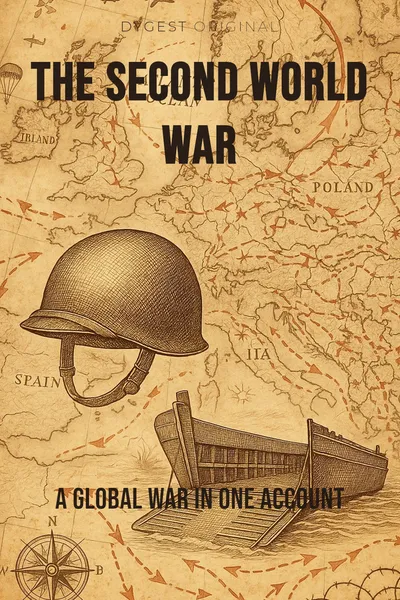
The Second World War
A global war in one account
Description
On September 1, 1939, German divisions crossed the Polish border, and two days later Britain and France declared war. We tend to file that morning as the start of everything, the moment the twentieth century tipped into its worst decade. But the war that opened in Poland was already several wars braided together, and the earliest of them had begun elsewhere and earlier. Japan had been fighting in China since 1937, some would say since it seized Manchuria in 1931. Italy had invaded Ethiopia in 1935. The Spanish Civil War had been a rehearsal ground for German and Italian aircraft since 1936. What we call the Second World War was less a single event with a single starting gun than a set of regional conflicts that fused into one.
By the time it ended in 1945, it had killed somewhere between 60 and 80 million people, most of them civilians, and had drawn in more than fifty nations across six continents and every ocean. It reshaped borders, emptied empires, split a continent, and left two powers standing where six great powers had jostled before. No war before or since has been fought at this scale, and none has left a longer shadow over the arrangements we still live inside.
The difficulty with telling it as one story is exactly that scale. The desert around El Alamein, the ice at Stalingrad, the carrier decks at Midway, the beaches of Normandy — these can feel like separate films. What connects them is not just chronology but a single logic: a handful of turning points, spread across three continents in the space of a year, that converted near-defeat into a slow, grinding certainty of Allied victory. Understanding the war means understanding how those pieces locked together.
The question we’re asking : How did a scatter of regional conflicts become one global war, and where did its outcome actually turn?What we’ll see : How the theatres connected, how close the Axis came, where the tide broke, and the world the victory left behind.
Table of contents
01Chapter 1 — The war that already had two fronts before it began
The Second World War is usually dated from Poland, but its architecture was in place well before September 1939. In Asia, imperial Japan had been at war with China for two years, having pushed south from Manchuria into a brutal campaign that included the sack of Nanjing in late 1937. In Europe, the peace imposed at Versailles in 1919 had left Germany humiliated and revisionist, and by the mid-1930s Hitler was tearing up its clauses one at a time — rearming, remilitarizing the Rhineland in 1936, absorbing Austria and then Czechoslovakia while Britain and France chose accommodation over confrontation.
The Munich Agreement of 1938, in which the democracies handed Hitler the Sudetenland to avoid war, has become the byword for the failure of appeasement. What it bought was not peace but time, and less of it than anyone hoped. The decisive move came in August 1939, when Nazi Germany and the Soviet Union — ideological enemies — signed a non-aggression pact with a secret protocol carving up Eastern Europe between them. It freed Hitler to strike west without fear of a two-front war, and it freed Stalin to take his share of Poland and the Baltic states.

02Chapter 2 — The years the Axis nearly won
It is easy, knowing how it ended, to forget how close the Axis came. Through 1940 and 1941, the momentum ran almost entirely one way. Britain survived the summer and autumn of 1940 in the Battle of Britain, the first campaign fought entirely in the air, when Royal Air Force fighters denied the Luftwaffe the control it needed to invade. That was a genuine reprieve. But survival was not the same as strength, and Britain spent the following two years absorbing losses across the Atlantic, the Mediterranean and North Africa.
Then, in June 1941, Hitler made the decision that defined the war. Operation Barbarossa sent more than three million Axis troops across the Soviet border in the largest land invasion in history, breaking the pact of 1939. The early gains were staggering — vast encirclements, hundreds of thousands of prisoners, German spearheads within sight of Moscow by December. Behind the front, the invasion unleashed the machinery of mass murder that would become the Holocaust, the systematic extermination of six million Jews alongside millions of others.
03Chapter 3 — The turning: Stalingrad, Midway, El Alamein
Historians argue about which battle turned the war, and the honest answer is that no single one did. Instead, within roughly twelve months spanning 1942 and early 1943, the tide broke in all three main theatres at once, and the pattern that followed never reversed. The turning was global because the war had become global.
In the Pacific, the reversal came first and came suddenly. At Midway in June 1942, American carriers, aided by broken Japanese codes, sank four of Japan's fleet carriers in a single day. Japan never replaced them, and the initiative in the Pacific passed to the United States, which began the long, bloody campaign of island-hopping toward the Japanese home islands. A navy that had run wild for six months was now on the defensive for the rest of the war.
04Chapter 4 — The order built on the rubble
The war did not simply end; it delivered a settlement, and the shape of that settlement mattered as much as the fighting. Even before the shooting stopped, the victors were designing the world that would follow. At Bretton Woods in 1944 they built the financial architecture of the postwar economy. At meetings in Tehran, Yalta and Potsdam, Roosevelt, Churchill and Stalin sketched the political map — and in doing so drew the line that would run through Europe for the next forty years.
The most consequential fact of 1945 was where the armies stopped. The Red Army held Eastern Europe; the western Allies held the West. Germany was divided, Berlin quartered, and a continent that had been fought over was frozen into two blocs. The alliance that had defeated Hitler dissolved almost immediately into the Cold War, because the two powers left standing had incompatible visions of the order they had jointly won. The war against fascism produced, as its direct inheritance, a standoff between capitalism and communism.
05Conclusion
Seen whole, the war resolves into a pattern beneath its vastness. It began as separate conflicts in China, in Ethiopia, in Poland, and fused into one when Germany invaded the Soviet Union and Japan struck the United States. It nearly went the other way in 1941, when the Axis had moved first and moved fast. And it turned, decisively and almost simultaneously, across three continents in the twelve months around Stalingrad, Midway and El Alamein, after which the sheer weight of Allied resources made the ending only a matter of time and blood.
Related books