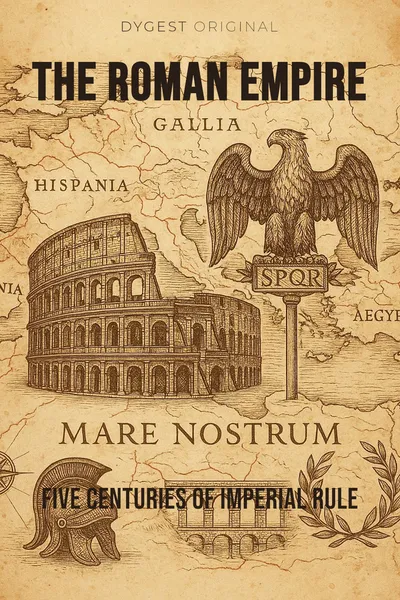
The Roman Empire
Five centuries of imperial rule
Description
In 27 BC, a man named Octavian stood before the Roman Senate and, in a piece of political theater still studied two thousand years later, offered to hand back all his powers. The Senate, which understood exactly what was being asked of it, declined. It gave him instead a new name — Augustus, the revered one — and a bundle of authorities that added up, in everything but title, to sole rule. Rome had been a republic for nearly five centuries. It would now be an empire for nearly five more, and the fiction that nothing had really changed was the founding lie the whole system rested on.
What followed was not one long golden afternoon. Rome at its height stretched from the rain of northern Britain to the sands of Egypt, holding perhaps sixty to seventy million people under a single administration — and then it contracted, fractured, and in the West simply stopped, the last emperor deposed in 476 AD by a general who did not bother to claim the throne. In between sat centuries of roads and aqueducts, civil wars and plagues, brilliant governance and ruinous succession crises. The Empire was less a monument than a machine that kept nearly breaking and kept being rebuilt.
We tend to remember Rome in two moods — the marble grandeur and the decadent collapse — and both flatten a stranger, more human story. It is the story of how a city built to be run by a few hundred aristocrats learned, badly and then well and then badly again, to govern a continent, and of why the thing it built refused to fully die even after it fell.
The question we’re asking : How did a single city hold a continent together for five centuries, and what actually made it break?What we’ll see : The slow accident by which Rome became an empire, the systems that kept it standing, the crises that nearly ended it, and the long afterlife of what it left behind.
Table of contents
01Chapter 1 — The republic that could not govern its own conquests
Before the emperors, Rome was a republic — a system built for a city-state and its neighbors, run by elected magistrates and a Senate of aristocrats who guarded power jealously against any one man holding too much of it. For a few hundred years it worked well enough. The trouble began with success. As Rome defeated Carthage in the third and second centuries BC and swallowed Spain, Greece, and the coast of North Africa, it found itself administering territories that a handful of annually rotating officials could not possibly manage.
The conquests broke the republic from the inside. Generals who spent years in the provinces built armies loyal to them personally rather than to the state, paid in plunder and promised land. Money from the new territories flooded back to a small elite while ordinary citizen-farmers, away on long campaigns, lost their smallholdings. The gap between the machinery of a city-state and the reality of an empire became a chasm, and ambitious men learned to march their loyal legions across it.

02Chapter 2 — The machinery that held a continent together
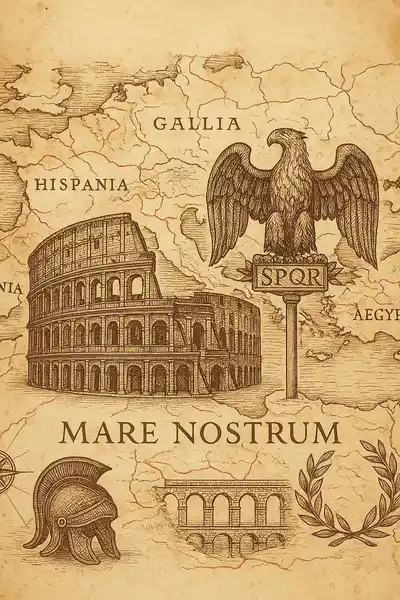
What Augustus and his successors built was, at its best, an astonishingly effective machine for keeping order across enormous distances. The famous roads — eventually some 80,000 kilometers of them — were engineered first for the legions to move fast, then used by traders, tax collectors, and imperial couriers. A merchant in Gaul and a soldier in Syria could use the same coins, appeal in principle to the same law, and buy goods carried by ships crossing a Mediterranean that Rome, uniquely, controlled entirely and called mare nostrum, our sea.
The genius was as much administrative as military. Rome governed lightly where it could. Local elites were co-opted rather than crushed; a Gaulish or Spanish aristocrat could become a Roman citizen, hold office, and eventually even sit in the Senate. Citizenship, once jealously hoarded, was extended in widening circles until the emperor Caracalla granted it to nearly all free inhabitants in 212 AD. The offer was clever: become Roman, and Rome largely lets you run your own affairs while collecting its taxes and keeping the peace.
03Chapter 3 — The century Rome nearly came apart
For a long time the succession problem stayed manageable. Then, in the third century AD, it nearly destroyed everything. Between roughly 235 and 284 AD, Rome cycled through more than twenty emperors — most of them generals raised up by their own troops and murdered by the next contender within a few years. The period is known simply as the Crisis of the Third Century, and it came close to being the end.
Everything hit at once. Frontier armies fighting each other left the borders exposed, and both the resurgent Persians in the east and Germanic groups in the north pushed hard against them. In 260 AD the emperor Valerian was captured alive by the Persians — an unthinkable humiliation. The currency, debased repeatedly to pay the armies, collapsed into rampant inflation. Plague swept through the population. For a stretch the Empire physically split into three pieces, with breakaway regimes in Gaul and in the east running their own affairs.
04Chapter 4 — What Rome left in the walls and the words
The western Empire did not end in a single catastrophe. It bled out over the fifth century as the imperial center lost the ability to pay its armies and defend its borders. Germanic peoples, some fleeing pressure from the Huns further east, moved into the provinces — sometimes as invaders, often as settlers and hired troops who ended up governing in Rome's name and then simply in their own. Rome itself was sacked in 410 AD, an event that shook the ancient world, and again in 455. When the general Odoacer deposed the boy-emperor Romulus Augustulus in 476 AD, it was less a fall than a formality; real power had already passed to the men on the ground.
Here is the strange part. The state stopped, but the idea of it would not. In the east, the Empire simply continued — what we call the Byzantine Empire was to its own people just Rome, and it lasted until Constantinople finally fell in 1453, nearly a thousand years later. In the west, the very kings who had dismantled imperial authority spent centuries trying to claim it. Charlemagne had himself crowned Roman emperor in 800 AD. The Holy Roman Empire carried the name into the nineteenth century. The Tsars of Russia and the Kaisers of Germany both took their titles, at one remove, from Caesar.
05Conclusion
Augustus's careful lie — that he had restored the republic while quietly ending it — turned out to be the most honest thing about Rome. The Empire was always a fiction held together by force, roads, and law, forever one bad succession away from chaos, and it spent five centuries in a cycle of near-collapse and stubborn rebuilding. That it nearly died in the third century and carried on for two hundred more years in the West, and a thousand in the East, says less about its invincibility than about how hard people worked to keep the machine running.
Related books