The Marathon
Twenty-six miles as mass ritual
Description
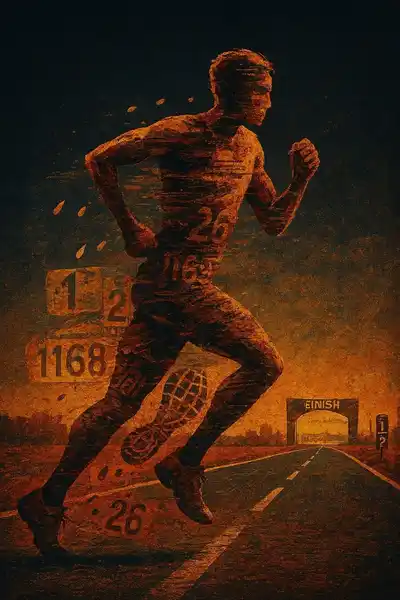
On November 4, 2023, roughly fifty thousand people crossed the starting line of the New York City Marathon and ran twenty-six miles and three hundred and eighty-five yards through five boroughs, most of them with no chance of winning and no intention of trying. They were accountants and teachers and retirees and people who, a year earlier, could not have run to the corner. They had trained for months, paid a fee to suffer, and arranged for friends to stand on sidewalks holding signs. Nobody made them do it. That is the strange part.
The number matters because the marathon is one of the few endurance ordeals that ordinary people willingly seek out. There is no prize for the twelve-thousandth finisher. There is no career riding on it. And yet participation in road marathons worldwide has climbed steadily for decades, with the six largest big-city races each drawing tens of thousands of runners and rejecting many more through lottery. A distance invented to test elite athletes has become a thing that millions of amateurs organize their lives around.
What we have, in other words, is a mass ritual hiding inside a footrace — a fixed distance, a shared calendar, a crowd that gathers to watch strangers hurt themselves on purpose. It looks like sport, but it behaves like something older. The marathon rewards almost no one and satisfies almost everyone who finishes, which is a peculiar economy of effort, and worth following back to where it came from.
The question we’re asking : How did a distance built for elite competition turn into an ordeal that millions of amateurs choose for themselves?What we’ll see : From a battlefield legend to a modern crowd of fifty thousand, and what the finish line actually gives the person who crosses it last.
Table of contents
01 Chapter 1 — A messenger who probably never ran
The story everyone knows starts on a battlefield. In 490 BCE, after the Greeks defeated a Persian invasion on the plain of Marathon, a messenger named Pheidippides supposedly ran to Athens, announced the victory, and dropped dead from exhaustion. It is a good story. It is also, in that neat form, almost certainly not true. The ancient sources are a mess. The earliest accounts of the battle, written by Herodotus a few decades later, mention a runner named Pheidippides, but they send him on a different errand entirely — a long run to Sparta to beg for military help before the fighting, a distance of roughly a hundred and forty miles, not the tidy twenty-six from Marathon to Athens.
The dying-messenger version came centuries later, stitched together by writers like Plutarch and Lucian, who were writing hundreds of years after the fact and were not especially concerned with accuracy. Names shifted between tellings. The collapse at the finish may have been borrowed from a different anecdote entirely. What survived into modern memory was not the historical event but the image: a man running until his body gives out, carrying news that could not wait. That image, rather than any verified run, is the real ancestor of the race.

02 Chapter 2 — How a stunt became a distance
The first modern marathon was run at the 1896 Athens Olympics, and it worked better as theater than anyone expected. A Greek water carrier named Spyridon Louis won on home ground, and the crowd went delirious. The race was an instant fixture. But the distance was not yet fixed. Early marathons ran roughly forty kilometers, give or take, the length adjusted to whatever route the host city could offer. For more than a decade, a marathon simply meant a very long run of approximately that size.
The exact figure — twenty-six miles and three hundred and eighty-five yards, or 42.195 kilometers — came from the 1908 London Olympics, and its origin is almost comically mundane. The course was laid out so the runners would start near Windsor Castle, within sight of the royal children, and finish in front of the royal box at the stadium. The distance was whatever those two points happened to be apart. There was no ancient logic to it, no calculation of human limits. It was a matter of royal sightlines. The number stuck, and in 1921 it was formally adopted as the official marathon distance worldwide.
03 Chapter 3 — The day the amateurs took over
The change came in the 1970s, and it came fast. In the United States a running boom took hold, driven partly by a growing interest in fitness, partly by books like Jim Fixx's bestselling guide to jogging in 1977, and partly by a single televised moment: Frank Shorter, an American, winning the Olympic marathon in Munich in 1972. Ordinary people who had never considered running suddenly saw a distance they might attempt themselves. Running stopped being the private discipline of a few and became something a regular person could take up on a Saturday.
The institutions caught up quickly. The New York City Marathon had started in 1970 as a small loop of Central Park with a few dozen finishers. In 1976 it moved out into all five boroughs, turning the race into a citywide event that ran past millions of spectators. The design was deliberate: make the course a tour of the city, line the streets with crowds, and the whole thing becomes a public festival rather than an athletic contest. Other cities followed. London staged its first mass marathon in 1981, explicitly modeled on the idea that ordinary people finishing was the point.
04 Chapter 4 — Why anyone runs 26.2 miles at all
Strip away the myth and the history and one question is left standing on the sidewalk: why would a person with a job and a family and no athletic ambition choose to spend six months training for a day of self-inflicted pain? The prize is nothing. The pace is slow. The body, past a certain point in the race, is genuinely suffering. And yet the demand keeps growing, which means the marathon is giving people something the rest of modern life does not.
Part of the answer is that the marathon offers a rare thing: an ordeal with a clear beginning, a clear end, and an unambiguous result. Most of adult life is diffuse. Work is never finished, parenting has no finish line, progress is hard to measure. The marathon is the opposite. You either cross the line or you don't, and the distance cannot be negotiated or faked. In a world short on clean outcomes, twenty-six miles delivers a verdict. That legibility is a large part of the appeal — the ordeal is bounded, and its meaning is not up for debate.
05 Conclusion
The fifty thousand who ran through New York that November morning were the far end of a long chain that starts with a messenger who probably never made the run he is famous for. Between the legend and the crowd sit a royal sightline that fixed the distance, a small world of obsessives who guarded it, and a 1970s decision to throw the race open to anyone willing to train. Each step added a layer, and none of them was inevitable. The marathon we have is an accident that hardened into a tradition.
Related books