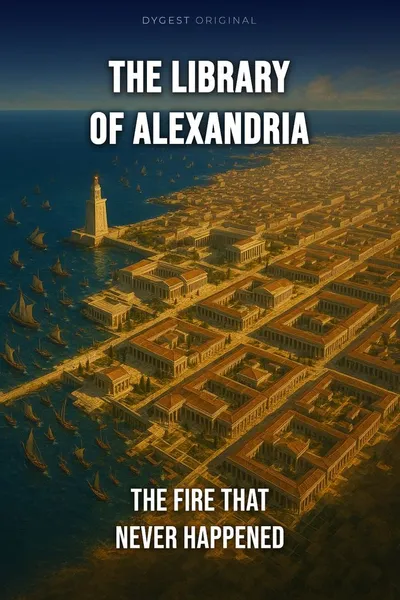
The Library of Alexandria
The fire that never happened
Description
The Library of Alexandria is the most famous lost institution in Western memory. The image is vivid and durable — a great building of scrolls on the Mediterranean coast, tens of thousands of works by Greek and Hellenistic authors, the accumulated knowledge of the ancient world, reduced to ashes in a single catastrophic fire. The version that usually gets told identifies one villain, whether Julius Caesar, a Christian mob, or an Arab caliph, depending on who's telling. Classical civilization was set back by a millennium, the story goes, in an afternoon.
Almost none of that is accurate. The Library of Alexandria did not burn down in a single fire. It declined across seven hundred years, through at least four distinct destructive events, each of which removed part of what was left. No single one of those events can be called the end. By the time any claim of a final destruction can be dated, the institution had already largely ceased to function. The simple story of a sudden loss — the flame, the scrolls, the afternoon — is a compression of something much slower, more complicated, and less dramatic.
This is not a minor factual correction. The persistence of the single-fire myth, across two thousand years and against every piece of scholarly evidence, is a case study in how cultural memory works. A clear event with a named villain is easier to remember than a gradual collapse. The simple version becomes, for most people, what the library was and what happened to it. Understanding why the evidence loses to the story is one of the most useful things classical history can teach us.
● The question we're asking: what actually happened to the Library of Alexandria, and why does everyone remember a single catastrophic fire that never happened that way?
● What we'll see: what the library actually was, the four separate destructive events spread across seven centuries, what was and wasn't really lost, and what the persistence of the single-fire myth tells us about how cultural memory works.
Table of contents
01What the library actually was
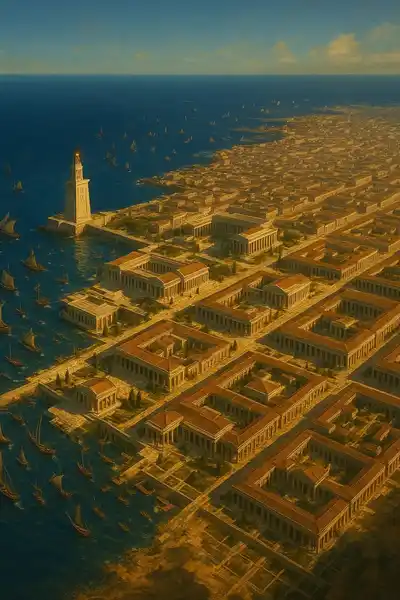
The library was founded around 283 BC, under Ptolemy I Soter, one of Alexander the Great's generals who took control of Egypt after Alexander's death. His son Ptolemy II Philadelphus expanded it. It was part of a larger institution called the Mouseion — literally a temple to the Muses — which also included lecture halls, dining halls, observation rooms, and gardens. The Mouseion was, functionally, the first major research institution of the Hellenistic world.
The library pursued an explicit acquisitions policy that was unusually aggressive for its era. Ships arriving in Alexandria harbor were searched for manuscripts. Any scroll found was taken to the library, copied, and then — according to several sources — the copy was returned to the ship while the original stayed in Alexandria. Ptolemy III is said to have borrowed the master scrolls of the Athenian tragedians Aeschylus, Sophocles, and Euripides, forfeited a substantial deposit, and kept the originals anyway.

02The four destructive events
The first of the destructive events came in 48 BC, during Julius Caesar's Alexandrian campaign. Caesar was besieged in the royal quarter of the city by the forces of Ptolemy XIII. To prevent his ships from being captured, Caesar set fire to them in the harbor. The fire spread to the docks and warehouses near the waterfront. Whether or not it reached the main library is disputed by ancient sources themselves. Plutarch, writing about 150 years later, claims the library was destroyed. Caesar's own account of the campaign doesn't mention it. Strabo, writing decades after Caesar, describes the library as still functioning.
The second major event was the reconquest of Alexandria by the Roman emperor Aurelian in 273 AD. Aurelian was retaking the eastern provinces from the Palmyrene Empire of Queen Zenobia, and the fighting in Alexandria devastated the Bruchion, the central royal quarter where the main library was located. Ancient sources describe widespread destruction of the royal buildings. Whatever remained of the main library collection from the 1st-century damage likely ended here.
03What was actually lost
The question of what was actually lost at Alexandria is more complicated than the myth suggests. Hellenistic libraries didn't hold unique works as a rule. They held copies. Most major texts existed in multiple libraries across the Mediterranean — Pergamon, Antioch, Athens, Rome, Constantinople, and dozens of private collections. The Alexandria library was the largest, but it was not a single point of failure for classical learning.
The major Greek and Hellenistic works that survived did not survive because of Alexandria. They survived because they were copied, generation after generation, across monasteries, scriptoria, and private collections over roughly a thousand years. Plato's dialogues, Aristotle's major works, Euclid's Elements, Homer's epics, the tragedians — all of these came down through Byzantine, Islamic, and European copying traditions, not through Alexandria specifically. The actual transmission of classical knowledge was a distributed, multi-century process.
04Why the myth survives anyway
The single-fire myth persists because it's useful. It gives the loss a narrative shape. One event, one villain, one moment the world lost something irreplaceable. A gradual decline across seven centuries, across four cities and three empires, doesn't tell as well. Human memory defaults to dramatic compression. The library gets the dramatic version not because the evidence supports it but because dramatic stories win.
Each retelling of the myth has served a purpose. Christian writers in late antiquity emphasized the Caesar version, implying the pagans were to blame. Enlightenment writers in the 18th century emphasized the Christian mob of 391, making the Church the villain. Orientalist writers in the 19th century emphasized the Caliph Umar story, making Islam the destroyer. Modern secular accounts tend to blend all three, making 'intolerance' generally responsible. The library is always the victim of whoever the teller wants to indict.
05Conclusion
The Library of Alexandria did not burn down on a single day in 48 BC, or 273, or 391, or 642. It declined across more than seven hundred years, through at least four destructive events, each of which took part of what remained. The knowledge the library preserved was preserved at other libraries and in other copying traditions; what was uniquely lost was real but almost certainly smaller than legend claims. The great single fire of the classical imagination is a story the classical world itself invented and every subsequent era has rewritten to suit.
Related books