The Kennedy Assassination, Part 1
Dallas, 22 November 1963
Description
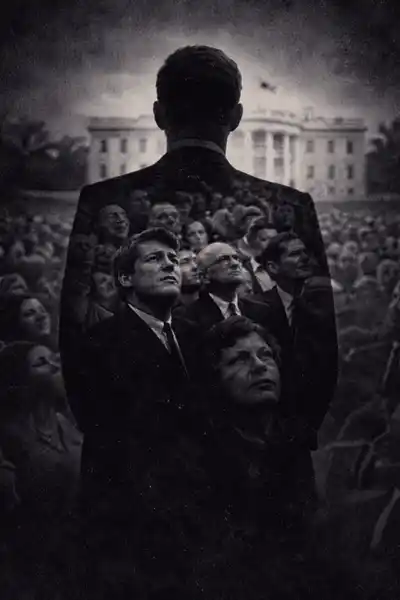
On the morning of Friday, 22 November 1963, it was raining in Dallas, and the men planning the President's visit worried mostly about the weather. A wet motorcade meant the plexiglass bubble top would stay on the presidential limousine, and John F. Kennedy did not like the bubble top — it kept people from seeing him. Around mid-morning the clouds broke. The top came off. By the time Air Force One touched down at Love Field just before noon, the sky over Texas was a clean, brilliant blue, and a crowd was pressing against the fences to watch the President and Jacqueline Kennedy walk down the steps into the sun.
The trip had a purpose beyond handshakes. Kennedy had come to Texas to mend a Democratic Party splitting at the seams, and Dallas in particular carried a reputation he was there partly to disarm — a city that had jeered his ambassador to the United Nations a month earlier, a place some of his own people had quietly warned him against. He wanted to show he could ride through it in an open car, smiling, unafraid. For most of the route through downtown, that is exactly what happened. The crowds were warm, ten and twelve deep in places. Nellie Connally, the governor's wife, turned around in the car and said, more or less, that Dallas loved him.
Then the motorcade turned onto Elm Street, into a small park called Dealey Plaza, and in the space of a few seconds the afternoon came apart. What followed was not a single clean event but a scramble — of witnesses who heard different things, of officers running in different directions, of reporters phoning in fragments that contradicted each other within minutes. Before the country could grieve, it first had to figure out what had even happened.
The question we’re asking : What actually unfolded in Dallas on 22 November 1963, hour by hour, before anyone had time to make sense of it?What we’ll see : We follow the day itself — the arrival, the plaza, the hospital, and the disordered hours in which a nation tried and failed to agree on what it had just seen.
Table of contents
01Chapter 1 — A city that wanted to make amends
The Texas trip had been in the works for months, and it was politics before it was anything else. Kennedy's margin in 1960 had been razor-thin, and Texas — twenty-five electoral votes, home state of his vice president Lyndon Johnson — was already looking shaky for 1964. Worse, the state party was tearing itself apart between its conservative and liberal wings, personified by Governor John Connally on one side and Senator Ralph Yarborough on the other. The President had essentially come to force the two men to be seen smiling together. That is why Yarborough was made to ride in Johnson's car, and why so much of the planning fixated on who sat where.
Dallas made the White House nervous. The city had a hard-edged right-wing streak, and it had a history. Adlai Stevenson, the ambassador to the UN, had been spat on and struck with a placard there in late October. On the morning of the visit, handbills circulated around town showing Kennedy in the style of a mugshot under the words WANTED FOR TREASON. A full-page ad in that day's Dallas Morning News, bordered in black like a death notice, accused him of being soft on communism. Some advisers had wondered aloud whether he should go at all.

02Chapter 2 — Seven seconds on Elm Street
Dealey Plaza is small — smaller than it looks in memory. It is a shallow bowl of grass fringed by streets, with a colonnade and a low fence on a gentle rise that would come to be called the grassy knoll, and, overlooking the corner where Elm bends, a seven-story brick building, the Texas School Book Depository. The limousine was moving at about eleven miles an hour, roughly forty feet below and ahead of the Depository's upper windows, when the first shot cracked across the plaza a little after 12:30 in the afternoon.
Accounts of what people heard diverged from the very first instant, and never fully converged. Some heard three shots, some two, some four; some thought a motorcycle had backfired, some thought firecrackers. Zapruder, a local dressmaker filming from a concrete pedestal with a home-movie camera, captured the sequence in a few seconds of silent color film that would later be studied frame by frame for decades. In it, the President is seen to raise his hands toward his throat. Governor Connally, in front of him, is hit and slumps toward his wife. Then, in a frame that has never lost its power to shock, the fatal head shot.
03Chapter 3 — Parkland, and a word nobody wanted to say
Parkland Memorial Hospital was four miles away. The limousine covered the distance in roughly four minutes, radioing ahead. When it screamed up to the emergency entrance a little before 12:40, there was a moment of horrible stillness — no one moved to lift the President out, because Jackie would not let go of him, cradling his head so that others could not see the wound. An agent quietly took off his suit coat and draped it over before they carried him inside to Trauma Room One.
The doctors who worked on him understood almost at once that there was nothing to be done. The head wound was catastrophic. They performed the motions of resuscitation anyway — a tracheotomy, transfusions, chest compressions — for the same reason anyone does when the patient is the President of the United States: because stopping was unthinkable while any procedure remained. A priest was called. At 1:00 p.m., roughly half an hour after the shots, John F. Kennedy was pronounced dead. Governor Connally, in a separate trauma room, was in serious condition but would survive.
04Chapter 4 — The hours a country could not agree on
Step back from the individual scenes and the shape of the afternoon becomes its own story. Nearly everything that would define the Kennedy assassination for the next sixty years was decided not by careful investigation but by the raw disorder of a few hours in which no one was in charge of the facts. The founding record of the most examined crime in American history was assembled on the run, by frightened people, before anyone understood what they were looking at.
Consider how much was already fractured by nightfall. Witnesses in the same plaza had heard different numbers of shots from different directions. The car had been washed out and the crime scene compromised before it could be properly secured. The President's body had been wrestled away from the Dallas authorities and flown to Washington, where the autopsy was performed by military pathologists working under pressure and without the Texas records — a chain of custody so ragged that it seeded doubt for decades. A man named Lee Harvey Oswald was arrested that afternoon in a movie theater, charged first with killing a policeman and then with killing the President, and he would be shot dead two days later on live television before he could be tried. The one person who might have answered the questions was gone almost as fast as Kennedy.
05Conclusion
By the time Air Force One lifted off from Love Field that afternoon, carrying a dead president, a widow still in her bloodstained suit, and a new president who had just been sworn in aboard the plane by a local judge, the sunlit optimism of the morning was already unrecoverable. The day had begun with worries about rain and a bubble top. It ended with a nation staring at its screens, unable to assemble what it had watched into a single coherent picture.
Related books