The Declaration of Independence
Jefferson’s draft and the document that became founding myth
Description
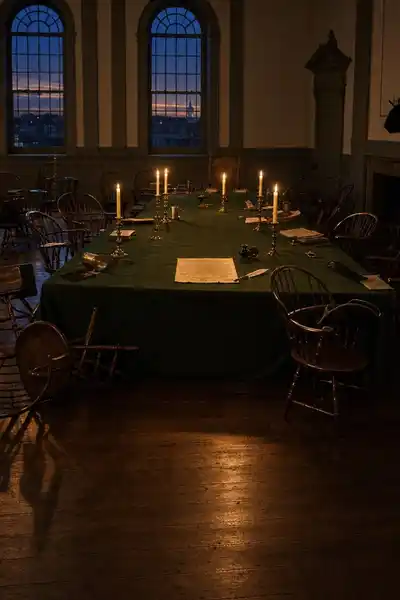
In the third week of June 1776, in a rented second-floor parlor at the corner of Seventh and Market Streets in Philadelphia, a thirty-three-year-old Virginia plantation owner named Thomas Jefferson sat down with quill and paper to draft a document that the Second Continental Congress had asked him to prepare. The Congress had been debating, since early June, a resolution by the Virginia delegate Richard Henry Lee declaring the thirteen British North American colonies independent of the British Crown. The committee of five that had been appointed to draft the formal declaration composed of John Adams of Massachusetts, Benjamin Franklin of Pennsylvania, Roger Sherman of Connecticut, Robert Livingston of New York, and Jefferson had delegated the actual writing to Jefferson, on the explicit grounds, in Adams’s later recollection, that Jefferson had the “happy talent of composition” and that “a Virginian ought to appear at the head of this business.” Jefferson worked on the draft across approximately seventeen days, producing a document that the committee modified, that Congress further modified during debate on July 2-4, and that the body formally approved on July 4, 1776.
The document that emerged has become one of the more consequential single texts in modern political history. The structure Jefferson developed a preamble articulating general principles of natural rights and consent of the governed, followed by a list of specific grievances against King George III, concluding with the formal declaration of independence became the substantial template for subsequent independence movements across the following two centuries. The specific phrasings Jefferson produced “all men are created equal,” “life, liberty, and the pursuit of happiness,” “consent of the governed,” “decent respect to the opinions of mankind” have become substantially central to American political vocabulary and have been quoted in subsequent American political documents at substantial frequency. The Declaration that the Continental Congress approved on a hot July day in 1776 has been the foundational reference of American political identity for the subsequent two and a half centuries.
The case has become one of the central reference points in modern American political history and in the broader study of how foundational texts shape subsequent political development. The Declaration was not, in 1776, a substantial legal document; it was a political statement designed to substantially justify the separation from Britain and to secure foreign support, particularly French support, for the war effort that was already in progress. The document’s subsequent transformation into the substantial foundational reference of American political identity occurred across the following century, with the explicit incorporation of its principles into political argument by Lincoln, by the abolitionist movement, by the civil rights movement, and by the broader trajectory of American political reform. The text that Jefferson drafted in seventeen days has substantially structured the American political imagination ever since.
The question we’re asking: what did Jefferson actually write, what political work did the document do in 1776, and what does the case reveal about how foundational texts shape subsequent political development?
What we’ll see: Jefferson and the drafting process, the document’s specific content and its 1776 reception, the long transformation into American political identity, and what survives.
Table of contents
01Jefferson and the drafting
Thomas Jefferson had arrived in Philadelphia in June 1775 as a Virginia delegate to the Second Continental Congress, having previously served in the Virginia House of Burgesses and having written the 1774 pamphlet A Summary View of the Rights of British America that had established his reputation as a political writer. The pamphlet had argued that the American colonies were under the British Crown but not under Parliament, placing Jefferson among the more aggressive American advocates for resistance. That reputation substantially shaped the committee’s decision to delegate the drafting to him.
The drafting was shaped by the intellectual traditions Jefferson had absorbed at William and Mary and in his subsequent reading. The natural rights philosophy of John Locke, the Scottish Enlightenment of Francis Hutcheson, the legal commentaries of Blackstone, and the writings of Emer de Vattel had all shaped Jefferson’s thinking about political authority. The Declaration synthesized these traditions into a distinctly American formulation, drawing on multiple sources without direct quotation from any single one.

02The document and its 1776 reception
The document had three parts. The preamble articulated the philosophical framework: “We hold these truths to be self-evident, that all men are created equal, that they are endowed by their Creator with certain unalienable Rights, that among these are Life, Liberty and the pursuit of Happiness.” The second section listed twenty-seven specific grievances against King George III. The conclusion formally declared the colonies independent, with the commitment that “we mutually pledge to each other our Lives, our Fortunes, and our sacred Honor.”
The political work the document was designed to do had several dimensions. The most immediate was to justify the separation to the broader American population that would have to support the war. The Declaration’s focus on the king’s grievances rather than on Parliament’s actions, which had been the principal source of the colonial conflict framed the conflict as a defensive response to royal tyranny rather than as a rejection of the British constitutional framework. The framing was essential to maintaining American support across the subsequent seven years.
03The long transformation into American political identity
The Declaration’s transformation into the foundational reference of American political identity occurred across the nineteenth century. The document was less central to American political argument in the immediate post-independence period than the Constitution of 1787 and the Bill of Rights of 1791. The Declaration was celebrated as a historical event but was not deployed as a source of legal or political authority in the early decades of the republic.
The shift began with the anti-slavery movement of the 1820s and 1830s. The abolitionists deployed the Declaration’s “all men are created equal” formulation as the principal moral argument against slavery, with the contradiction between the document’s principles and the persistence of American slavery becoming central to the abolitionist case. William Lloyd Garrison’s The Liberator quoted the Declaration in its political argument. Frederick Douglass’s 1852 “What to the Slave Is the Fourth of July?” speech constructed the principal abolitionist deployment of the Declaration’s framework.
04What survives, and what the case shows
The Declaration’s status as the foundational reference of American political identity has been established for the past 150 years. The text continues to be quoted in political argument across the partisan spectrum. The specific phrasings “all men are created equal,” “life, liberty, and the pursuit of happiness,” “consent of the governed” remain central to American political vocabulary. The annual celebration of Independence Day commemorates the document’s approval. The original parchment manuscript, at the National Archives in Washington, functions as a national relic.
The deeper lesson is about how foundational texts produce political consequences across time periods substantially longer than their original political moments. Jefferson drafted the Declaration in seventeen days to address the specific political problem of justifying independence from Britain. Its subsequent transformation into the foundational moral reference was the work of subsequent generations who deployed it for substantially different purposes than the original drafters had anticipated. The Declaration Lincoln deployed at Gettysburg was the same text Jefferson had drafted in 1776, but the political work it was doing was substantially different.
05Conclusion
Thomas Jefferson died on July 4, 1826, exactly fifty years after the document he had drafted was approved. John Adams, who had been on the drafting committee, died the same day. The coincidence on the fiftieth anniversary has been substantially central to the subsequent commemoration of both figures.
Related books