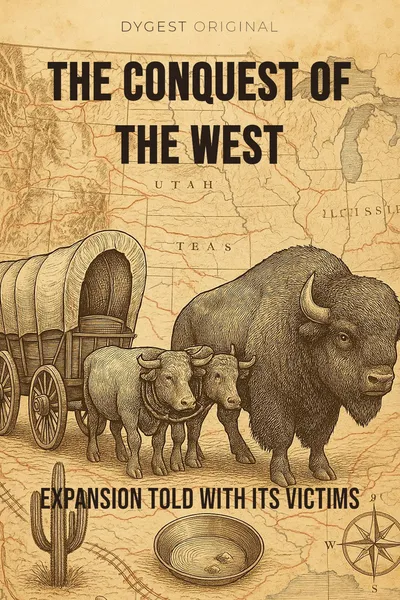
The Conquest of the West
Expansion told with its victims
Description
In 1890, the Superintendent of the Census made a small administrative note that would echo for a century. For every earlier count, the map had shown a frontier line — the edge past which the United States considered its land unsettled. That year, the line was gone. Population had scattered densely enough across the West that there was no continuous edge left to draw. A bureaucrat's footnote, buried in a government report, declared the frontier officially closed. Three years later, a young historian named Frederick Jackson Turner stood up in Chicago and told a room of colleagues that this closing marked the end of the first great chapter of American life.
Turner's story was clean and flattering. The frontier, he argued, had made Americans American — self-reliant, democratic, forever renewed by contact with open land. It became one of the most influential ideas the country ever told about itself, taught in schools and repeated in films for generations. What the story left out was that the land was never open. It was inhabited, farmed, hunted, and governed by hundreds of nations, and the westward movement that Turner celebrated was, for those nations, an invasion measured in treaties broken, populations halved, and homelands legislated away.
The conquest of the West is usually told as motion — wagons, railroads, gold, the map filling in from east to west. Told from the ground it moved across, it is a different subject entirely: not the settling of empty space but the transfer of a continent from one set of peoples to another, carried out with laws as much as with rifles. Both stories are true. Only one of them tends to get told.
The question we’re asking : What did westward expansion actually do to the peoples already living across the continent, and how did a story of settlement come to cover it?What we’ll see : The mechanics of a conquest carried out by treaty, statute and railroad — and the myth built afterward to make it feel like destiny.
Table of contents
01Chapter 1 — The moving line
When the United States won independence, its claimed territory stopped roughly at the Mississippi. Everything beyond was, on paper, foreign or unknown; in fact it was home to peoples who had lived there for thousands of years — Lakota and Cheyenne on the plains, Shoshone and Nez Perce in the mountains, Navajo and Apache in the Southwest, dozens of nations along every river. The map that Americans carried in their heads showed wilderness. The land itself showed nations with their own borders, alliances and wars.
The line began to move fast. The Louisiana Purchase of 1803 doubled the country overnight, though France was selling a claim, not a cleared territory — the peoples living on it had not been consulted and did not consider themselves sold. The annexation of Texas, the war with Mexico that ended in 1848, and the settlement of the Oregon boundary pushed the United States to the Pacific in barely two generations. On the map, this looked like growth. On the ground, it meant that millions of square miles suddenly fell under a government that regarded the existing inhabitants as obstacles to be moved.

02Chapter 2 — The paper that dispossessed
The conquest of the West was fought with rifles, but it was won with documents. Between the 1770s and the 1870s, the United States signed roughly 370 treaties with Native nations. Each one was a formal agreement between sovereign parties, ratified by the Senate, carrying the full weight of law. Each one also tended to follow the same arc: land was ceded in exchange for guarantees of the land that remained, payments, and promises of protection — and then, as settlers pressed in or minerals were found, the guarantees were renegotiated, narrowed, or simply ignored.
The pattern was not incidental; it was the method. A treaty would fix a boundary and call it permanent. Within a decade, a railroad survey or a gold strike would make that boundary inconvenient, and a new treaty would shrink it. The Lakota, guaranteed the Black Hills "forever" in the 1868 Fort Laramie Treaty, watched that forever collapse within eight years when gold was found there and prospectors poured in with the army behind them. The word permanent, in this system, meant until the land became valuable.
03Chapter 3 — Removal, reservation, allotment
Three federal policies, stacked across the century, carried out most of the dispossession. The first was removal. In 1830, Congress passed the Indian Removal Act, authorizing the relocation of eastern nations to territory west of the Mississippi. The Cherokee, who had adopted a written constitution and taken their case to the Supreme Court, won a ruling in their favor — and were removed anyway. The forced march of 1838 and 1839, remembered as the Trail of Tears, killed several thousand Cherokee along the route. The Choctaw, Creek, Chickasaw and Seminole were driven west under similar terms.
The second policy was the reservation. As expansion filled the plains, the government stopped trying to move nations beyond the frontier — there was no longer a beyond — and instead began confining them to fixed, shrinking tracts. Peoples who had followed the buffalo across enormous ranges were pressed onto reserves and told to farm. The buffalo themselves were nearly exterminated in the same decades, partly by commercial hunting and partly as deliberate policy, since destroying the herds destroyed the independence of the plains nations. By the 1880s, the animal that had sustained an entire way of life was almost gone, and the way of life with it.
04Chapter 4 — The myth that outlived the frontier
Step back from the treaties and the acreage, and a larger question comes into view: how did a conquest this thorough come to be remembered as a settlement? The answer lies partly in Turner's 1893 lecture and everything built on top of it. By declaring the frontier the source of American character, he gave the whole century of expansion a purpose that had nothing to do with the people displaced by it. The frontier became a stage for national self-making, and the nations already living on it became scenery — present, sometimes, as danger or as vanishing nobility, but never as parties with a claim.
The dime novels, the Wild West shows, and eventually the Western film industry finished the editing. The plot they repeated was almost always the same: pioneers building something out of nothing, threatened by a wilderness that included its inhabitants. Cast that way, the story could not hold dispossession, because dispossession requires that the land already belonged to someone. A frontier myth needs empty space. So the space was rendered empty, again and again, in a hundred versions of the same tale.
05Conclusion
The 1890 census note that closed the frontier was an accounting fact: the land had been claimed, parceled and filled in. Read alongside the Dawes rolls and the shrinking treaty maps, it also marks the near-completion of a transfer — a continent that had belonged to hundreds of nations now belonged, by law, to the government that had spent a century writing them out of the deed. The line on the map disappeared because the taking was essentially done.
Related books