NGOs
Private actors in public roles
Description
In 2010, in the weeks after the earthquake that flattened much of Port-au-Prince, more than ten thousand nongovernmental organizations were operating in Haiti — a country of roughly ten million people. It was one of the highest NGO-per-capita densities anywhere on earth, and it earned Haiti a nickname it never asked for: the Republic of NGOs. Water, sanitation, schooling, medical care, the rebuilding of neighborhoods — much of what a functioning state normally handles was being run by organizations answerable to donors in Geneva, Washington and Oslo rather than to anyone in Haiti. Billions of dollars flowed in. Years later, audits struggled to say clearly where a great deal of it had gone.
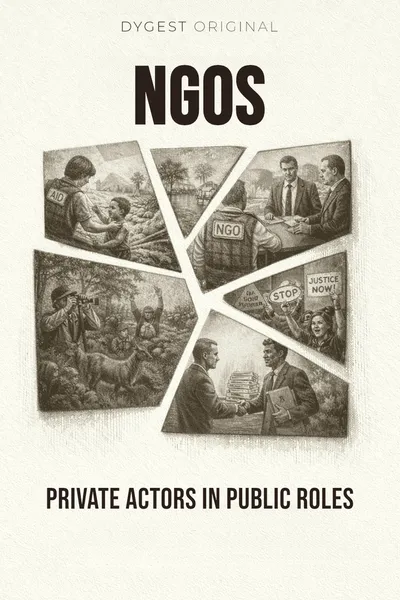
Haiti was an extreme case, but the arrangement it exposed is not exotic at all. Across the world, organizations with no army, no tax base and no ballot box now vaccinate children, monitor elections, draft the language that ends up in international treaties, and decide which villages get a clinic. Some employ tens of thousands of people and move budgets larger than the governments they operate alongside. They are not companies — they do not exist to turn a profit. They are not states — nobody elected them. They sit in a category we still describe by what they are not: non-governmental.
That negative definition hides a lot. It groups a two-person advocacy shop and a global federation with a billion-dollar budget under the same three letters. And it quietly sidesteps the thing that makes the whole sector interesting and uneasy at once — the fact that private bodies have taken on jobs we normally reserve for public authority, and taken on the power that comes with them.
The question we’re asking : When private organizations perform public functions — funded by whom, answerable to whom — where does their authority actually come from?What we’ll see : We follow the money, the influence and the accountability of the NGO, and end on the harder question underneath: who granted the power in the first place.
Table of contents
01Chapter 1 — The word that covers everything and nothing
The term itself is a bureaucratic accident. When the United Nations was founded in 1945, its charter granted a consultative role to "non-governmental organizations" — a phrase meant simply to name the private groups, unions and associations that would sit alongside member states without being states themselves. It was a category defined by exclusion, and the exclusion stuck. Eighty years later we still label an enormous, varied slice of civic life by the one thing it is not.
Under those three letters live wildly different animals. There is the small human-rights collective run out of a shared office. There is Médecins Sans Frontières, which fields thousands of medical staff in war zones and treats millions of patients a year. There is the World Wildlife Fund, whose panda logo is recognized in places its conservation programs never reach. There are advocacy groups that never deliver a single service and exist only to change laws, and there are operational giants that build sewers and run refugee camps. Calling them all "NGOs" flattens a spectrum that runs from a neighborhood association to something closer to a private government.

02Chapter 2 — Where the money actually comes from
The romantic image of the NGO is a crowd of small donors — the monthly ten dollars, the disaster appeal, the sponsored child. That image is real for some organizations and misleading for most large ones. Across the sector, a very large share of funding comes not from the public but from governments and a handful of major foundations. Aid agencies, foreign ministries and multilateral bodies channel enormous sums through NGOs precisely because it is often cheaper and politically easier than delivering services directly. The nominally non-governmental organization frequently turns out to be, in budget terms, substantially government-financed.
This creates a quiet dependency that shapes behavior more than any charter does. An organization living on institutional grants has to keep those funders happy, which means chasing whatever priorities donors announce this year — resilience one season, climate adaptation the next — and reporting success in the metrics donors want to see. Money arrives earmarked for specific projects, rarely for the unglamorous work of keeping the lights on, so organizations become fluent in writing proposals that fit fashionable categories rather than local needs. The tail of funding wags the dog of mission more often than anyone likes to admit.
03Chapter 3 — Power without a mandate
The influence NGOs wield is easy to underestimate because it rarely looks like force. It looks like a report, a briefing, a seat at a negotiating table. Yet the sector has quietly become one of the most effective political actors of the past half-century. The campaign to ban landmines, driven by a coalition of NGOs, produced an international treaty in 1997 and a Nobel Peace Prize for the coalition that led it. Human-rights organizations shape the language of conventions before diplomats ever debate them. Environmental groups set the terms of climate summits. Much of what looks like the will of the international community was first drafted in the offices of private organizations.
On the ground, the power is more concrete still. In places where the state is weak or absent, an NGO deciding which district gets a water project or which clinic gets staffed is making a governing decision, whatever the org chart says. It sets priorities, allocates scarce goods, and creates winners and losers, all without the messy business of consulting an electorate. Recipients experience this less as charity than as authority — a foreign body they did not choose, making choices they cannot vote against, that determine whether their children are treated.
04Chapter 4 — The legitimacy no one voted for
Strip away the specifics and the NGO poses a genuinely awkward question about power. We generally think legitimate authority comes from one of two places: from the market, where customers vote with their money, or from the state, where citizens vote with their ballots. The NGO claims a third source — moral purpose. It says: our authority rests on the fact that we are doing good, disinterestedly, for people who need it. It is a claim to legitimacy by virtue rather than by mandate.
For a small advocacy group speaking truth to power, that claim is unremarkable; anyone is free to argue for a cause. The difficulty arrives when the same moral claim underwrites real governing power — the allocation of resources, the delivery of essential services, the shaping of law affecting millions. At that scale, "we are doing good" starts to do the work that elections do elsewhere, and it does it without the checks elections bring. Good intentions, however sincere, are not a substitute for consent, and the people most affected are usually the ones least able to grant or withhold it.
05Conclusion
The Republic of NGOs in Haiti was not a failure of individual organizations, most of which were trying, in difficult conditions, to help. It was a failure of the arrangement itself: a country's public functions dispersed across thousands of private bodies, each accountable to distant funders, none accountable to the Haitians they served, with no one holding the whole. When so much authority answers upward and so little answers down, even good work leaves a governing vacuum where responsibility should sit.
Related books