Mount Rushmore
The monument on stolen land
Description
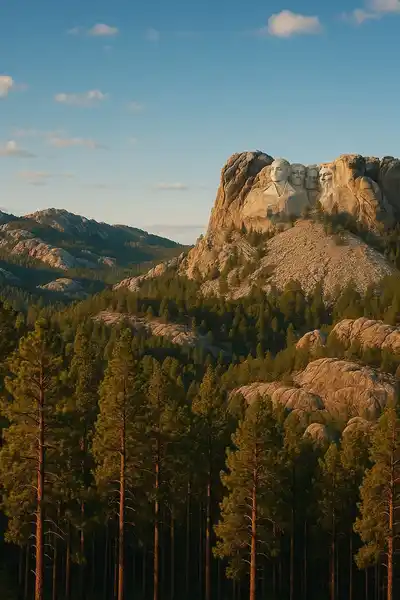
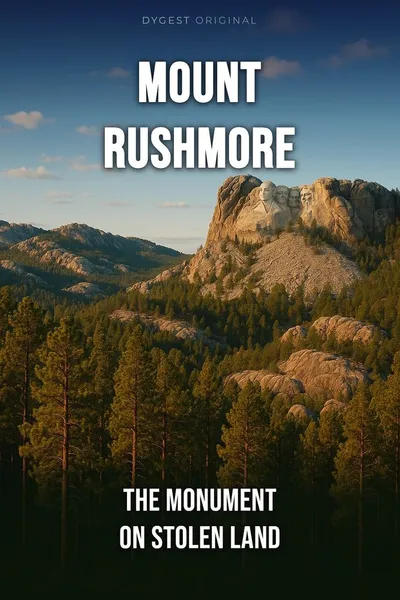
In the Black Hills of western South Dakota, about three hours' drive from the Wyoming border, four enormous faces are carved into the southeast side of a granite mountain. George Washington, Thomas Jefferson, Theodore Roosevelt, and Abraham Lincoln stare out over a landscape of pine forest and rolling hills. The sculpture is sixty feet tall — each head, by itself, is the size of a six-story building. Roughly two million people visit every year. It is one of the most recognizable monuments in the world and one of the most photographed landmarks in American tourism.
The mountain it is carved into is called Mount Rushmore, after a New York lawyer who visited briefly in 1885. Before that, and still, the mountain had another name. The Lakota Sioux call it Tunkasila Sakpe Paha — the Six Grandfathers. The Six Grandfathers is a sacred site in Lakota religion. The Black Hills more broadly are the spiritual heart of Lakota territory. They were also, by treaty, legally Lakota land when the sculpting began in 1927.
The story of how a sacred mountain on legally Lakota land came to be covered in the faces of four American presidents, and of how the Lakota have spent almost a century trying and failing to get it back, is the story Mount Rushmore doesn't tell. It is also the story that makes the monument a useful case study in how national symbols are made, what they require, and what they quietly leave out.
● The question we're asking: how did a sacred Lakota mountain on legally treaty-protected land become the faces of four American presidents, and why has the legal case for its return gone nowhere for a century?
● What we'll see: the 1868 treaty that guaranteed the Black Hills, the 1877 seizure Congress passed unilaterally, the sculptor with a Klan past who carved the monument, and what Mount Rushmore tells us about how national memory is built.
Table of contents
01The treaty the United States broke
The Lakota's legal claim to the Black Hills was established by the Treaty of Fort Laramie in 1868. That treaty, signed between the United States government and the Sioux Nation after years of war over the Bozeman Trail, set aside a large territory including the Black Hills as the Great Sioux Reservation. The text was specific: the land would belong to the Sioux "for the absolute and undisturbed use and occupation" of the nation, and no unauthorized person was to settle on it. The treaty was ratified by the Senate. It had the full force of American law.
It lasted about six years. In 1874, an expedition led by Lieutenant Colonel George Armstrong Custer entered the Black Hills — illegally, by the terms of the 1868 treaty — and announced the discovery of gold. Within months, thousands of white miners had flooded in. The US military, which was supposed to enforce the treaty, made a show of trying to remove them, but it had no political support to do so. By 1876, the United States was at open war with the Lakota over the territory it had promised them eight years earlier.

02How the monument got made
The idea of carving Mount Rushmore came from a South Dakota state historian named Doane Robinson, who in 1923 was trying to think of ways to bring tourists to western South Dakota. The economy of the region, which had been boom-and-bust since the gold rush, was struggling. Robinson's initial proposal was to carve figures from western American history — explorers, Indigenous leaders, Buffalo Bill — into a rock formation called the Needles.
To execute the project, Robinson reached out to Gutzon Borglum, a Danish-American sculptor who had just been fired from another monumental project — the Stone Mountain carving of Confederate leaders in Georgia. Borglum was already a well-known figure in American public art and a difficult one. He had a history of quarreling with patrons, and he had been active in the Ku Klux Klan during his Stone Mountain years, including attending Klan gatherings and designing Klan imagery. The Klan connection was not a secret; it was reported in newspapers of the time.
03The Lakota response, a century of it
The Lakota position on the monument during its construction was clear. The Six Grandfathers was a sacred mountain on land the Lakota still claimed, which was being carved into the faces of American presidents — including one, Jefferson, whose Indian policy had been explicit about removal, and another, Roosevelt, who had famously said that he agreed with the common view that "the only good Indians are dead Indians." Several Lakota leaders protested throughout the 1930s. Their protests had no political weight.
After the monument's completion, the Lakota and broader Indigenous activism returned to it periodically as a symbolic target. In 1970, members of the American Indian Movement occupied the monument for several months as part of a broader wave of Indigenous activism that also produced the occupation of Alcatraz and the Wounded Knee standoff of 1973. The occupations drew attention to the Fort Laramie treaty but did not change policy. The monument continued to welcome tourists, and the Black Hills continued to be federal land.
04What monuments do
Mount Rushmore is useful as a case study because it makes explicit choices that other monuments make implicitly. The decision to carve four specific presidents — and not, say, four Indigenous leaders, or four abolitionists, or four women — was not a neutral representation of American history. It was a particular vision of who counted in that history, chosen by a sculptor with a Klan background and funded by a federal government that had explicitly taken the land from the people whose sacred mountain was being altered.
Every national monument involves those choices. Lincoln Memorial is a monument to a specific reading of Lincoln's role. The Jefferson Memorial is the result of a specific debate in the 1930s about whether to honor a slaveholder. Statues of Confederate generals scattered across the American South were a specific political project of the early twentieth century. None of these monuments is a transparent record of the past; each one is an argument about how the past should be remembered, made visible in stone.
05Conclusion
Four presidents stare out over the Black Hills. The mountain they are carved into is sacred to the people who legally owned the land when the carving began, was sculpted by a man with a Klan past, and remains at the center of a legal claim the Supreme Court has validated but the United States has not acted on. None of that is on the plaque at the visitor center. All of it is available to anyone who looks.
Related books