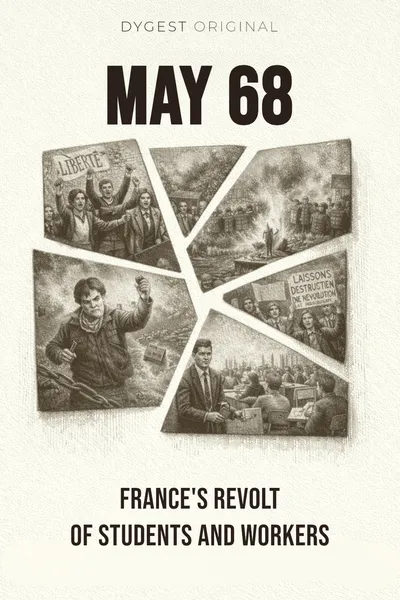
May 68
France's revolt of students and workers
Description
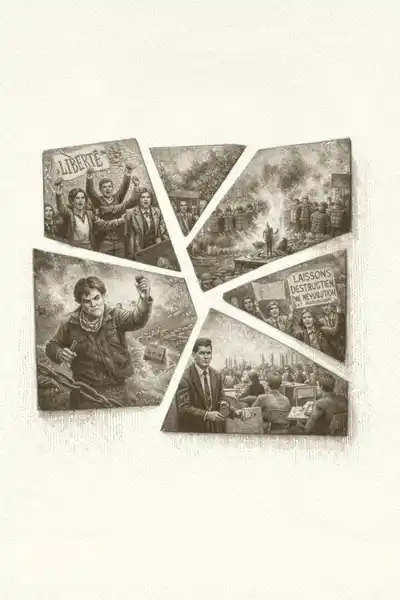
On the night of May 10, 1968, the students who had barricaded the streets of the Latin Quarter in Paris tore up paving stones, overturned cars, and cut down trees to hold their ground against the riot police. By dawn, hundreds were injured and hundreds more arrested. The neighborhood around the Sorbonne looked like a battlefield, and radio listeners across France had followed the whole thing live, hour by hour, as the confrontation escalated. What had started a few weeks earlier as a squabble over dormitory visiting rights at a suburban campus had become something nobody could quite name.
Within days it stopped being about students at all. The largest general strike in French history spread across the country, pulling in something like nine million workers and shutting down factories, trains, mail, and fuel. For a few weeks in May and June, the fifth-largest economy in the world simply stopped. President Charles de Gaulle, the towering figure who had governed France since 1958 and liberated it in 1944, seemed for a moment to have no answer at all — and then, just as suddenly, he did.
The strange thing about May 68 is how completely it failed on its own terms and how deeply it changed France anyway. There was no new government, no seizure of power, no revolution in the sense the marchers chanted for. De Gaulle's party won the elections that followed in a landslide. And yet the France that emerged over the following decade — in its schools, its families, its workplaces, its sense of what authority could ask of a person — was not the France that had gone into that May.
The question we’re asking : How did a student quarrel become a near-revolution, and what did it actually leave behind once the barricades came down?What we’ll see : A five-week sequence that swung from riot to general strike to electoral rout — and an outcome that turned up somewhere other than where everyone was looking.
Table of contents
01Chapter 1 — The night the Latin Quarter burned
The trouble began not in central Paris but at Nanterre, a bleak new university campus on the western edge of the city, thrown up in a hurry to absorb the baby-boom generation that was crowding into higher education. French universities had roughly tripled their enrollment across the 1960s, and the institutions had not kept up. Overcrowded lecture halls, rigid professors, and rules that read like a boarding-school code — including a ban on male students visiting the women's dormitories — produced a low, constant friction. In March 1968 a group of students, among them a red-headed sociology student named Daniel Cohn-Bendit, occupied an administration building. The dean eventually closed Nanterre and summoned the ringleaders to disciplinary hearings at the Sorbonne.

02Chapter 2 — When the students met the assembly line
The march of May 13 brought hundreds of thousands into the streets of Paris, students and workers walking together, and it might have ended there as a memorable but contained day of protest. Instead, something the union leaders had not called for began the next day on its own. Workers at the Sud-Aviation plant near Nantes occupied their factory and locked in the management. Within seventy-two hours the Renault plants had followed, and then the movement rolled outward across the country almost faster than anyone could track it. By the third week of May, roughly nine million workers were out — not on a scheduled strike, but in a spreading wave of occupations that no single organization controlled.
This was the moment that turned a student revolt into a national crisis, and it revealed the strange, unstable coalition at the heart of May 68. The students were driven by something cultural and existential — a revolt against boredom, hierarchy, consumer conformity, the whole weight of an old order. The workers, for the most part, wanted concrete things: higher wages, shorter hours, union recognition, respect on the shop floor. The two currents flowed together for a few weeks, but they were never really the same river, and the difference would matter enormously by June.
03Chapter 3 — De Gaulle vanishes, then reappears
At the height of the crisis, the man who had dominated French public life for a generation seemed to falter. De Gaulle, then seventy-seven, gave a televised address on May 24 proposing a referendum, and it landed flat — the grandeur that had worked for a decade suddenly sounded out of touch. His prime minister, Georges Pompidou, was doing the practical work of managing the strikes and negotiating Grenelle, while the president looked increasingly like a figure from another era, marooned by events he did not understand.
Then, on May 29, de Gaulle disappeared. He cancelled a cabinet meeting and left Paris without telling almost anyone where he was going. For several hours the government did not know the whereabouts of the head of state, and rumors flew that he had given up. In fact he had flown by helicopter to Baden-Baden in West Germany, to the headquarters of General Jacques Massu, commander of the French forces stationed there. What exactly passed between them is still debated, but de Gaulle appears to have been checking that the army would stand behind him if it came to that. Reassured, he flew back the next day a changed man.
04Chapter 4 — The revolution that lost the vote and won the decade
The elections of late June 1968 delivered a crushing verdict. De Gaulle's Gaullist party and its allies won a commanding majority — the largest in the history of the Fifth Republic to that point. The forces of order had not merely survived; they had been rewarded. By the strict measure the marchers themselves had set, chanting for revolution and the fall of the regime, May 68 was a defeat. There was no new state, no workers' councils running the country, no rupture in the constitutional order. De Gaulle stayed in office, though not for long: he resigned less than a year later, in April 1969, after losing an unrelated referendum, and it is one of the ironies of the period that the man who mastered May fell over something much smaller.
And yet to leave it there is to miss what actually happened. The lasting effect of May 68 was not political but cultural, and it worked slowly, over the decade that followed, in places the electoral map could not register. The revolt had been, at bottom, an attack on a certain kind of authority — the patriarchal father, the untouchable professor, the boss whose word was law, the whole architecture of a rigid, hierarchical, Catholic-inflected society that had held into the 1960s. That architecture did not survive intact.
05Conclusion
Fifty years on, the paving stones of the Latin Quarter have long since been paved over — literally, in some streets, to keep them from being pried up again. The events that began with a quarrel over dormitory rules and swelled into the largest general strike France had ever seen ended, in the accounting of votes and governments, in almost complete failure for the people who made them. De Gaulle won, the workers took their wages, and the barricades came down. On paper, the old order held.
Related books