Labubu
A collectible engineered for scarcity
Description
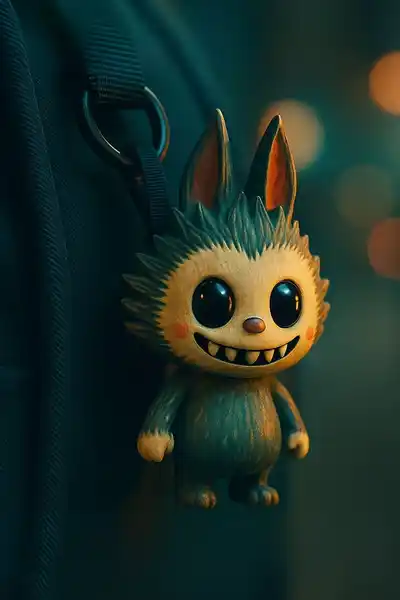
In the spring of 2024, a Thai member of the girl group Blackpink named Lisa started clipping small fuzzy monsters to her designer handbags and posting the results to her tens of millions of followers. The monster had a name, Labubu, a row of jagged teeth, and pointed ears, and it came from a Hong Kong artist named Kasing Lung, who had been drawing these creatures since around 2015 for a picture-book series called The Monsters. Pop Mart, a Beijing toy company, held the license and turned the drawing into a plush keychain. Within a year, the queues outside Pop Mart stores stretched around blocks in Bangkok, London and Los Angeles, and resale prices for the rarer figures ran into the hundreds of dollars.
None of this happened because a toy suddenly got better. The Labubu of 2024 was, materially, a small vinyl-faced plush that cost a few dollars to make and sold for roughly twenty to thirty. What changed was not the object but the way it reached us. Pop Mart sold Labubu the way it sells almost everything: in a blind box, a sealed package that hides which of a dozen variants is inside, with one figure per series designed to be brutally rare. You do not choose a Labubu. You gamble for one.
That small design choice — hide the product, ration the good ones — turned a niche designer toy into one of the most talked-about consumer objects of the decade, and turned Pop Mart into a company worth tens of billions. It is worth looking at how a sealed cardboard box does that, and what it says about the things we now line up to buy.
The question we’re asking : How does a cheap plush toy, sold in a box you can't see into, become an object people camp overnight to buy?What we’ll see : How the blind-box model works, who built the machine behind it, and why the shortage is the point rather than the accident.
Table of contents
01 Chapter 1 — The elf that ate the toy aisle
Kasing Lung grew up in the Netherlands and soaked up Nordic folklore, which is where the Labubu look comes from: something between a woodland elf and a gremlin, wide-eyed and grinning with nine pointed teeth. For years The Monsters lived in art books and small-run figures, the kind of thing collectors in the designer-toy scene knew about and almost nobody else did. It was a cult object, priced and produced like one.
The turn came when Pop Mart signed Lung and put Labubu into its retail engine in the late 2010s, then leaned hard on it after 2023. The company already knew how to manufacture a craze; what it needed was a character with enough personality to carry one. Labubu had a face people either found ugly or found irresistible, and that split — the mild ugliness, the sense that liking it was a slightly personal choice — turned out to be an asset. People felt like they had discovered it.

02 Chapter 2 — The box you can't see into
The blind box is the whole trick, and it is older than Labubu. Japanese gachapon capsule machines had been selling mystery toys for decades, and trading-card packs have run on the same logic since the middle of the last century: you pay a fixed price, you get a random result, and somewhere in the set there is something you probably won't get. Pop Mart's contribution was to industrialize this for collectible figures and sell it at scale, in clean minimalist stores that look more like a phone shop than a toy aisle.
Here is how a typical series works. A Labubu collection has around a dozen distinct designs sold in identical sealed boxes. Buy one and you cannot tell what is inside. Most designs appear at a reasonable ratio, but one is a "secret" figure seeded at something like one in every seventy-two boxes, sometimes rarer. So completing a set by buying single boxes means either extraordinary luck or a great deal of money, and the secret figure means that even a full set is, for most people, out of reach.
03 Chapter 3 — The machine behind the shortage
The rarity in a blind-box line looks like a natural fact — some figures just happen to be scarce — but it is a decision made on a spreadsheet. Pop Mart sets the ratios. It decides that the secret figure appears once in every so many boxes, it decides how many units of a series to manufacture, and it decides when to stop making them. The shortage is not the market straining against supply. It is a supply deliberately held below demand, which is a different thing entirely.
Layered on top of the ratios is the drop. Pop Mart releases series in waves, in limited quantities, often with regional exclusives so that a figure available in one country cannot easily be bought in another. New editions arrive and old ones are retired rather than restocked. Every one of these levers narrows the window in which you can get a given Labubu, and a narrow window does reliable work on a buyer: the sense that it might be gone tomorrow is a far stronger motivator than the object itself usually justifies.
04 Chapter 4 — Wanting what we can't have on purpose
Strip away the elf face and Labubu is a clean illustration of something that has spread well beyond toys: scarcity as a manufactured feature rather than a fact of the world. For most of economic history, things were scarce because they were genuinely hard to produce — a plush keychain is not. Its shortage exists because someone decided it should, and calibrated it carefully enough to keep desire at a boil without ever quite satisfying it. The empty shelf is not a failure of the supply chain. It is the product working as designed.
This is the same logic running underneath a lot of what we now line up for. Luxury houses cap production of a handbag and maintain waiting lists for items they could easily make more of. Sneaker brands drop limited runs and let resale prices do the advertising. Streetwear built an entire culture on the timed release of deliberately insufficient stock. In each case the value lives less in the object than in the difficulty of getting it, and the difficulty is engineered. Labubu simply makes the mechanism unusually visible, because the object at the center of it is so plainly modest.
05 Conclusion
Two years after Lisa first clipped a monster to her handbag, the queues had cooled in some places and moved to others, which is roughly what happens to every engineered craze once the supply loosens and the next series arrives. Pop Mart, meanwhile, was no longer a curiosity but one of the more valuable consumer companies to come out of China, built on a picture-book character and a sealed cardboard box. The toy that people fought to buy was, the whole time, a few dollars of vinyl and plush.
Related books