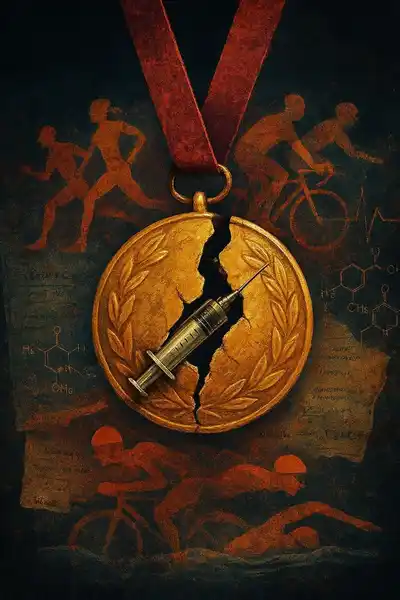
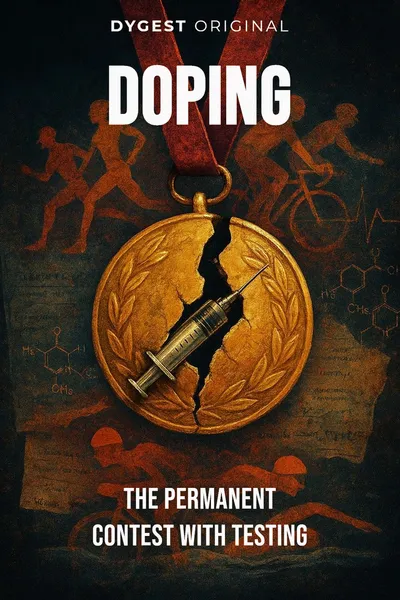
Doping
The permanent contest with testing
Description
On a July morning in 1967, on the slopes of Mont Ventoux, the British cyclist Tom Simpson collapsed and died during the Tour de France. He was thirty. In his jersey pockets and his bloodstream investigators found amphetamines, mixed with the heat and the exhaustion of the climb. Simpson was not a cheat operating in the shadows; he was a professional using what many professionals used, in an era when the peloton ran on stimulants and nobody thought to test. His death is often marked as the moment the question stopped being whether athletes doped and became what anyone intended to do about it.
Nearly six decades later, the machinery built to answer that question is vast. Laboratories accredited by the World Anti-Doping Agency screen thousands of samples a year for hundreds of banned substances. Athletes file their whereabouts so testers can arrive unannounced. Blood is frozen and stored for a decade, ready to be reopened when the science improves. And still the positives keep coming — sometimes years after the medals were handed out, sometimes never at all for substances everyone suspects are in use.
The story of doping is usually told as a parade of fallen heroes. But underneath the scandals runs a quieter, more relentless dynamic: two sides refining their craft against each other, each advance answered by a counter-advance. To understand it, we have to look at what the substances actually do, and at how the people trying to catch them have had to keep reinventing what catching even means.
The question we’re asking : If every method of cheating eventually gets caught, why does the catching never end?What we’ll see : How the body gets tuned, how the tests learned to look backward in time, and why the contest has no last round.
Table of contents
01 Chapter 1 — The body as a machine to be tuned
Doping is not one thing. It is a family of interventions, each aimed at a different bottleneck in athletic performance, and understanding the detection story means first understanding what the substances are actually for. The oldest are the stimulants — amphetamines, ephedrine, later cocaine — which mask fatigue and let an athlete push past the point where the body would normally quit. They are crude, dangerous, and, as Simpson learned, capable of overriding the warnings that keep people alive. They dominated the mid-century era precisely because there was nothing to stop them.
The more consequential leap came with substances that change the body's chemistry over weeks rather than hours. Anabolic steroids, synthetic cousins of testosterone, let muscle rebuild faster and heavier after training, so an athlete can train harder and recover in time to train again. From the 1970s onward they reshaped strength and sprint events, most notoriously in the East German state program, where thousands of athletes — many of them teenagers — were dosed on schedule, sometimes without being told what they were taking.

02 Chapter 2 — How the tests learned to look back
The first anti-doping tests were, in retrospect, almost innocent. Introduced at the 1968 Olympics, they looked for stimulants in urine — the substance is present, or it is not. This works well against drugs that are chemically foreign to the body and clear within days. It works badly against everything else. An athlete who knew when the test was coming, or who used a substance the lab could not yet identify, had little to fear. For years the testers were essentially checking whether a runner had a cold medicine in their system while the real transformations happened out of view.
Steroids forced the first reinvention. Because synthetic anabolics resemble the body's own hormones, catching them meant developing techniques precise enough to tell natural testosterone from a lab-made near-copy, and to flag the telltale ratios that a doped body produces. Detection windows were still short, so athletes learned to time their cycles, stopping the drug in time for the compound to clear before competition while keeping the muscle it had built. The test could see the crime only while it was happening, not the advantage it had left behind.
03 Chapter 3 — The chemists who stayed one step ahead
For every advance in detection, someone was working the other side. The most vivid case surfaced in 2003, when a used syringe was mailed anonymously to American anti-doping authorities. Inside was a residue that matched no known compound. It turned out to be tetrahydrogestrinone — THG, a steroid engineered by a California lab called BALCO for one purpose: to be invisible to existing tests. It had been designed backward, from the assay rather than the biology, and it worked until a coach with a grudge handed over the sample. Athletes across several sports had been using something the testers did not know existed.
BALCO revealed the deeper structure of the problem. As long as testing looks for a defined list of substances, a chemist with resources can build a molecule that does the same physiological job while sitting just outside the list. The banned catalog is always, by definition, a record of what is already known. The frontier belongs to whoever is willing to synthesize what has not yet been named.
04 Chapter 4 — A race that has no finish line
Step back from the individual scandals and a stranger picture appears: doping and detection are not a problem waiting to be solved but a contest built to run forever. Every tool the testers create teaches the other side exactly what to avoid. A new assay for EPO tells a doctor precisely how little to use, and when to stop. A biological passport tells a sophisticated program how gently it must nudge the numbers to stay inside the noise. Enforcement does not end the game; it raises the price of entry and rewrites the rules of play.
This is the uncomfortable heart of the matter. The anti-doping system cannot declare victory, because victory would mean knowing that no undetected method exists — and that is precisely the thing it can never know. The frozen samples, the ten-year reach, the whole apparatus of retroactive testing, are an admission written into the design: today's clean result is provisional, valid only until the science improves. The system is honest about its own limits in a way sport rarely acknowledges out loud.
05 Conclusion
Tom Simpson died in an era with no tests at all, on drugs that were an open secret. The world that followed built one of the most elaborate surveillance systems ever aimed at a group of otherwise law-abiding people — whereabouts filings, unannounced visits, a decade of frozen blood — and still it cannot promise that the athlete crossing the line first did it clean. What it can promise is that the question will be asked again, later, with better tools.
Related books