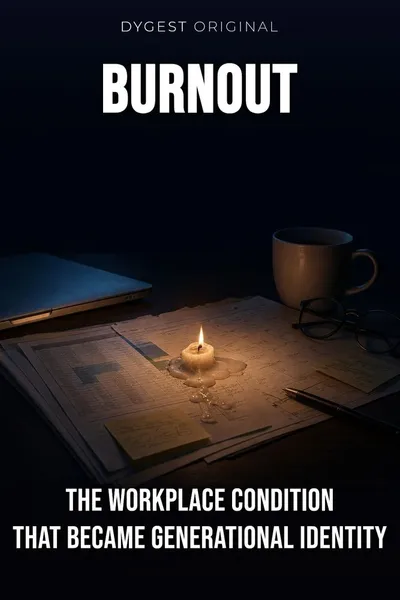
Burnout
The workplace condition that became generational identity
Description
In 1974, a German-American psychologist named Herbert Freudenberger published a paper in the Journal of Social Issues describing a syndrome he had observed among the volunteer staff of a free clinic in New York’s East Village. The staff, who had begun the work with substantial idealism, were arriving at a state he called burnout exhausted, cynical about the patients they had originally wanted to help, unable to feel professional satisfaction. The term migrated from clinical psychology into broader workplace discourse across the 1980s and 1990s, picked up momentum across the 2000s, and became, across the past decade, one of the principal frameworks Millennials and Gen Z use to describe their relationship to work itself.
The shift was significant. In Freudenberger’s framing, burnout was a clinical condition affecting specific workers in high-empathy professions. By the 2020s, surveys reported that approximately two-thirds of workers under 35 identified as burned out. The condition had become a generational description. Anne Helen Petersen’s 2019 BuzzFeed essay “How Millennials Became the Burnout Generation” established the framework in popular culture, and the WHO’s 2019 inclusion of burnout in the ICD-11 institutionalized the term.
The question is whether burnout describes a real condition that has actually worsened, or whether it names a long-standing condition that a specific generation has become more willing to articulate. The honest answer is probably both. Working conditions have substantially intensified for many categories of work longer hours, more surveillance, less job security, the always-on smartphone leak between work and rest. The cultural willingness to name exhaustion as systemic rather than personal has also expanded. Burnout is both a real condition and a category that organizes how a generation thinks about itself.
The question we’re asking: what burnout actually is, who has it, and why it became the defining condition of two generations.
What we’ll see: Freudenberger’s original framework, the structural conditions that made burnout generational, the cultural moment of recognition, and what survives.
Table of contents
01Freudenberger and the original clinical framework
Herbert Freudenberger was working pro bono at the St. Mark’s free clinic in lower Manhattan in the early 1970s, treating heroin addicts and the broader counterculture population that had emerged from the 1960s. He noticed, across approximately a year of observation, a recurring pattern among the volunteer staff: people who had arrived with substantial motivation were progressively losing it, developing a specific kind of cynical detachment from the patients they had originally wanted to help, and experiencing physical exhaustion that did not respond to ordinary rest. He called the syndrome burnout and described it in clinical terms.
The systematic framework that emerged across the subsequent decade was substantially developed by the Berkeley social psychologist Christina Maslach. Her Maslach Burnout Inventory, first published in 1981 and substantially refined across subsequent decades, identified three dimensions: emotional exhaustion, depersonalization (the cynical detachment Freudenberger had described), and reduced personal accomplishment. The framework substantially established burnout as a workplace condition with measurable dimensions, distinct from depression or anxiety despite overlapping with both.

02The structural conditions that made it generational
The shift from clinical syndrome to generational identifier required substantial changes in the underlying conditions of work. Several specific factors converged across the period 2000-2020. The 2008 financial crisis substantially reduced job security across most occupational categories, with the recovery being substantially slower than previous business cycles. The gig economy that emerged across the 2010s substantially reduced the security and benefits that had previously been attached to full-time employment. The smartphone, which became widely adopted across 2007-2012, substantially eliminated the boundary between work hours and personal hours that had previously been institutionally maintained.
The economic conditions for the generations entering the workforce across this period were substantially worse than what their parents had experienced. The cost of housing, education, and healthcare grew substantially faster than wages across the 2000s and 2010s. The student debt burden approximately $1.7 trillion in aggregate by 2024 substantially constrained the financial autonomy of younger workers. The career path that had been substantially available to previous generations entry-level job at a stable company, gradual advancement, eventual home ownership and retirement was substantially less reliable for Millennials and unavailable in many sectors for Gen Z.
03The cultural moment of recognition
Anne Helen Petersen’s January 2019 BuzzFeed essay “How Millennials Became the Burnout Generation” went viral substantially because it articulated what had been substantially diffuse experience as a coherent generational condition. The essay described “errand paralysis” the inability to complete small adult tasks like scheduling a doctor’s appointment or returning a package as a symptom of broader exhaustion. The framework resonated substantially because it named experience that had been substantially individualized as collective.
The cultural reception across the subsequent years was substantial. The term burnout, which had been substantially confined to occupational psychology, became substantially central to broader cultural conversation about work, mental health, and generational identity. The 2020 pandemic substantially accelerated the framework, with the work-from-home transition exposing many workers to both extended work hours and reduced separation between work and personal life. The Great Resignation of 2021-2022, in which approximately 50 million American workers voluntarily left their jobs, was substantially framed in burnout terms.
04What survives, and what to do about it
The burnout framework continues to operate as one of the principal cultural frameworks for understanding the contemporary workplace, particularly for Millennials and Gen Z. The cultural reception will probably continue to evolve as work conditions continue to change. The clinical and academic framework will continue to refine the specific dimensions and the effective interventions. The two will probably continue to operate in parallel, with the cultural framework substantially shaping how individuals interpret their experience and the clinical framework substantially shaping how organizations and health systems respond.
The practical implications are specific. Individual-level interventions meditation apps, sleep optimization, the various “self-care” products that have proliferated across the 2010s produce modest results when applied to workplaces that maintain the conditions that produced the burnout. The structural interventions that produce more substantial results are not individually controllable: reducing workload, increasing autonomy, fixing perceived unfairness, building genuine community at work. The framework that places burnout responsibility on individuals is substantially the wrong framework for addressing it.
05Conclusion
Burnout has become a generational identity for Millennials and Gen Z in ways that go beyond the original clinical syndrome Freudenberger described. The framework names real conditions, names them collectively rather than individually, and locates responsibility in workplaces rather than in the people who work in them. The cultural shift is substantial. The structural change that would actually reduce burnout is substantially less advanced than the cultural recognition.
Related books